

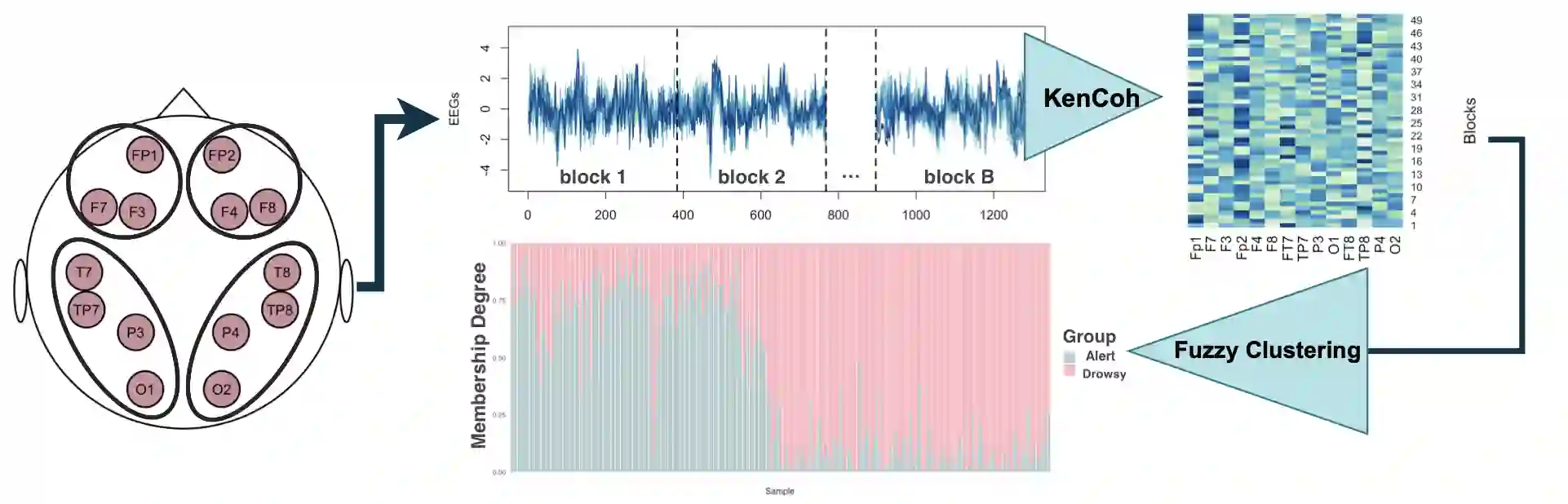
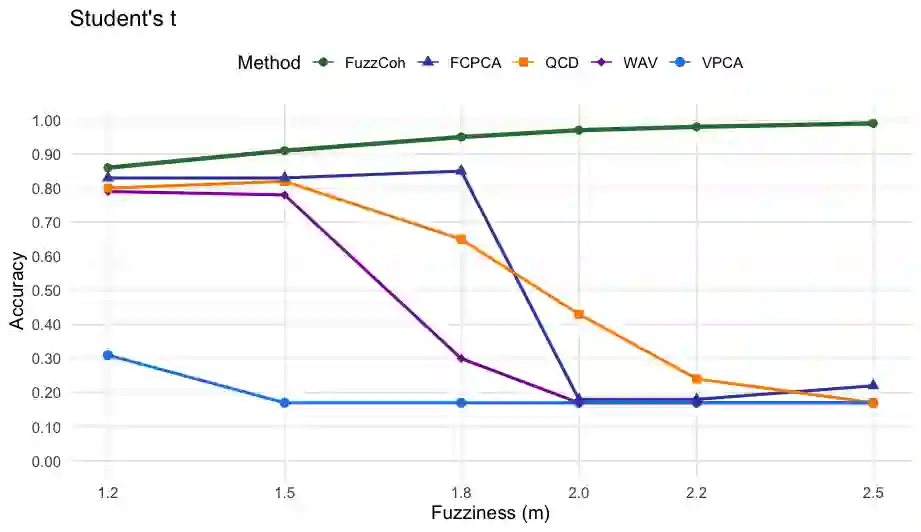
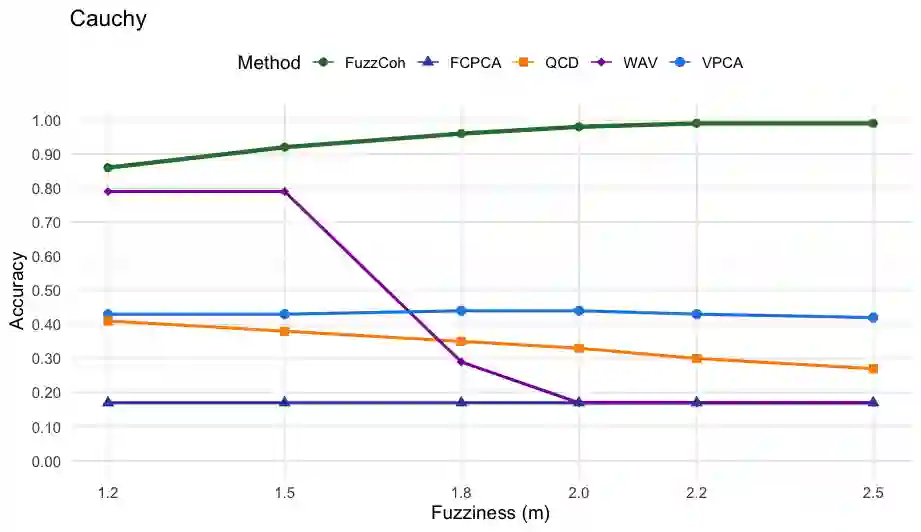
Clustering multivariate time series (MTS) is challenging due to non-stationary cross-dependencies, noise contamination, and gradual or overlapping state boundaries. We introduce a robust fuzzy clustering framework in the spectral domain that leverages Kendall's tau-based canonical coherence to extract frequency-specific monotonic relationships across variables. Our method takes advantage of dominant frequency-based cross-regional connectivity patterns to improve clustering accuracy while remaining resilient to outliers, making the approach broadly applicable to noisy, high-dimensional MTS. Each series is projected onto vectors generated from a spectral matrix specifically tailored to capture the underlying fuzzy partitions. Numerical experiments demonstrate the superiority of our framework over existing methods. As a flagship application, we analyze electroencephalogram recordings, where our approach uncovers frequency- and connectivity-specific markers of latent cognitive states such as alertness and drowsiness, revealing discriminative patterns and ambiguous transitions.
翻译:多元时间序列(MTS)的聚类因非平稳交叉依赖性、噪声污染以及状态边界渐变或重叠而具有挑战性。本文提出一种谱域鲁棒模糊聚类框架,利用基于Kendall tau的典型相干性提取跨变量的频率特异性单调关系。该方法基于主导频率的跨区域连接模式提升聚类精度,同时保持对异常值的鲁棒性,使其广泛适用于含噪声的高维MTS。每个序列被投影至由谱矩阵生成的向量上,该矩阵专为捕捉底层模糊划分而设计。数值实验表明本框架优于现有方法。作为典型应用,我们分析了脑电图记录,该方法揭示了潜在认知状态(如警觉与困倦)中频率与连接特异性的标志物,同时展现了判别性模式与模糊过渡状态。





相关内容



 微信扫码咨询专知VIP会员