

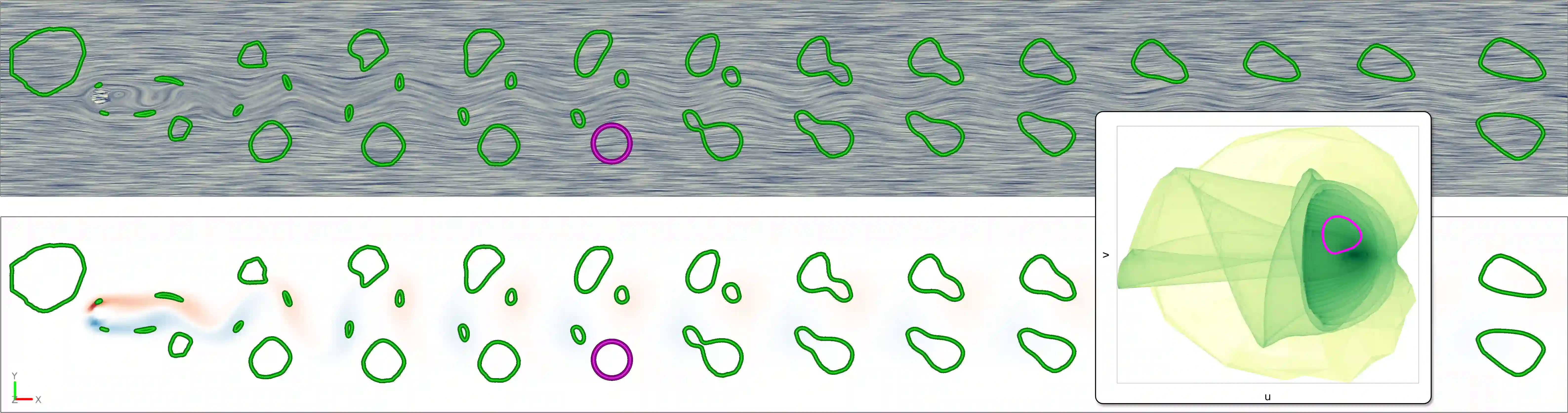
Extracting level sets from scalar data is a fundamental operation in visualization with many applications. Recently, the concept of level set extraction has been extended to bivariate scalar fields. Prior work on vector field equivalence, wherein an analyst marks a region in the domain and is shown other regions in the domain with similar vector values, pointed out the need to make this extraction operation fast, so that analysts can work interactively. To date, the fast extraction of level sets from bivariate scalar fields has not been researched as extensively as for the univariate case. In this paper, we present a novel algorithm that extracts fiber lines, i.e., the preimages of so called control polygons (FSCP), for bivariate 2D data by joint traversal of bounding volume hierarchies for both grid and FSCP elements. We performed an extensive evaluation, comparing our method to a two-dimensional adaptation of the method proposed by Klacansky et al., as well as to the naive approach for fiber line extraction. The evaluation incorporates a vast array of configurations in several datasets. We found that our method provides a speedup of several orders of magnitudes compared to the naive algorithm and requires two thirds of the computation time compared to Klacansky et al. adapted for 2D.
翻译:从标量数据中提取水平集是可视化中的基本操作,具有广泛的应用。近年来,水平集提取的概念已扩展到双变量标量场。先前关于矢量场等价性的研究(即分析人员标记域中的一个区域,并显示域中具有相似矢量值的其他区域)指出,需要使该提取操作快速进行,以便分析人员能够交互式工作。迄今为止,双变量标量场中水平集的快速提取尚未像单变量情况那样得到广泛研究。在本文中,我们提出了一种新颖算法,该算法通过联合遍历网格和FSCP元素的包围盒层次结构,从双变量2D数据中提取纤维线,即所谓的控制多边形(FSCP)的原像。我们进行了广泛评估,将我们的方法与Klacansky等人提出的方法(经二维适配)以及纤维线提取的朴素方法进行了比较。评估涵盖了多个数据集中的大量配置。我们发现,与朴素算法相比,我们的方法提供了数个数量级的加速,并且与适配于2D的Klacansky等方法相比,计算时间仅需其三分之二。




相关内容




 微信扫码咨询专知VIP会员