

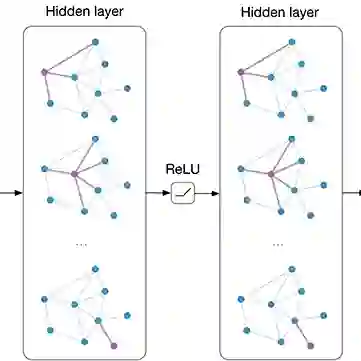
Collaborative Mobile Crowd Sensing (CMCS) enhances data quality and coverage by promoting teamwork in task sensing, with worker recruitment representing a complex multi-objective optimization problem. Existing strategies mainly focus on the characteristics of workers themselves, neglecting the asymmetric trust relationships between them, which affects the rationality of task utility evaluation. To address this, this paper first employs the Mini-Batch K-Means clustering algorithm and deploys edge servers to enable efficient distributed worker recruitment. Historical data and task requirements are utilized to obtain workers' ability types and distances. A trust-directed graph in the worker's social network is input into the Graph Convolutional Network (GCN) framework for training, capturing asymmetric trustworthiness between worker pairs. Privacy leakage is prevented in CMCS scenarios through high trust values between workers. Ultimately, an undirected recruitment graph is constructed using workers' abilities, trust values, and distance weights, transforming the worker recruitment problem into a Maximum Weight Average Subgraph Problem (MWASP). A Tabu Search Recruitment (TSR) algorithm is proposed to rationally recruit a balanced multi-objective optimal task utility worker set for each task. Extensive simulation experiments on four real-world datasets demonstrate the effectiveness of the proposed strategy, outperforming other strategies.
翻译:协作移动群智感知(CMCS)通过促进团队协作感知,提升了数据质量与覆盖范围,其中工作者招募是一个复杂的多目标优化问题。现有策略主要关注工作者自身特征,忽视了他们之间的非对称信任关系,影响了任务效用评估的合理性。针对这一问题,本文首先采用Mini-Batch K-Means聚类算法并部署边缘服务器,实现高效分布式工作者招募。利用历史数据和任务需求获取工作者的能力类型及距离信息。将工作者社交网络中的信任有向图输入图卷积网络(GCN)框架进行训练,捕获工作者对之间的非对称可信度。通过工作者之间的高信任值防止CMCS场景中的隐私泄露。最终,利用工作者能力、信任值及距离权重构建无向招募图,将工作者招募问题转化为最大权重平均子图问题(MWASP)。提出禁忌搜索招募(TSR)算法,为每个任务合理招募一组平衡多目标最优的任务效用工作者集合。在四个真实数据集上的大量仿真实验验证了所提出策略的有效性,其性能优于其他策略。




相关内容




 微信扫码咨询专知VIP会员