

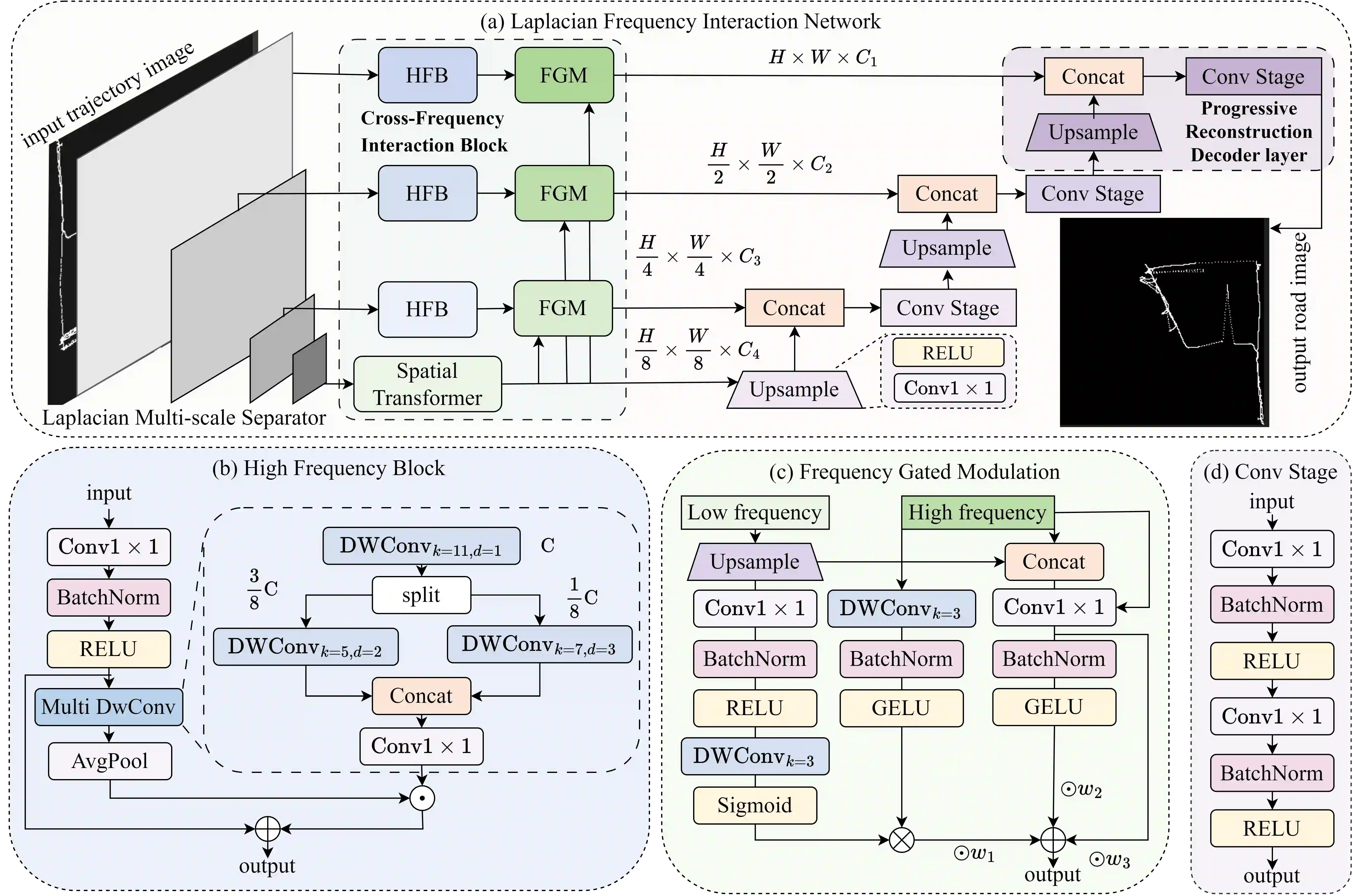
Rural thematic road network construction aims to extract topological road structures from movement trajectory images of agricultural machinery. However, this task faces challenges where downsampling methods commonly used in existing studies tend to blur the sparse high-frequency road structures, and the heavy noise from dense field operations often leads to fragmented or redundant topologies in the extracted networks. To address these challenges, we propose LFINet, a Laplacian Frequency Interaction Network. The network begins with a Laplacian Multi-scale Separator (LMS) to decouple the image into low-frequency semantic contexts and high-frequency structural details. These components are then processed by the Cross-Frequency Interaction Block (CFIB) through a dual-pathway architecture in which a High-Frequency Block (HFB) refines local structures while a Spatial Transformer (ST) captures global semantics. Subsequently, a Frequency Gated Modulation (FGM) mechanism integrates the features from pathways by leveraging semantic contexts to calibrate the structural details. Finally, a Progressive Reconstruction Decoder iteratively fuses multi-scale features to ensure topological consistency. Experiments conducted on a real-world agricultural trajectories dataset from Henan Province, China, show that LFINet establishes a new state-of-the-art. Specifically, it achieves an F1-score of 92.54% and an IoU of 86.12%, surpassing the second-ranked method by 0.64% and 1.1%, respectively. This confirms its capability to effectively construct topological road networks from noisy and sparse field data.
翻译:乡村专题路网构建旨在从农业机械运动轨迹图像中提取拓扑道路结构。然而,该任务面临现有研究中常用的降采样方法易模糊稀疏高频道路结构,以及密集田间作业产生的强噪声常导致提取网络拓扑碎片化或冗余等挑战。为解决这些问题,我们提出LFINet——一种拉普拉斯频率交互网络。该网络首先通过拉普拉斯多尺度分离器(LMS)将图像解耦为低频语义上下文和高频结构细节;随后通过跨频率交互块(CFIB)经双路径架构处理这些成分:其中高频块(HFB)精炼局部结构,而空间变换器(ST)捕获全局语义;接着,频率门控调制(FGM)机制通过利用语义上下文校准结构细节,融合两路径特征;最后,渐进式重建解码器迭代融合多尺度特征以确保拓扑一致性。在中国河南省真实农业轨迹数据集上的实验表明,LFINet达到了新的最优水平。具体而言,其F1分数达92.54%,交并比(IoU)为86.12%,分别超越排名第二的方法0.64%和1.1%。这证实了该方法能从含噪稀疏的田间数据中有效构建拓扑路网。




相关内容

 微信扫码咨询专知VIP会员