

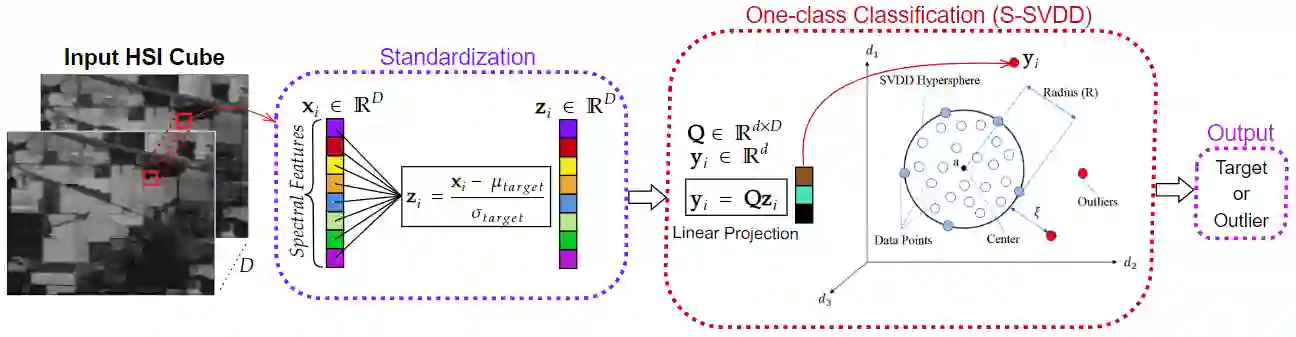
Hyperspectral image (HSI) classification is an important task in many applications, such as environmental monitoring, medical imaging, and land use/land cover (LULC) classification. Due to the significant amount of spectral information from recent HSI sensors, analyzing the acquired images is challenging using traditional Machine Learning (ML) methods. As the number of frequency bands increases, the required number of training samples increases exponentially to achieve a reasonable classification accuracy, also known as the curse of dimensionality. Therefore, separate band selection or dimensionality reduction techniques are often applied before performing any classification task over HSI data. In this study, we investigate recently proposed subspace learning methods for one-class classification (OCC). These methods map high-dimensional data to a lower-dimensional feature space that is optimized for one-class classification. In this way, there is no separate dimensionality reduction or feature selection procedure needed in the proposed classification framework. Moreover, one-class classifiers have the ability to learn a data description from the category of a single class only. Considering the imbalanced labels of the LULC classification problem and rich spectral information (high number of dimensions), the proposed classification approach is well-suited for HSI data. Overall, this is a pioneer study focusing on subspace learning-based one-class classification for HSI data. We analyze the performance of the proposed subspace learning one-class classifiers in the proposed pipeline. Our experiments validate that the proposed approach helps tackle the curse of dimensionality along with the imbalanced nature of HSI data.
翻译:高光谱图像分类在环境监测、医学成像、土地利用/土地覆盖分类等诸多应用中是一项重要任务。由于近期高光谱传感器获取的大量光谱信息,使用传统机器学习方法分析所采集的图像具有挑战性。随着频带数量的增加,为实现合理的分类精度,所需训练样本数量呈指数级增长,这即所谓的维数灾难。因此,在开展高光谱数据分类任务之前,通常需单独应用波段选择或降维技术。本研究探讨了近期提出的用于单类分类的子空间学习方法。这些方法将高维数据映射至针对单类分类优化的低维特征空间。通过这种方式,所提出的分类框架无需单独的降维或特征选择过程。此外,单类分类器能够仅从单一类别的数据中学习数据描述。鉴于土地利用/土地覆盖分类问题中标签的不平衡性及丰富的光谱信息(高维度),所提出的分类方法特别适用于高光谱数据。总体而言,这是一项聚焦于基于子空间学习的单类分类在高光谱数据中应用的先驱性研究。我们分析了所提出的子空间学习单类分类器在该流程中的性能。实验验证表明,所提出的方法有助于应对维数灾难及高光谱数据的不平衡特性。




相关内容



 微信扫码咨询专知VIP会员