

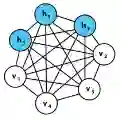
Generative models offer a direct way to model complex data. Among them, energy-based models provide us with a neural network model that aims to accurately reproduce all statistical correlations observed in the data at the level of the Boltzmann weight of the model. However, one challenge is to understand the physical interpretation of such models. In this study, we propose a simple solution by implementing a direct mapping between the energy function of the Restricted Boltzmann Machine and an effective Ising spin Hamiltonian that includes high-order interactions between spins. This mapping includes interactions of all possible orders, going beyond the conventional pairwise interactions typically considered in the inverse Ising approach, and allowing the description of complex datasets. Earlier work attempted to achieve this goal, but the proposed mappings did not do properly treat the complexity of the problem or did not contain direct prescriptions for practical application. To validate our method, we perform several controlled numerical experiments where the training samples are equilibrium samples of predefined models containing local external fields, two-body and three-body interactions in various low-dimensional topologies. The results demonstrate the effectiveness of our proposed approach in learning the correct interaction network and pave the way for its application in modeling interesting datasets. We also evaluate the quality of the inferred model based on different training methods.
翻译:生成模型提供了对复杂数据进行直接建模的途径。其中,基于能量的模型通过神经网络架构,旨在精确复现数据中所有统计相关性,达到玻尔兹曼权重层面的匹配。然而,理解此类模型的物理解释仍是一项挑战。本研究提出一种简单方案,即将受限玻尔兹曼机的能量函数直接映射到包含高阶自旋相互作用的有效伊辛自旋哈密顿量。该映射涵盖所有可能阶次的相互作用,超越了传统反伊辛方法中通常考虑的成对相互作用,从而能够描述复杂数据集。先前研究试图实现这一目标,但其提出的映射未能恰当处理问题复杂性,或缺乏可直接应用于实践的指南。为验证该方法,我们进行了多项受控数值实验——训练样本来自包含局域外场、二维及三维相互作用的预设模型在低维拓扑结构下的平衡态采样。结果表明,我们的方法能够有效学习正确的相互作用网络,为建模有意义的数据集铺平了道路。我们还基于不同训练方法评估了推断模型的质量。




相关内容



 微信扫码咨询专知VIP会员