

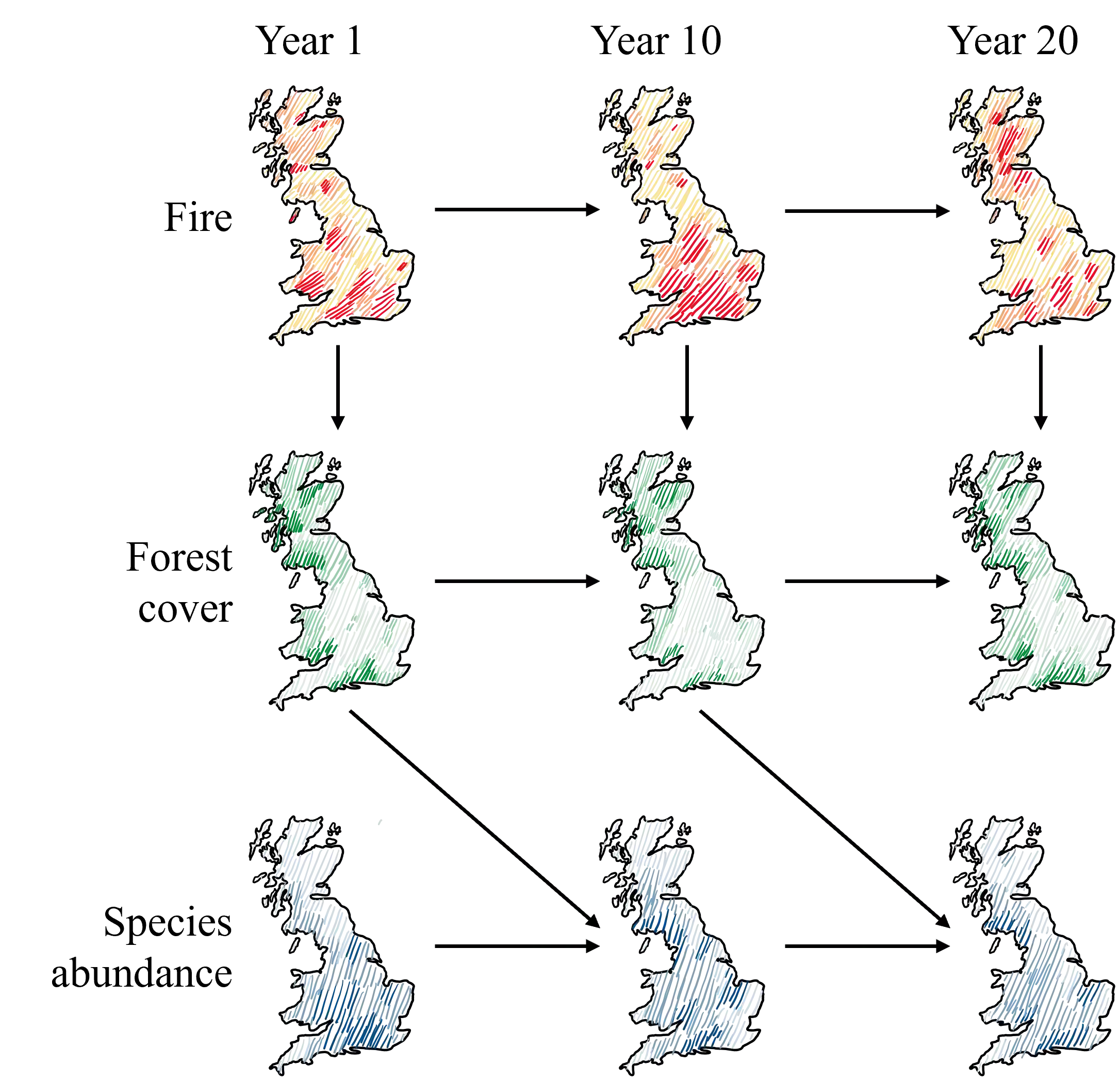
Causal discovery is the subfield of causal inference concerned with estimating the structure of cause-and-effect relationships in a system of interrelated variables, as opposed to quantifying the strength of causal effects. As interest in causal discovery builds in fields such as ecology, public health, and environmental sciences where data is regularly collected with spatial and temporal structures, approaches must evolve to manage autocorrelation and complex confounding. As it stands, the few proposed causal discovery algorithms for spatiotemporal data require summarizing across locations, ignore spatial autocorrelation, and/or scale poorly to high dimensions. Here, we introduce our developing framework that extends time-series causal discovery to systems with spatial structure, building upon work on causal discovery across contexts and methods for handling spatial confounding in causal effect estimation. We close by outlining remaining gaps in the literature and directions for future research.
翻译:因果发现是因果推断的一个子领域,专注于估计相互关联变量系统中因果关系的结构,而非量化因果效应的强度。随着生态学、公共卫生和环境科学等领域对因果发现的兴趣日益增长,这些领域的数据通常具有时空结构,因此方法必须演进以处理自相关和复杂的混杂因素。目前,少数提出的时空数据因果发现算法需要跨位置进行汇总、忽略空间自相关,和/或在处理高维数据时扩展性较差。本文中,我们介绍了正在开发的框架,该框架将时间序列因果发现扩展到具有空间结构的系统,基于跨情境的因果发现工作以及处理因果效应估计中空间混杂的方法。最后,我们概述了文献中尚存的空白以及未来研究的方向。




相关内容


 微信扫码咨询专知VIP会员