

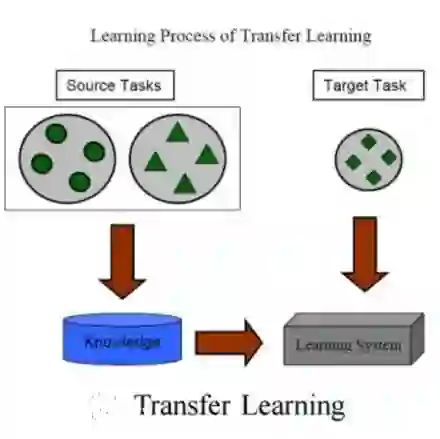
The availability of data is limited in some fields, especially for object detection tasks, where it is necessary to have correctly labeled bounding boxes around each object. A notable example of such data scarcity is found in the domain of marine biology, where it is useful to develop methods to automatically detect submarine species for environmental monitoring. To address this data limitation, the state-of-the-art machine learning strategies employ two main approaches. The first involves pretraining models on existing datasets before generalizing to the specific domain of interest. The second strategy is to create synthetic datasets specifically tailored to the target domain using methods like copy-paste techniques or ad-hoc simulators. The first strategy often faces a significant domain shift, while the second demands custom solutions crafted for the specific task. In response to these challenges, here we propose a transfer learning framework that is valid for a generic scenario. In this framework, generated images help to improve the performances of an object detector in a few-real data regime. This is achieved through a diffusion-based generative model that was pretrained on large generic datasets, and is not trained on the task-specific domain. We validate our approach on object detection tasks, specifically focusing on fishes in an underwater environment, and on the more common domain of cars in an urban setting. Our method achieves detection performance comparable to models trained on thousands of images, using only a few hundreds of input data. Our results pave the way for new generative AI-based protocols for machine learning applications in various domains, for instance ranging from geophysics to biology and medicine.
翻译:某些领域的数据可用性有限,尤其是在目标检测任务中,需要为每个对象标注正确的边界框。海洋生物学领域是这类数据稀缺的典型案例,其中开发自动检测水下物种的方法对环境监测具有重要意义。针对数据不足的问题,当前最先进的机器学习策略主要采用两种方法:第一种是在现有数据集上预训练模型,再推广至特定目标领域;第二种是通过复制粘贴技术或专用模拟器等方法,生成专门针对目标领域的合成数据集。第一种策略常面临显著的领域偏移,而第二种则需要为特定任务定制解决方案。为应对这些挑战,我们提出了一种适用于通用场景的迁移学习框架。在该框架中,生成的图像有助于在少量真实数据条件下提升目标检测器的性能。这一实现基于扩散生成模型,该模型在大规模通用数据集上预训练,且未在特定任务领域进行训练。我们在目标检测任务上验证了该方法,重点关注水下环境中的鱼类,以及城市环境中更为常见的车辆领域。我们的方法仅需数百张输入图像即可实现与数千张图像训练模型相当的检测性能。这一结果为基于生成式人工智能的机器学习应用协议开辟了新路径,可广泛适用于从地球物理学到生物学和医学等多个领域。




相关内容


 微信扫码咨询专知VIP会员