

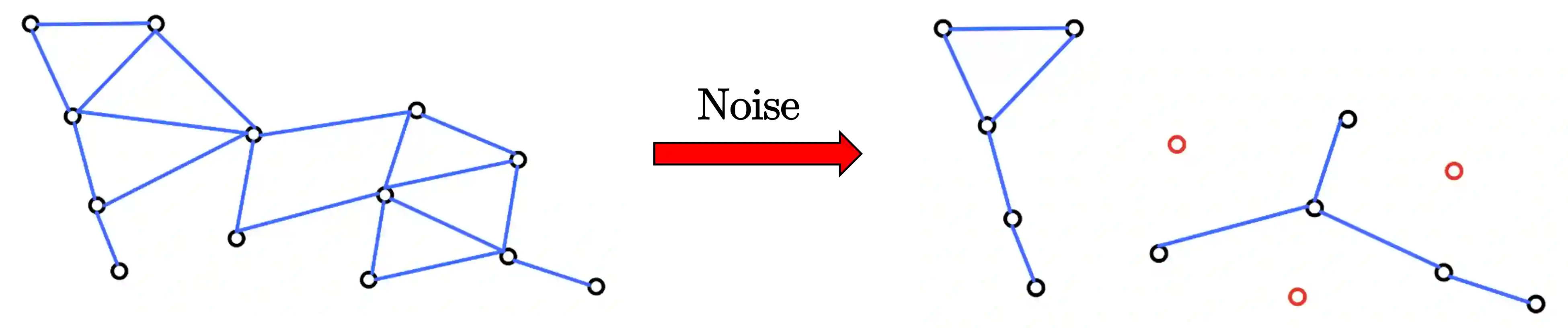
Sampling from the output distributions of quantum computations comprising only commuting gates, known as instantaneous quantum polynomial (IQP) computations, is believed to be intractable for classical computers, and hence this task has become a leading candidate for testing the capabilities of quantum devices. Here we demonstrate that for an arbitrary IQP circuit undergoing dephasing or depolarizing noise, whose depth is greater than a critical $O(1)$ threshold, the output distribution can be efficiently sampled by a classical computer. Unlike other simulation algorithms for quantum supremacy tasks, we do not require assumptions on the circuit's architecture, on anti-concentration properties, nor do we require $\Omega(\log(n))$ circuit depth. We take advantage of the fact that IQP circuits have deep sections of diagonal gates, which allows the noise to build up predictably and induce a large-scale breakdown of entanglement within the circuit. Our results suggest that quantum supremacy experiments based on IQP circuits may be more susceptible to classical simulation than previously thought.
翻译:仅包含对易门的量子计算(即瞬时量子多项式(IQP)计算)的输出分布采样被认为对经典计算机而言难以处理,因此该任务已成为测试量子设备能力的主要候选方案。本文证明,对于任意经历退相位或退极化噪声且深度超过临界$O(1)$阈值的IQP电路,其输出分布可由经典计算机高效采样。与其它量子霸权任务的模拟算法不同,我们无需对电路架构、反集中性质作假设,也无需$\Omega(\log(n))$的电路深度。我们利用IQP电路具有深层对角门序列的特性,使得噪声可预测地累积并引发电路内纠缠的大规模瓦解。我们的结果表明,基于IQP电路的量子霸权实验可能比此前认为的更易受到经典模拟的影响。




相关内容


 微信扫码咨询专知VIP会员