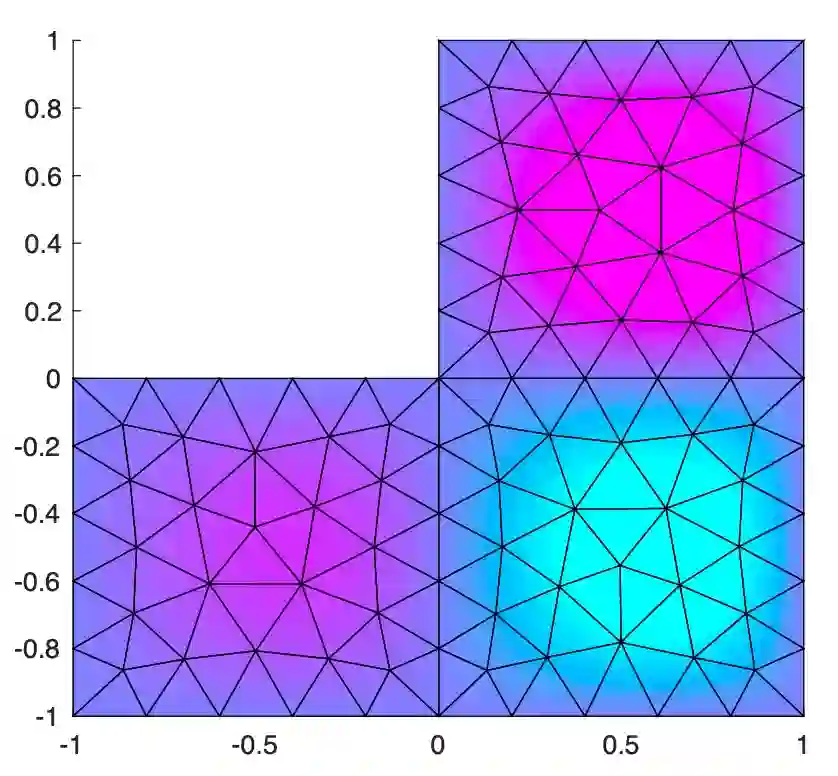
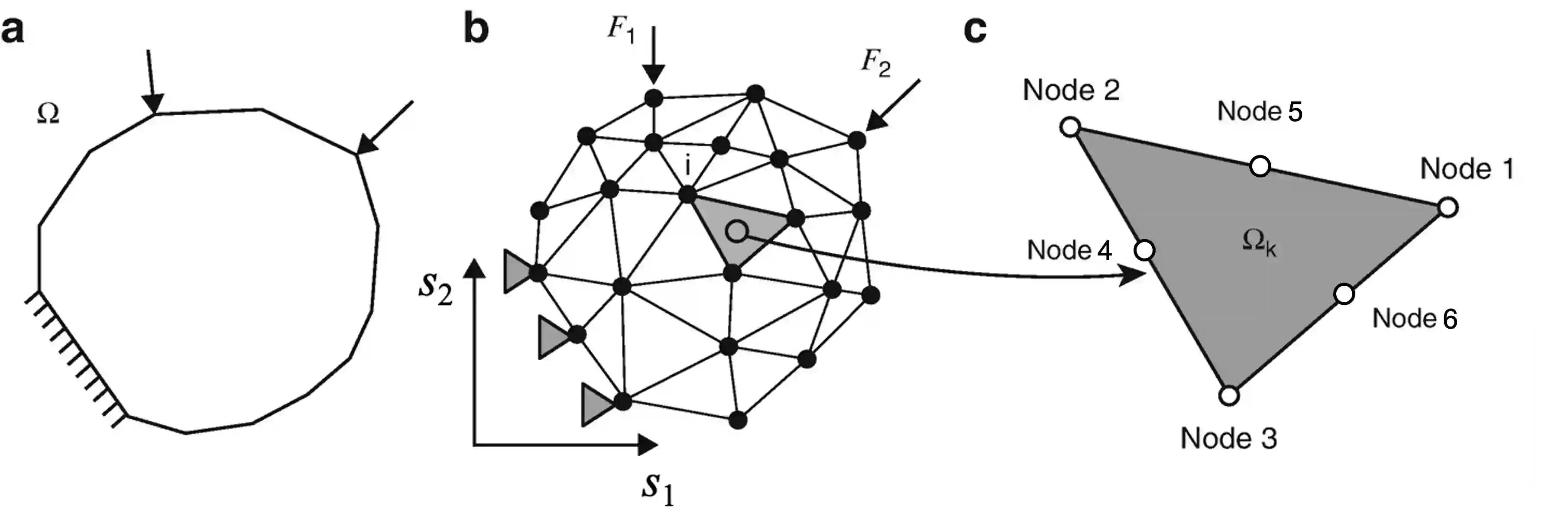
Partial differential equations (PDEs) have become an essential tool for modeling complex physical systems. Such equations are typically solved numerically via mesh-based methods, such as finite element methods, the outputs of which consist of the solutions on a set of mesh nodes over the spatial domain. However, these simulations are often prohibitively costly to survey the input space. In this paper, we propose an efficient emulator that simultaneously predicts the outputs on a set of mesh nodes, with theoretical justification of its uncertainty quantification. The novelty of the proposed method lies in the incorporation of the mesh node coordinates into the statistical model. In particular, the proposed method segments the mesh nodes into multiple clusters via a Dirichlet process prior and fits a Gaussian process model in each. Most importantly, by revealing the underlying clustering structures, the proposed method can extract valuable flow physics present in the systems that can be used to guide further investigations. Real examples are demonstrated to show that our proposed method has smaller prediction errors than its main competitors, with competitive computation time, and identifies interesting clusters of mesh nodes that exhibit coherent input-output relationships and possess physical significance, such as satisfying boundary conditions. An R package for the proposed methodology is provided in an open repository.


翻译:偏微分方程已成为模拟复杂物理系统的重要工具。这类方程通常通过网格方法(如有限元方法)进行数值求解,其输出由空间域内一组网格节点上的解组成。然而,此类仿真在探索输入空间时往往计算成本过高。本文提出了一种高效的仿真器,可同时预测一组网格节点上的输出,并从理论上证明了其不确定性量化的合理性。该方法的核心创新在于将网格节点坐标纳入统计模型。具体而言,该方法通过狄利克雷过程先验将网格节点划分为多个聚类,并在每个聚类中拟合高斯过程模型。最重要的是,通过揭示潜在的聚类结构,该方法可提取系统中存在的有价值流动物理特性,为后续研究提供指导。实际案例表明,与主要竞争方法相比,我们的方法具有更小的预测误差和具有竞争力的计算时间,并能识别出具有一致输入-输出关系且具备物理意义(如满足边界条件)的有趣网格节点聚类。本方法对应的R语言软件包已发布于开源存储库中。
0
下载
关闭预览

相关内容

牛津大学最新《计算代数拓扑》笔记书,107页pdf
专知会员服务
44+阅读 · 2022年2月17日
专知会员服务
50+阅读 · 2021年6月2日
【ACL2020】多模态信息抽取,365页ppt
专知会员服务
151+阅读 · 2020年7月6日
强化学习最新教程,17页pdf
专知会员服务
182+阅读 · 2019年10月11日
【SIGGRAPH2019】TensorFlow 2.0深度学习计算机图形学应用
专知会员服务
41+阅读 · 2019年10月9日
学习自然语言处理路线图
专知会员服务
140+阅读 · 2019年9月24日
RL解决'BipedalWalkerHardcore-v2' (SOTA)
CreateAMind
31+阅读 · 2019年7月17日
disentangled-representation-papers
CreateAMind
26+阅读 · 2018年9月12日
概率图模型体系:HMM、MEMM、CRF
机器学习研究会
30+阅读 · 2018年2月10日
CNN 反向传播算法推导
统计学习与视觉计算组
30+阅读 · 2017年12月29日
可解释的CNN
CreateAMind
18+阅读 · 2017年10月5日
Layer Normalization原理及其TensorFlow实现
深度学习每日摘要
32+阅读 · 2017年6月17日
基于LDA的主题模型实践(三)
机器学习深度学习实战原创交流
23+阅读 · 2015年10月12日
国家自然科学基金
1+阅读 · 2017年12月31日
国家自然科学基金
2+阅读 · 2017年12月31日
国家自然科学基金
2+阅读 · 2015年12月31日
国家自然科学基金
1+阅读 · 2015年12月31日
国家自然科学基金
2+阅读 · 2015年12月31日
国家自然科学基金
0+阅读 · 2014年12月31日
国家自然科学基金
0+阅读 · 2014年12月31日
国家自然科学基金
0+阅读 · 2014年12月31日
国家自然科学基金
0+阅读 · 2014年12月31日
国家自然科学基金
0+阅读 · 2014年12月31日
VIP会员
最新内容
战略前沿人工智能的再思考(中文)
专知会员服务
3+阅读 · 5月29日
《量化地基防空系统间接效应的博弈论方法》
专知会员服务
3+阅读 · 5月29日
“史诗怒火行动”中美军损失的作战飞机
专知会员服务
2+阅读 · 5月29日
ICML 2026 | 理解上下文持续学习中的泛化与遗忘
专知会员服务
5+阅读 · 5月28日
Agent Harness综述:大模型智能体执行器工程全景
专知会员服务
13+阅读 · 5月28日
《基于理论的威慑效能评估》
专知会员服务
8+阅读 · 5月28日
相关VIP内容
牛津大学最新《计算代数拓扑》笔记书,107页pdf
专知会员服务
44+阅读 · 2022年2月17日
专知会员服务
50+阅读 · 2021年6月2日
【ACL2020】多模态信息抽取,365页ppt
专知会员服务
151+阅读 · 2020年7月6日
强化学习最新教程,17页pdf
专知会员服务
182+阅读 · 2019年10月11日
【SIGGRAPH2019】TensorFlow 2.0深度学习计算机图形学应用
专知会员服务
41+阅读 · 2019年10月9日
学习自然语言处理路线图
专知会员服务
140+阅读 · 2019年9月24日
相关资讯
RL解决'BipedalWalkerHardcore-v2' (SOTA)
CreateAMind
31+阅读 · 2019年7月17日
disentangled-representation-papers
CreateAMind
26+阅读 · 2018年9月12日
概率图模型体系:HMM、MEMM、CRF
机器学习研究会
30+阅读 · 2018年2月10日
CNN 反向传播算法推导
统计学习与视觉计算组
30+阅读 · 2017年12月29日
可解释的CNN
CreateAMind
18+阅读 · 2017年10月5日
Layer Normalization原理及其TensorFlow实现
深度学习每日摘要
32+阅读 · 2017年6月17日
基于LDA的主题模型实践(三)
机器学习深度学习实战原创交流
23+阅读 · 2015年10月12日
相关基金
国家自然科学基金
1+阅读 · 2017年12月31日
国家自然科学基金
2+阅读 · 2017年12月31日
国家自然科学基金
2+阅读 · 2015年12月31日
国家自然科学基金
1+阅读 · 2015年12月31日
国家自然科学基金
2+阅读 · 2015年12月31日
国家自然科学基金
0+阅读 · 2014年12月31日
国家自然科学基金
0+阅读 · 2014年12月31日
国家自然科学基金
0+阅读 · 2014年12月31日
国家自然科学基金
0+阅读 · 2014年12月31日
国家自然科学基金
0+阅读 · 2014年12月31日
Top
微信扫码咨询专知VIP会员