

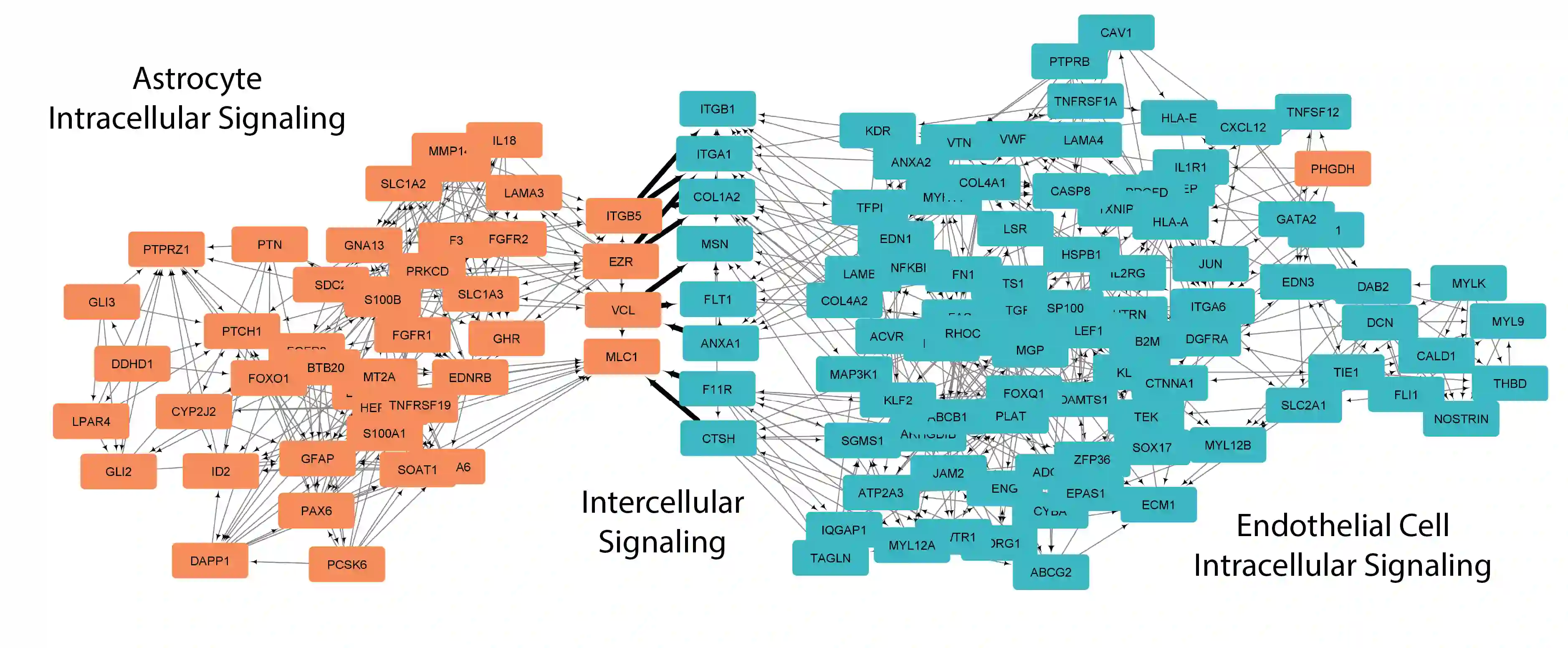
Directed graphs are a natural model for many phenomena, in particular scientific knowledge graphs such as molecular interaction or chemical reaction networks that define cellular signaling relationships. In these situations, source nodes typically have distinct biophysical properties from sinks. Due to their ordered and unidirectional relationships, many such networks also have hierarchical and multiscale structure. However, the majority of methods performing node- and edge-level tasks in machine learning do not take these properties into account, and thus have not been leveraged effectively for scientific tasks such as cellular signaling network inference. We propose a new framework called Directed Scattering Autoencoder (DSAE) which uses a directed version of a geometric scattering transform, combined with the non-linear dimensionality reduction properties of an autoencoder and the geometric properties of the hyperbolic space to learn latent hierarchies. We show this method outperforms numerous others on tasks such as embedding directed graphs and learning cellular signaling networks.
翻译:有向图是许多自然现象的建模基础,尤其是定义细胞信号传导关系的分子相互作用或化学反应网络等科学知识图谱。在此类场景中,源节点与汇节点通常具有截然不同的生物物理特性。由于其有序且单向的关系特性,许多此类网络还呈现出层级化与多尺度结构特征。然而,当前执行节点级与边级任务的机器学习方法大多未考虑这些特性,因而未能有效应用于细胞信号传导网络推断等科学任务。我们提出一种名为有向散射自编码器(DSAE)的新框架,该框架采用有向版本的几何散射变换,结合自编码器的非线性降维特性与双曲空间的几何属性,以学习潜在层级结构。实验表明,该方法在嵌入有向图及学习细胞信号传导网络等任务中显著优于现有方法。




相关内容




 微信扫码咨询专知VIP会员