

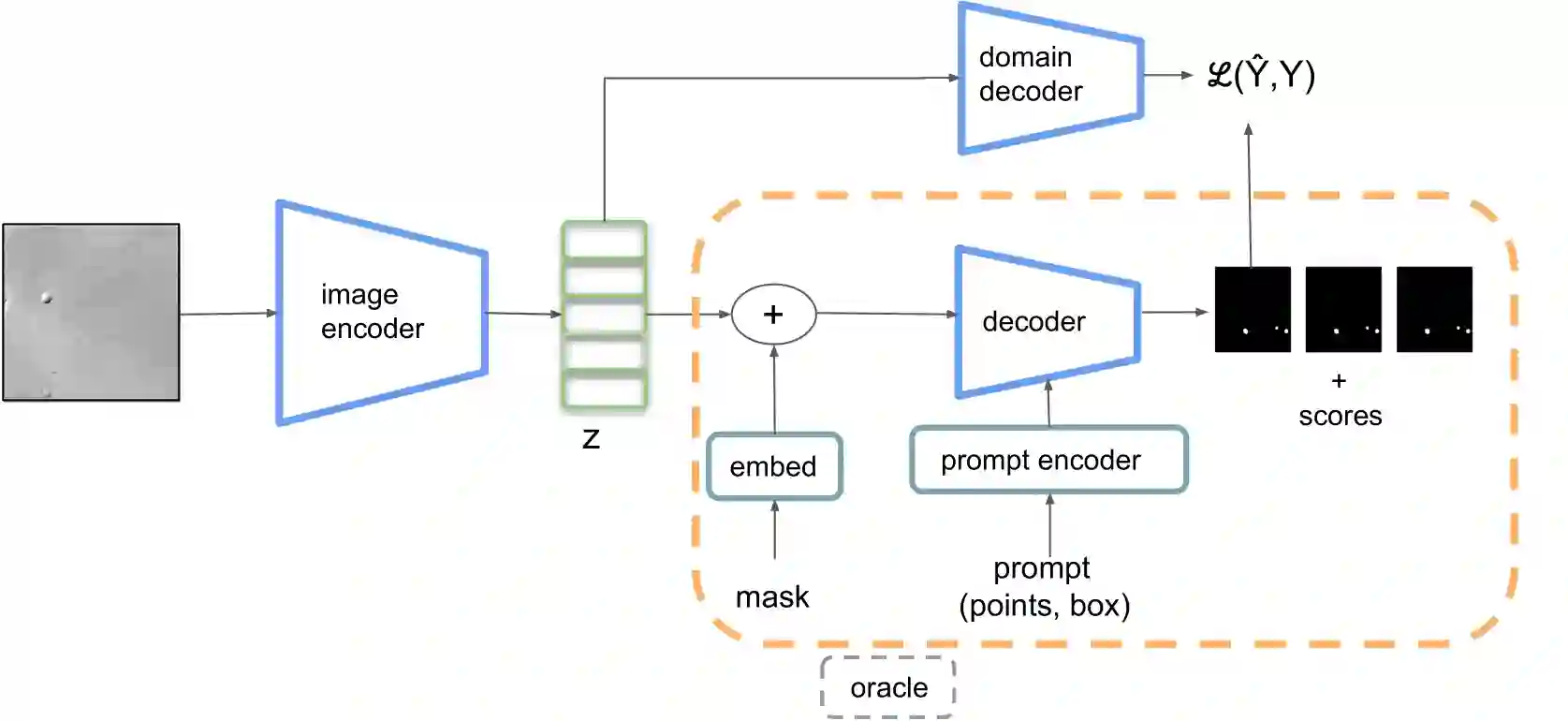
Planetary science research involves analysing vast amounts of remote sensing data, which are often costly and time-consuming to annotate and process. One of the essential tasks in this field is geological mapping, which requires identifying and outlining regions of interest in planetary images, including geological features and landforms. However, manually labelling these images is a complex and challenging task that requires significant domain expertise and effort. To expedite this endeavour, we propose the use of knowledge distillation using the recently introduced cutting-edge Segment Anything (SAM) model. We demonstrate the effectiveness of this prompt-based foundation model for rapid annotation and quick adaptability to a prime use case of mapping planetary skylights. Our work reveals that with a small set of annotations obtained with the right prompts from the model and subsequently training a specialised domain decoder, we can achieve satisfactory semantic segmentation on this task. Key results indicate that the use of knowledge distillation can significantly reduce the effort required by domain experts for manual annotation and improve the efficiency of image segmentation tasks. This approach has the potential to accelerate extra-terrestrial discovery by automatically detecting and segmenting Martian landforms.
翻译:行星科学研究涉及分析海量的遥感数据,这些数据的标注和处理往往成本高昂且耗时。该领域的关键任务之一是地质制图,需要识别并勾勒出行星图像中的感兴趣区域,包括地质特征与地貌。然而,人工标注这些图像是一项复杂且充满挑战的任务,需要大量的领域专业知识和精力投入。为了加速这一工作,我们提出利用近期推出的前沿Segment Anything(SAM)模型进行知识蒸馏。我们展示了这种基于提示的基础模型在快速标注以及快速适配到行星天窗制图这一典型用例中的有效性。研究表明,通过从模型中获得正确提示并据此获取少量标注,随后训练专门的领域解码器,即可在该任务上实现令人满意的语义分割。关键结果表明,采用知识蒸馏可显著减少领域专家在人工标注上的工作量,并提升图像分割任务的效率。该方法通过自动检测与分割火星地貌,具有加速地外天体发现的潜力。






相关内容





 微信扫码咨询专知VIP会员