

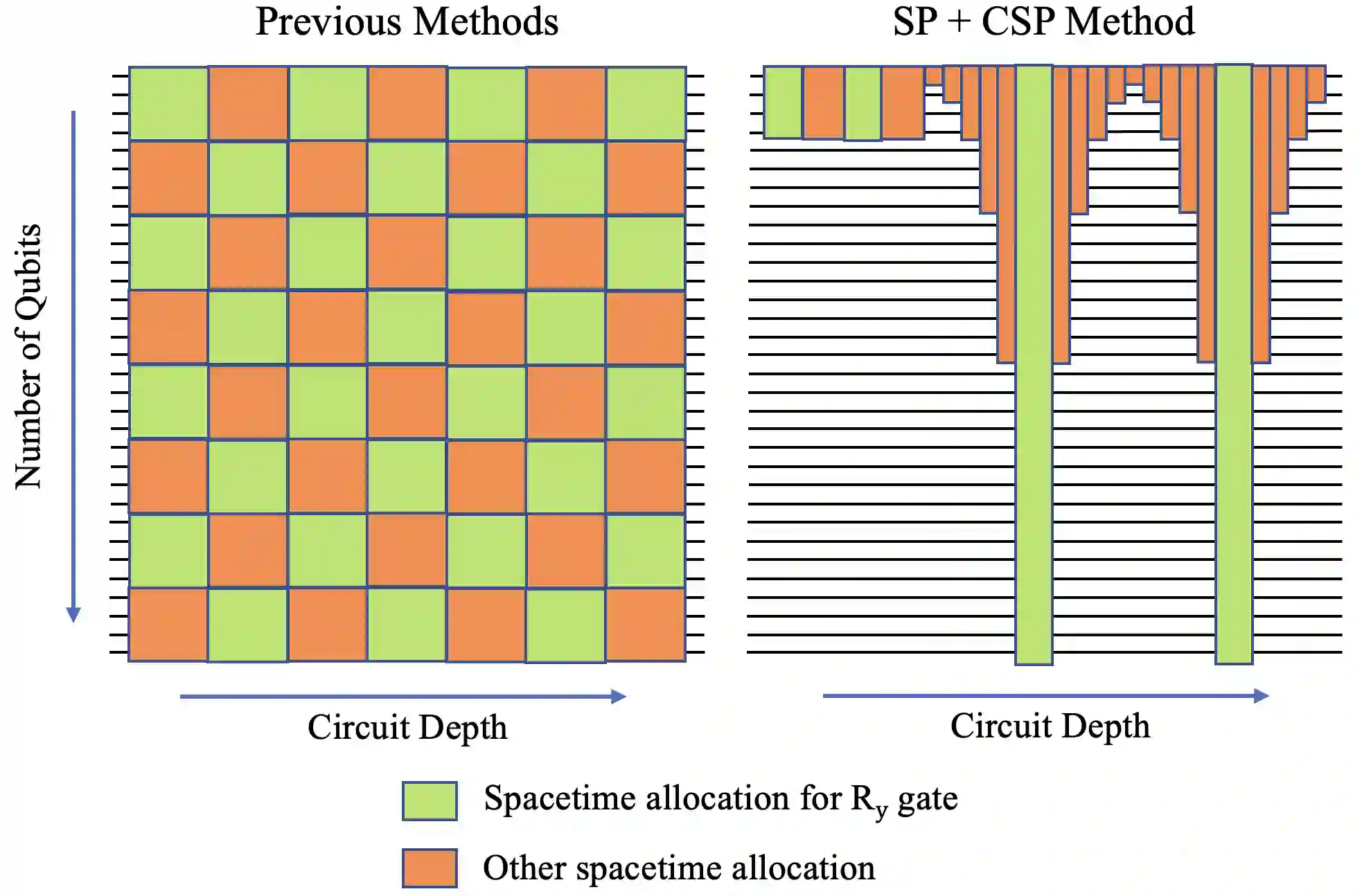
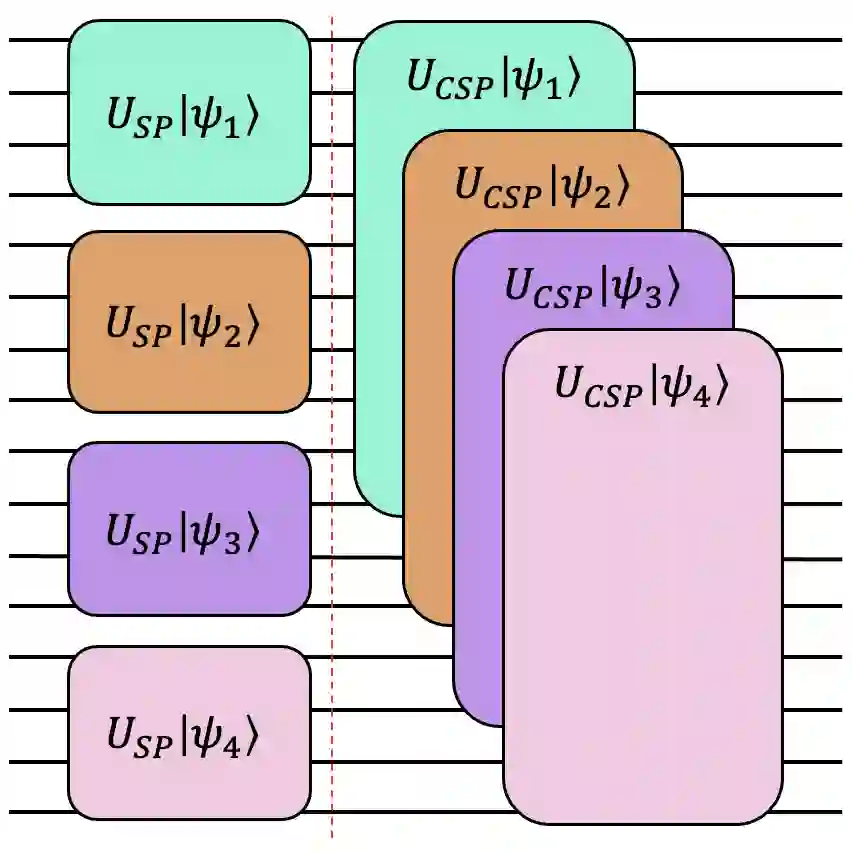
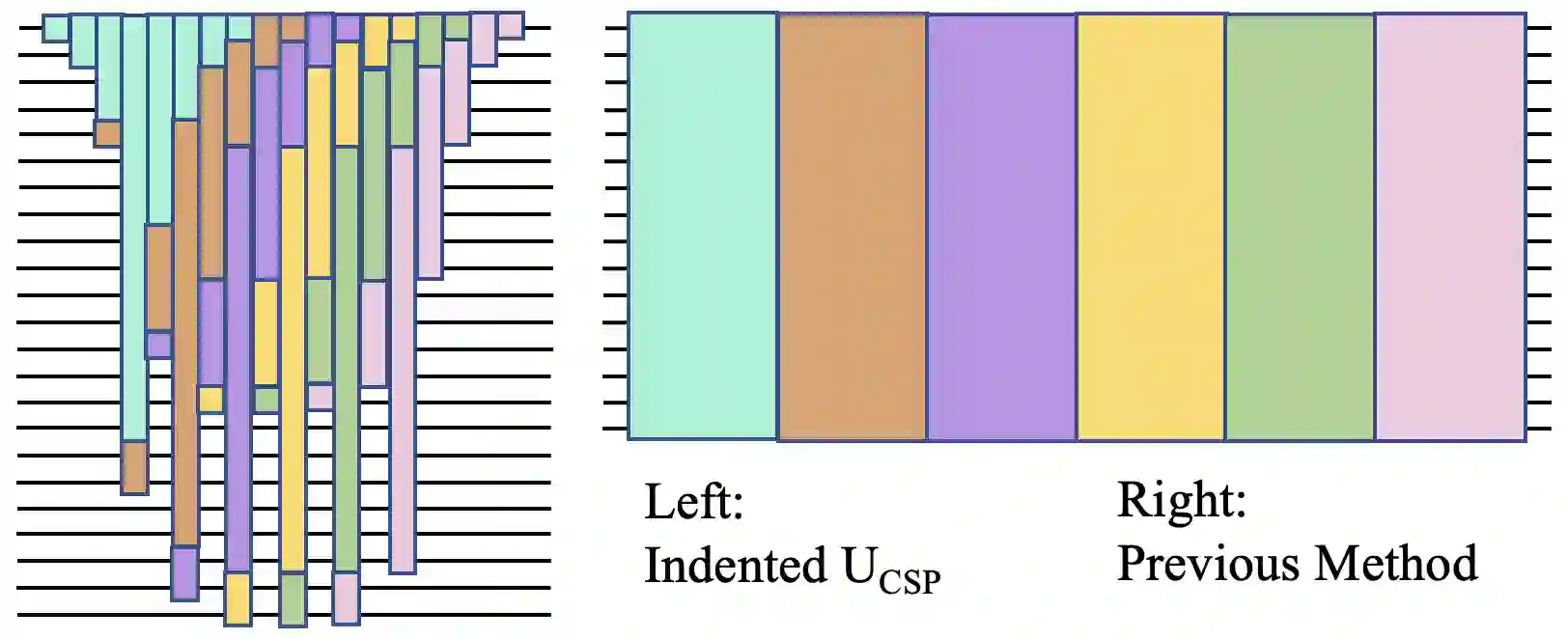
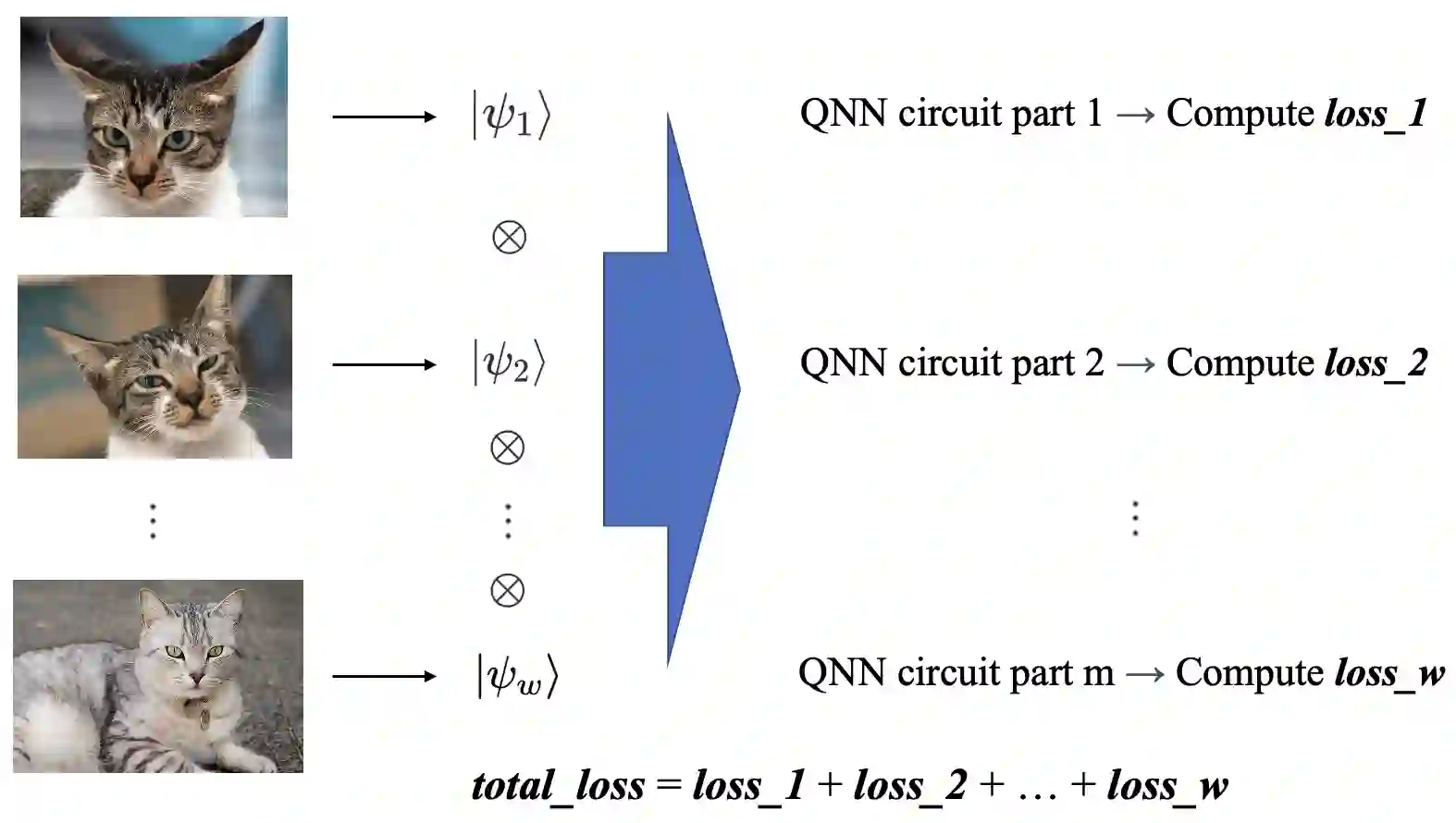
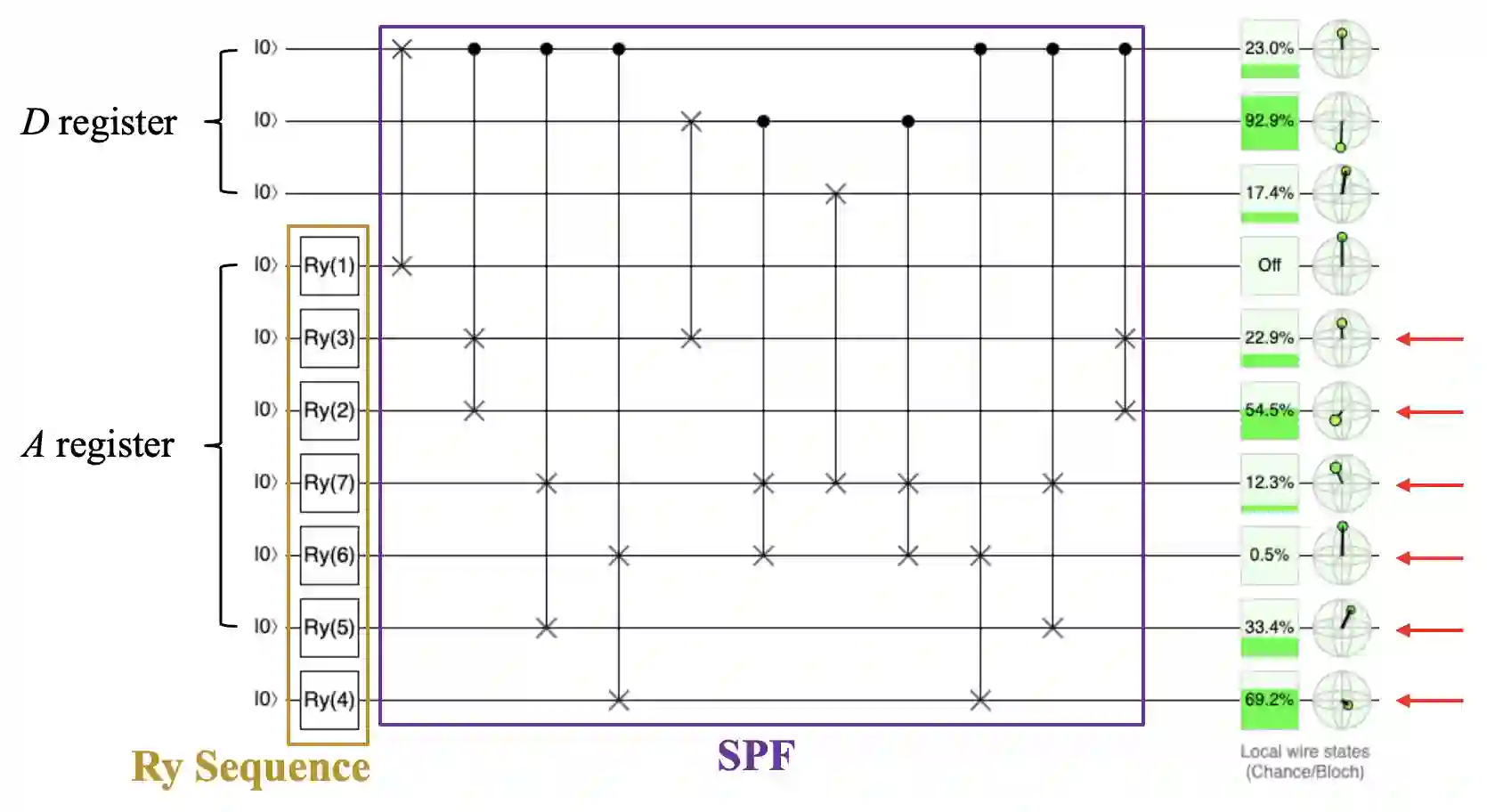
We propose a novel deterministic method for preparing arbitrary quantum states. When our protocol is compiled into CNOT and arbitrary single-qubit gates, it prepares an $N$-dimensional state in depth $O(\log(N))$ and spacetime allocation (a metric that accounts for the fact that oftentimes some ancilla qubits need not be active for the entire circuit) $O(N)$, which are both optimal. When compiled into the $\{\mathrm{H,S,T,CNOT}\}$ gate set, we show that it requires asymptotically fewer quantum resources than previous methods. Specifically, it prepares an arbitrary state up to error $\epsilon$ with optimal depth of $O(\log(N) + \log (1/\epsilon))$ and spacetime allocation $O(N\log(\log(N)/\epsilon))$, improving over $O(\log(N)\log(\log (N)/\epsilon))$ and $O(N\log(N/\epsilon))$, respectively. We illustrate how the reduced spacetime allocation of our protocol enables rapid preparation of many disjoint states with only constant-factor ancilla overhead -- $O(N)$ ancilla qubits are reused efficiently to prepare a product state of $w$ $N$-dimensional states in depth $O(w + \log(N))$ rather than $O(w\log(N))$, achieving effectively constant depth per state. We highlight several applications where this ability would be useful, including quantum machine learning, Hamiltonian simulation, and solving linear systems of equations. We provide quantum circuit descriptions of our protocol, detailed pseudocode, and gate-level implementation examples using Braket.
翻译:我们提出了一种新颖的确定性方法,用于制备任意量子态。当我们的协议被编译为CNOT门和任意单量子比特门时,它能够以深度$O(\log(N))$和时空分配(一种考虑到某些辅助量子比特在电路中无需全程活跃这一事实的度量)$O(N)$来制备一个$N$维态,这两者均为最优。当编译为$\{\mathrm{H,S,T,CNOT}\}$门集时,我们证明该方法所需的量子资源渐近地少于先前方法。具体而言,它能够以最优深度$O(\log(N) + \log (1/\epsilon))$和时空分配$O(N\log(\log(N)/\epsilon))$来制备任意态至误差$\epsilon$,分别优于$O(\log(N)\log(\log (N)/\epsilon))$和$O(N\log(N/\epsilon))$。我们展示了协议中减少的时空分配如何使得仅需常数因子辅助开销就能快速制备多个不相交的态——$O(N)$个辅助量子比特被高效复用,以深度$O(w + \log(N))$而非$O(w\log(N))$制备$w$个$N$维直积态,从而实现了每个态的有效常数深度。我们重点介绍了该能力在量子机器学习、哈密顿量模拟以及线性方程组求解等应用中的潜在用途。我们还提供了协议的量子电路描述、详细伪代码以及使用Braket的底层门级实现示例。




相关内容



 微信扫码咨询专知VIP会员