

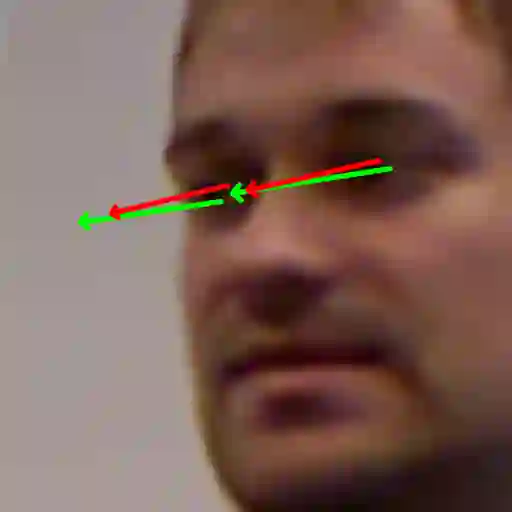
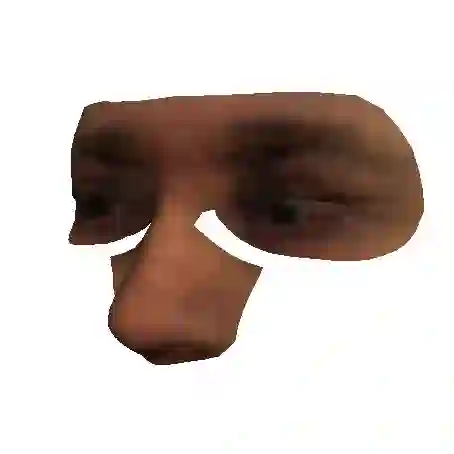
Rather than regressing gaze direction directly from images, we show that adding a 3D shape model can: i) improve gaze estimation accuracy, ii) perform well with lower resolution inputs and iii) provide a richer understanding of the eye-region and its constituent gaze system. Specifically, we use an `eyes and nose' 3D morphable model (3DMM) to capture the eye-region 3D facial geometry and appearance and we equip this with a geometric vergence model of gaze to give an `active-gaze 3DMM'. We show that our approach achieves state-of-the-art results on the Eyediap dataset and we present an ablation study. Our method can learn with only the ground truth gaze target point and the camera parameters, without access to the ground truth gaze origin points, thus widening the applicability of our approach compared to other methods.
翻译:我们证明,并非直接从图像中回归视线方向,而是通过添加3D形状模型能够:i) 提升视线估计精度,ii) 在低分辨率输入下表现良好,iii) 提供对眼部区域及其构成视线系统的更深入理解。具体而言,我们采用“眼-鼻”3D可变形模型(3DMM)来捕捉眼部区域的3D面部几何与外观特征,并为其配备基于几何聚散的视线模型,从而构建出“主动注视3DMM”。实验表明,本方法在Eyediap数据集上取得了最先进的成果,并开展了消融研究。与现有方法相比,我们的模型仅需真实注视目标点与相机参数即可进行学习,无需依赖真实注视原点数据,从而显著拓展了该方法的适用场景。







相关内容




 微信扫码咨询专知VIP会员