

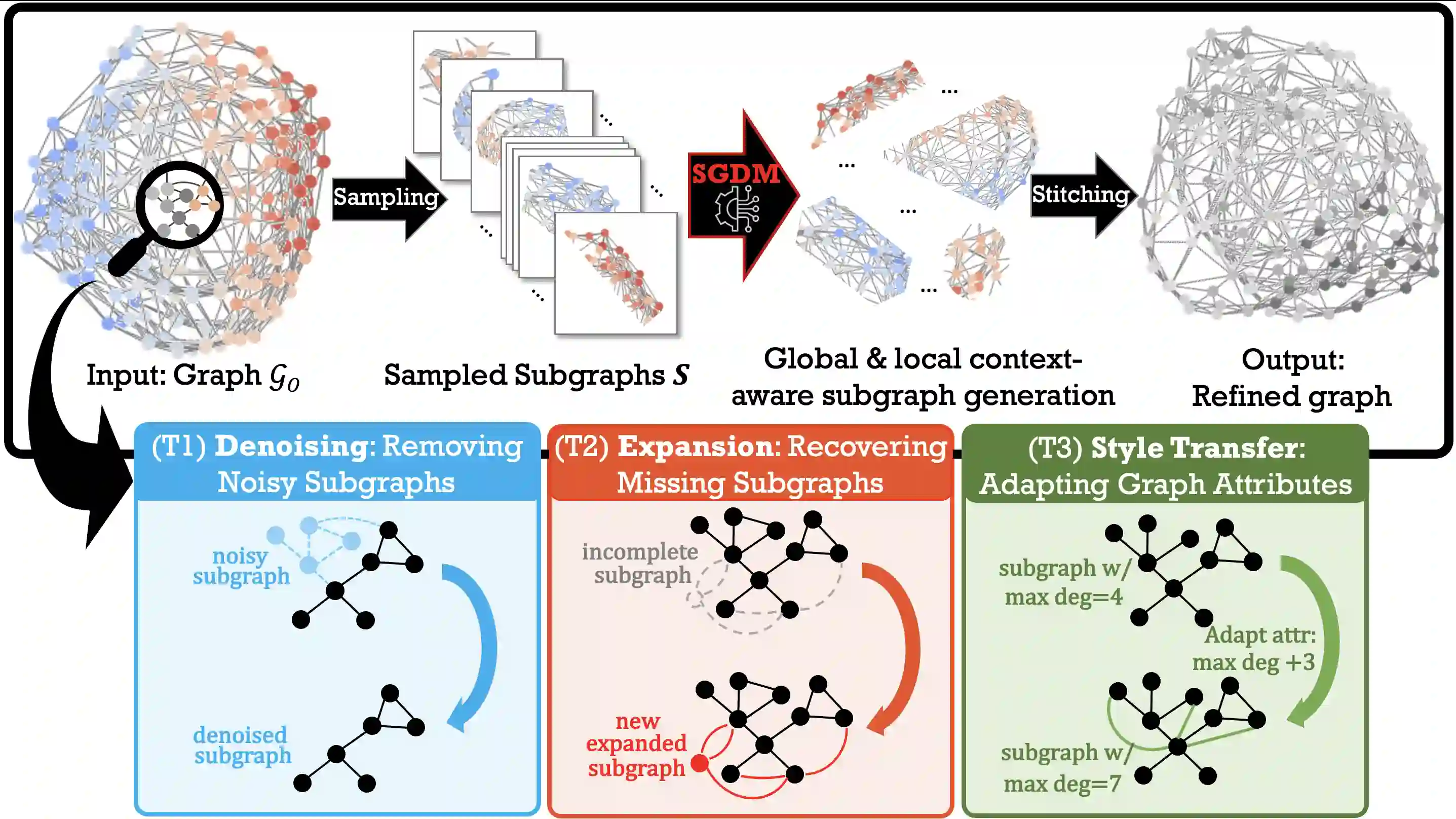
Most real-world networks are noisy and incomplete samples from an unknown target distribution. Refining them by correcting corruptions or inferring unobserved regions typically improves downstream performance. Inspired by the impressive generative capabilities that have been used to correct corruptions in images, and the similarities between "in-painting" and filling in missing nodes and edges conditioned on the observed graph, we propose a novel graph generative framework, SGDM, which is based on subgraph diffusion. Our framework not only improves the scalability and fidelity of graph diffusion models, but also leverages the reverse process to perform novel, conditional generation tasks. In particular, through extensive empirical analysis and a set of novel metrics, we demonstrate that our proposed model effectively supports the following refinement tasks for partially observable networks: T1: denoising extraneous subgraphs, T2: expanding existing subgraphs and T3: performing "style" transfer by regenerating a particular subgraph to match the characteristics of a different node or subgraph.
翻译:大多数现实世界网络都是来自未知目标分布的噪声和不完全样本。通过纠正错误或推断未观测区域来优化网络通常能提升下游性能。受图像纠错中强大生成能力的启发,以及"图像修复"与基于观测图补全缺失节点和边之间的相似性,我们提出了一种新颖的图生成框架SGDM,该框架基于子图扩散。我们的框架不仅提升了图扩散模型的可扩展性和保真度,还利用逆向过程执行新颖的条件生成任务。特别是,通过广泛的实证分析和一套新颖的评估指标,我们证明了所提模型能有效支持以下针对部分可观测网络的优化任务:T1:去除多余子图的噪声,T2:扩展现有子图,以及T3:通过再生特定子图以匹配不同节点或子图特征进行"风格"迁移。




相关内容





 微信扫码咨询专知VIP会员