

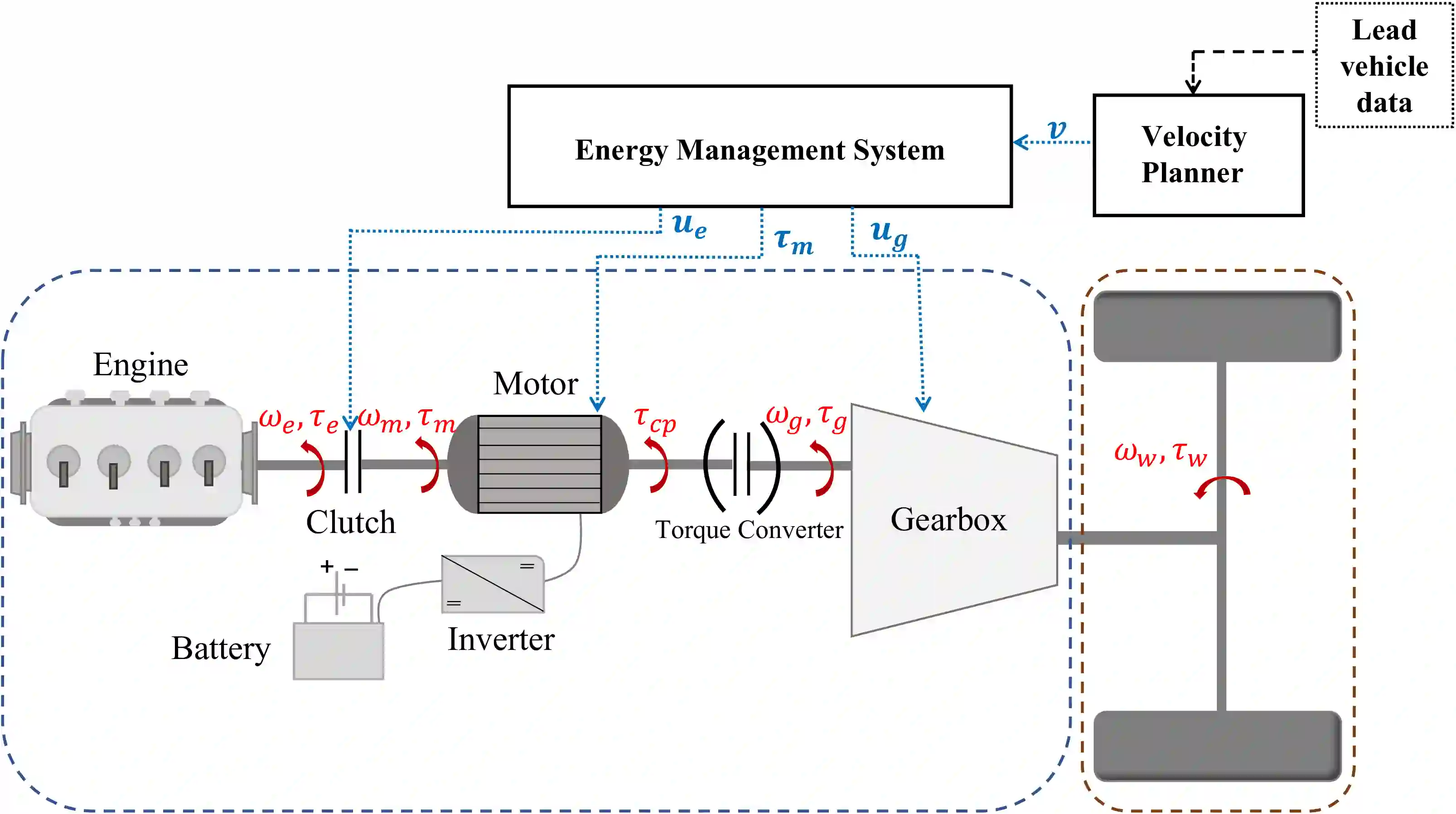
The powertrains of today's hybrid electric vehicles (HEVs) are developed for human drivers and, therefore, may not be the optimum choice for future Autonomous vehicles (AVs), given that AVs can accurately manipulate their velocity profile to avoid unnecessary energy loss. In this work, we closely examine the necessary degree of hybridization for AVs compared to human drivers by deploying real-world urban driving profiles and generating equivalent AV drive cycles in a mixed autonomy scenario. We solve the optimal energy management problem for HEVs with various motor sizes from the automotive market, and demonstrate that while human drivers typically require a motor size of around 30 kW to fully benefit from hybridization, AVs can achieve similar gains with only a 12 kW motor. This greater benefit from a smaller motor size can be attributed to a more optimal torque request, allowing for higher gains from regenerative braking and a more efficient engine operation. Furthermore, We investigate the benefits of velocity smoothing for both traditional cars and HEVs and explore the role of different mechanisms contributing to fuel consumption reduction. Our analysis reveals that velocity smoothing provides greater benefits to HEVs equipped with small motors compared to non-hybrid vehicles and HEVs with larger motors.
翻译:当今混合动力电动汽车(HEV)的动力总成是为人类驾驶员开发的,因此可能不是未来自动驾驶汽车(AV)的最优选择,因为自动驾驶汽车能够精确控制其速度曲线以避免不必要的能量损失。本文通过部署真实城市驾驶工况并在混合自主场景中生成等效的自动驾驶汽车行驶循环,深入研究了与人类驾驶员相比,自动驾驶汽车所需的混合化程度。我们求解了基于汽车市场中不同电机尺寸的混合动力电动汽车的最优能量管理问题,并证明:人类驾驶员通常需要约30千瓦的电机才能充分受益于混合化,而自动驾驶汽车仅需12千瓦的电机即可实现类似收益。这种小尺寸电机带来的更大收益可归因于更优化的扭矩需求,从而通过再生制动获得更高收益并实现更高效的发动机运行。此外,我们研究了速度平滑对传统汽车和混合动力电动汽车的效益,并探索了不同机制对燃油消耗降低的作用。分析表明,与未混合动力汽车及配备大电机的混合动力电动汽车相比,速度平滑为配备小电机的混合动力电动汽车带来更大收益。








相关内容


 微信扫码咨询专知VIP会员