

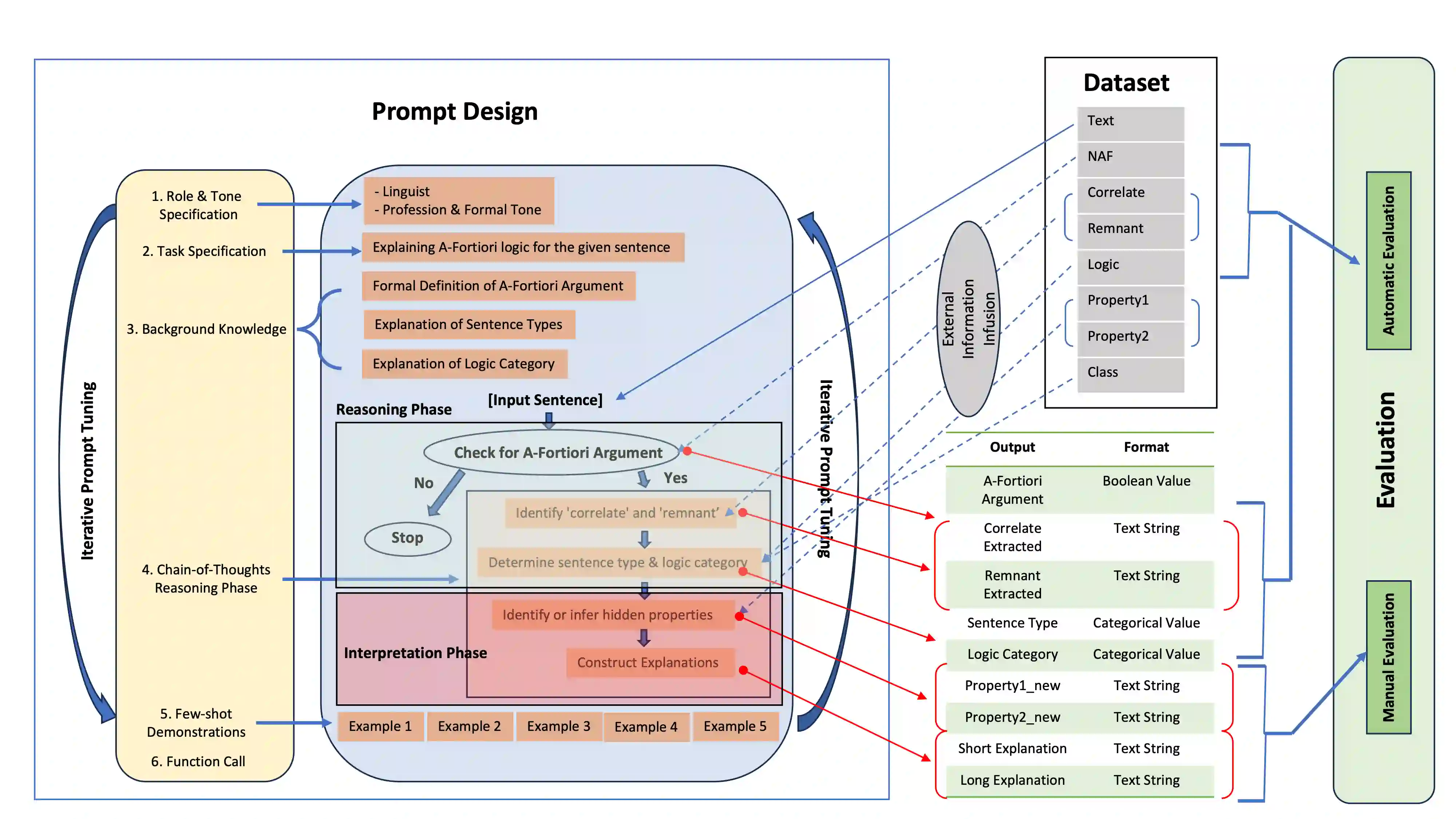
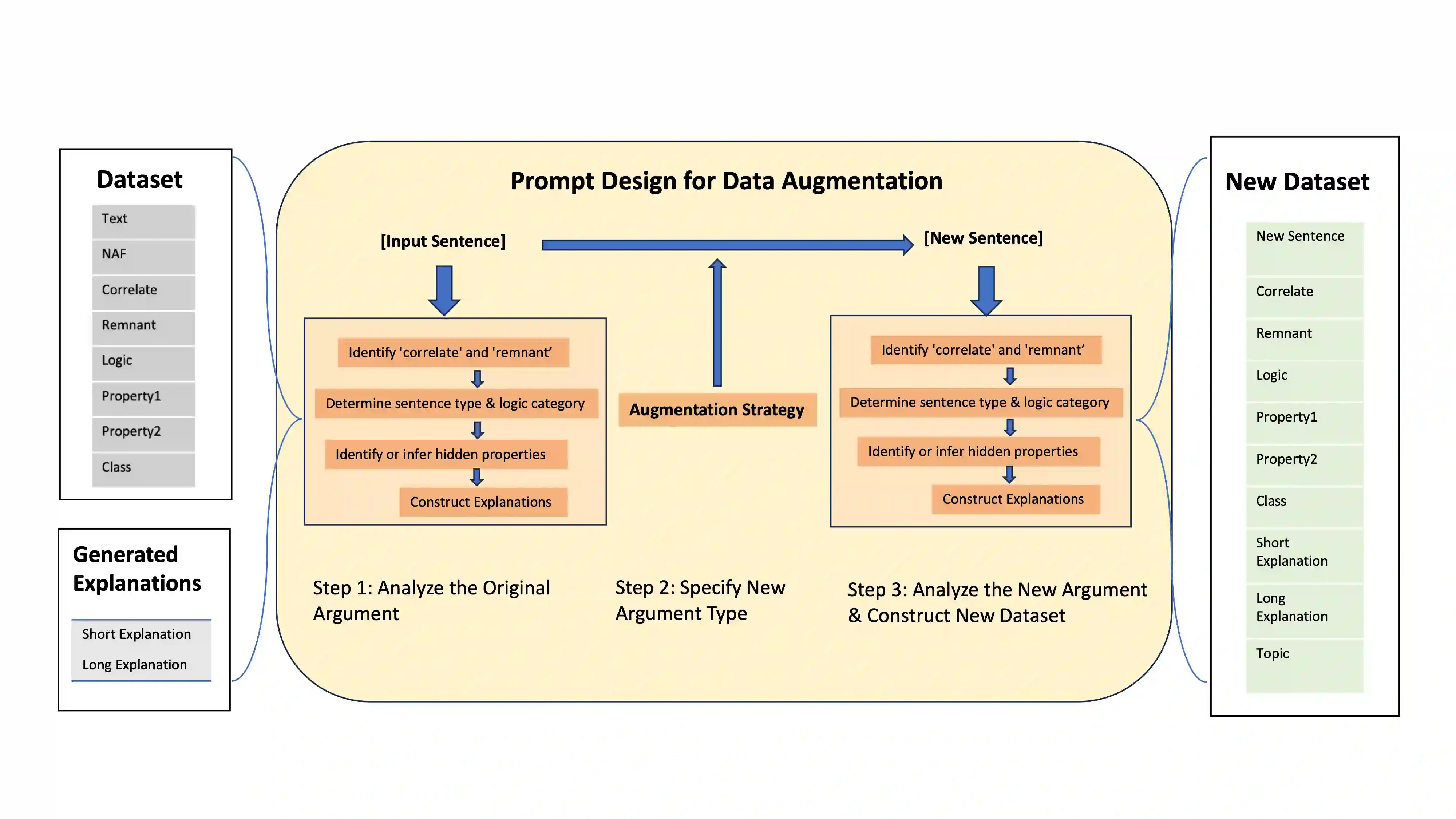
This thesis delves into a fortiori arguments in deductive reasoning, underscoring their relevance in various domains such as law, philosophy, and artificial intelligence. The research is centred on employing GPT-3.5-turbo to automate the analysis of these arguments, with a focus on understanding intricate reasoning processes, generating clear and coherent explanations, and creating novel arguments. The methodology encompasses a series of tasks including detailed reasoning, interpretation, and the augmentation of a fortiori arguments. It involves meticulously identifying these arguments in diverse contexts, differentiating comparative elements, and categorizing them based on their logical structure. Extensive experiments reveals the challenges encountered by GPT-3.5-turbo in accurately detecting and classifying a fortiori arguments. Nevertheless, the model demonstrates a performance that rivals specialized models, particularly in extracting key components and interpreting underlying properties. The integration of external information into the model's processing significantly elevates the quality of the generated explanations. Additionally, the model exhibits a noteworthy capability in augmenting arguments, thus contributing to the enrichment of the data set. Despite facing certain limitations, this thesis makes significant contributions to the fields of artificial intelligence and logical reasoning. It introduces novel methodologies, establishes a rigorous evaluation framework, and provides deep insights that set the stage for future advancements in automated logical reasoning. The findings and methodologies presented herein not only underscore the potential of AI in complex reasoning tasks but also highlight areas for future research and development.
翻译:本论文深入探讨演绎推理中的“a fortiori”论证,强调其在法律、哲学和人工智能等领域的相关性。研究聚焦于利用GPT-3.5-turbo自动分析此类论证,旨在理解复杂推理过程、生成清晰连贯的解释并创建新颖论证。方法论涵盖详细推理、解释及增强“a fortiori”论证等一系列任务,包括在不同语境中精确识别这些论证、区分比较性要素并基于其逻辑结构进行分类。广泛实验揭示了GPT-3.5-turbo在准确检测和分类“a fortiori”论证时面临的挑战。然而,该模型在提取关键组件和解释底层属性方面表现出与专用模型相媲美的性能。将外部信息整合到模型处理中显著提升了生成解释的质量。此外,模型在增强论证方面展现出显著能力,从而丰富了数据集。尽管存在某些局限性,本论文仍对人工智能与逻辑推理领域做出了重要贡献。它引入了新方法,建立了一个严格的评估框架,并提供了深刻见解,为未来自动化逻辑推理的进步奠定了基础。本文的研究成果和方法不仅凸显了人工智能在复杂推理任务中的潜力,还指明了未来研究与发展方向。




相关内容





 微信扫码咨询专知VIP会员