

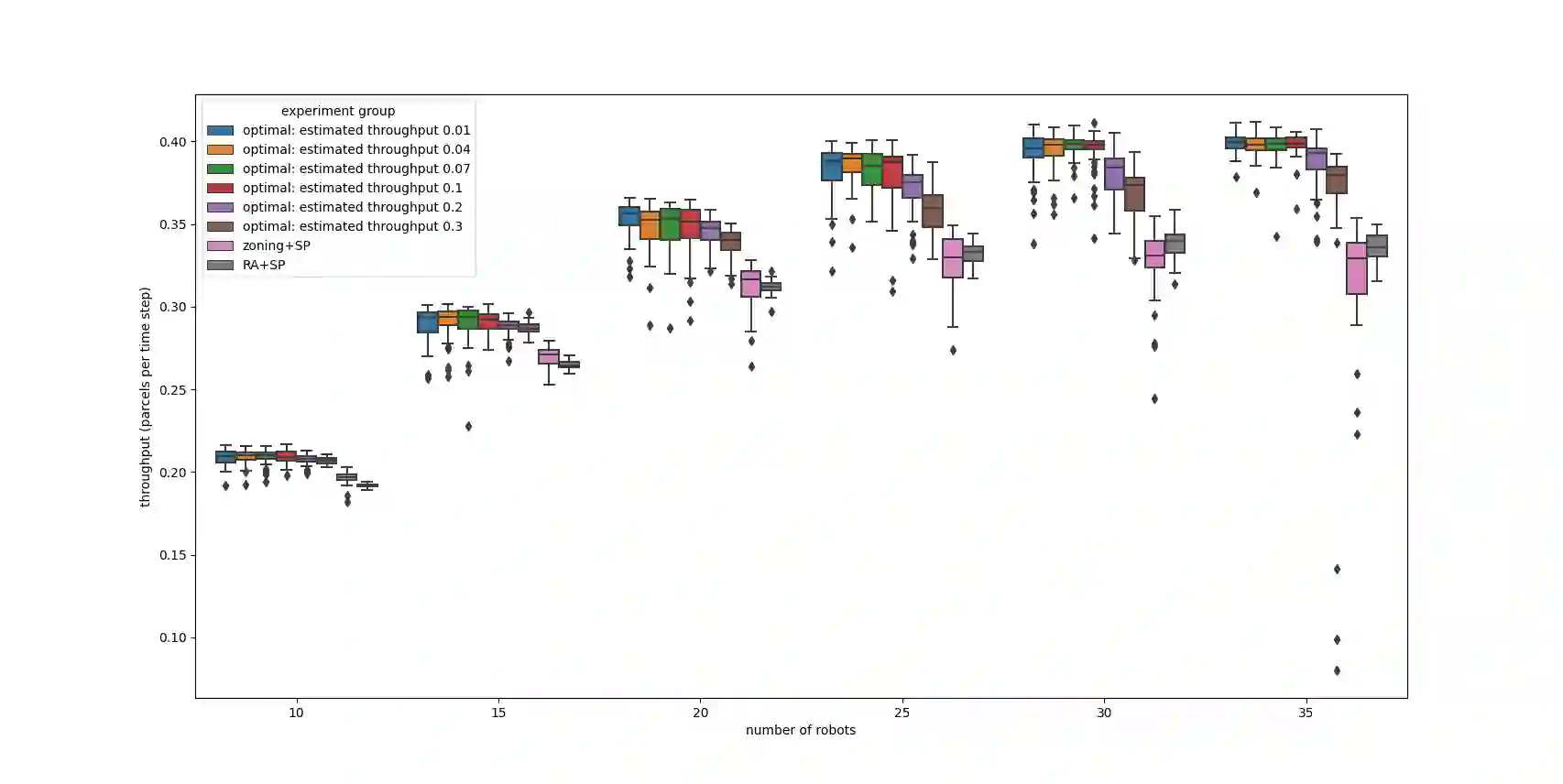
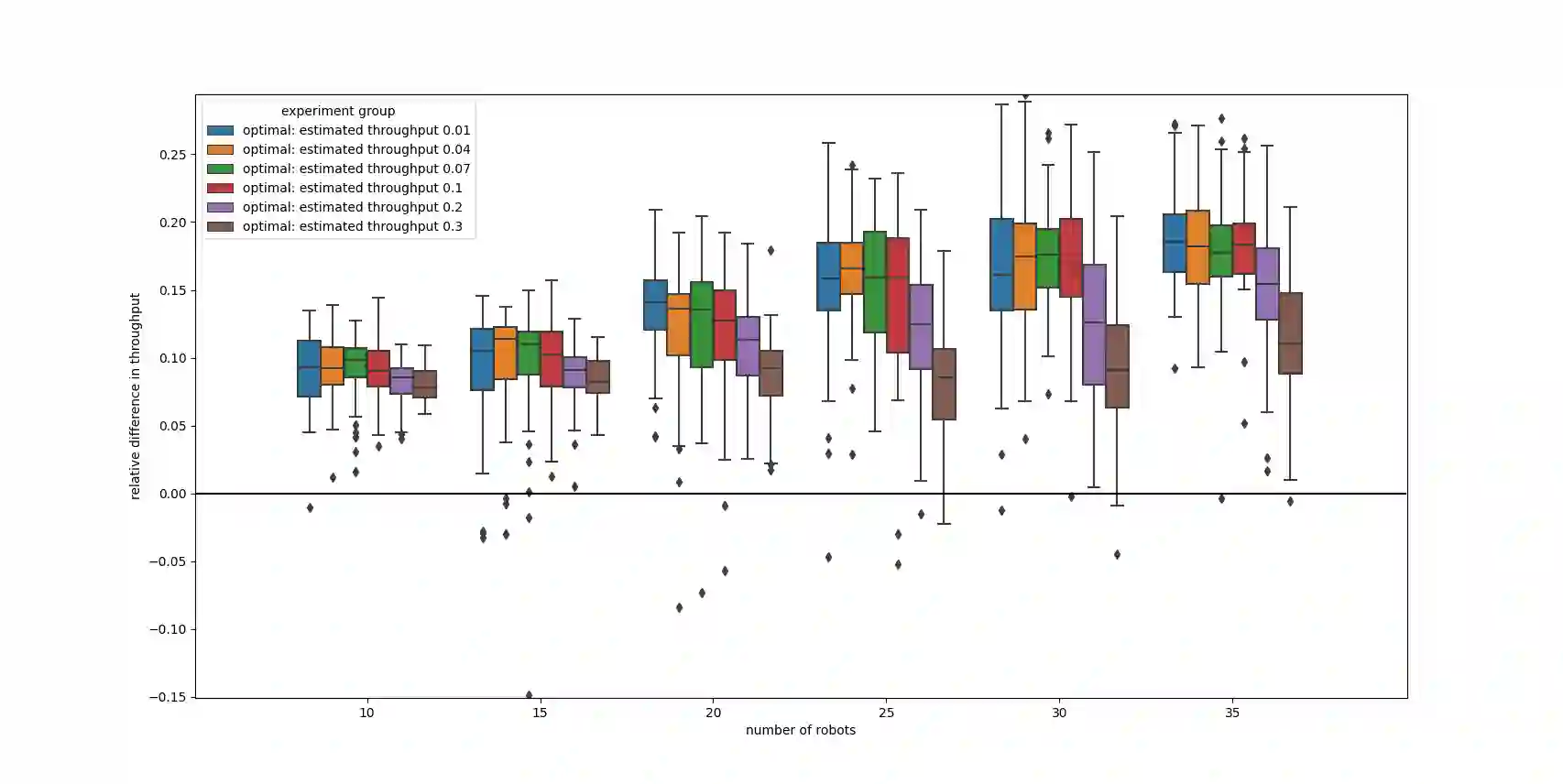
Express companies are deploying more robotic sorting systems, where mobile robots are used to sort incoming parcels by destination. In this study, we propose an integrated assignment and path-finding method for robots in such sorting systems. The method has two parts: offline and online. In the offline part, we represent the system as a traffic flow network, develop an approximate delay function using stochastic models, and solve the min-cost network flow problem. In the online part, robots are guided through the system according to the calculated optimal flow split probability. The online calculation of the method is decentralized and has linear complexity. Our method outperforms fast multi-agent path planning algorithms like prioritized planning because such algorithms lead to stochastic user equilibrium traffic assignment. In contrast, our method gives the approximated system-optimal traffic assignment. According to our simulations, our method can achieve 10%--20% higher throughput than zoning or random assignment. We also show that our method is robust even if the initial demand estimation is inaccurate.
翻译:快递公司正部署更多机器人分拣系统,其中移动机器人按目的地分拣 incoming 包裹。本研究针对此类分拣系统提出一种集成任务分配与路径规划方法。该方法包含离线与在线两部分:离线部分将系统表示为交通流网络,利用随机模型构建近似延迟函数,并求解最小费用网络流问题;在线部分则根据计算出的最优流分配概率引导机器人通过系统。该方法的在线计算具有分散化特性且复杂度为线性。与优先级规划等快速多智能体路径规划算法相比,本方法表现更优——此类算法会导致随机用户均衡交通分配,而本方法可给出近似系统最优交通分配。仿真结果表明,本方法相较于分区分配或随机分配,吞吐量提升10%--20%。此外,即使初始需求估计不准确,本方法仍具有鲁棒性。




相关内容





 微信扫码咨询专知VIP会员