

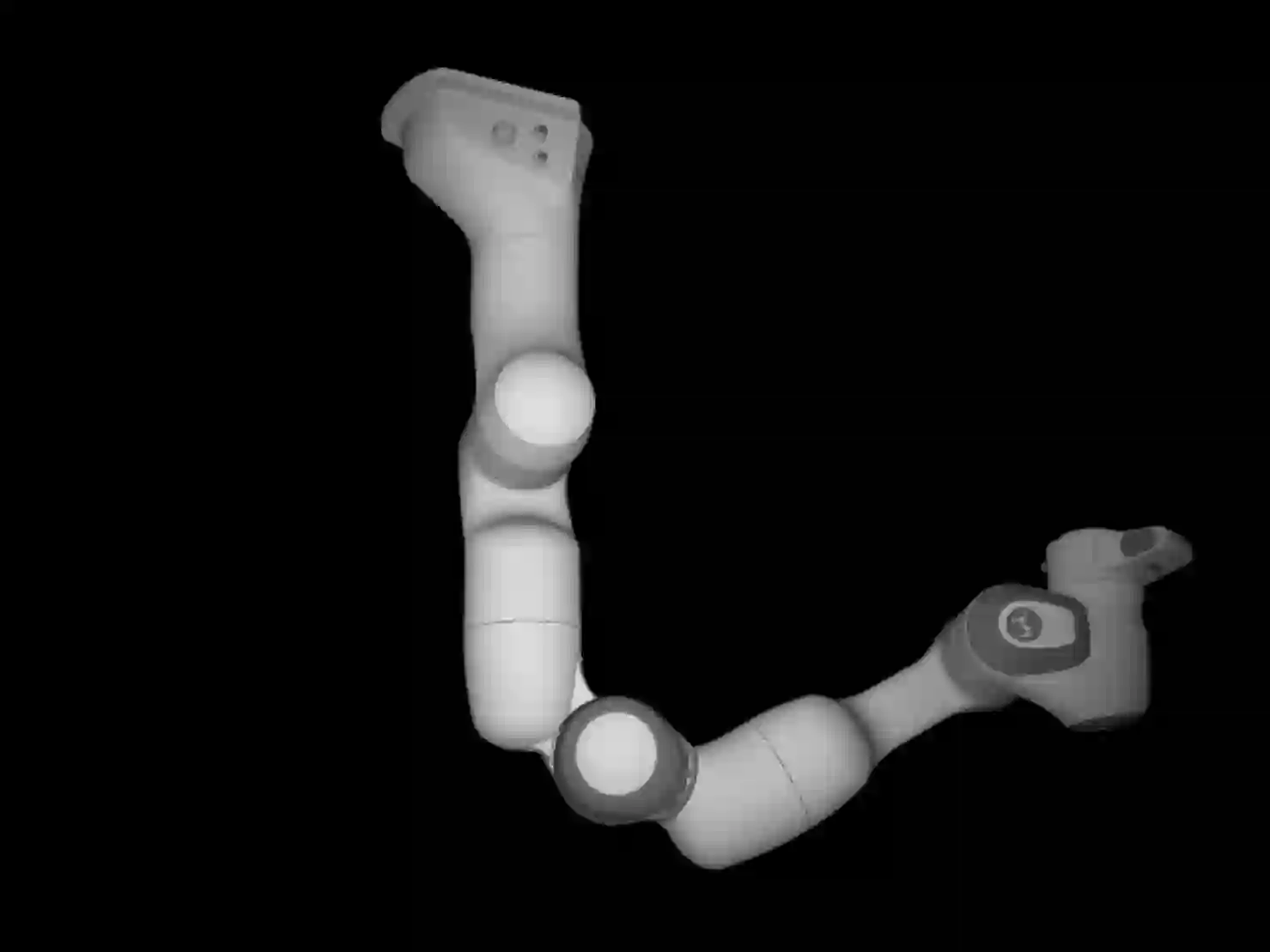
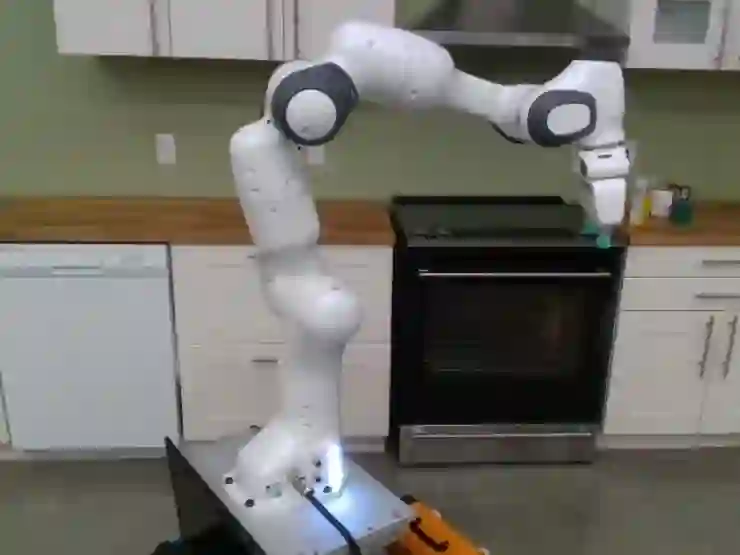
Autonomous manipulation systems operating in domains where human intervention is difficult or impossible (e.g., underwater, extraterrestrial or hazardous environments) require a high degree of robustness to sensing and communication failures. Crucially, motion planning and control algorithms require a stream of accurate joint angle data provided by joint encoders, the failure of which may result in an unrecoverable loss of functionality. In this paper, we present a novel method for retrieving the joint angles of a robot manipulator using only a single RGB image of its current configuration, opening up an avenue for recovering system functionality when conventional proprioceptive sensing is unavailable. Our approach, based on a distance-geometric representation of the configuration space, exploits the knowledge of a robot's kinematic model with the goal of training a shallow neural network that performs a 2D-to-3D regression of distances associated with detected structural keypoints. It is shown that the resulting Euclidean distance matrix uniquely corresponds to the observed configuration, where joint angles can be recovered via multidimensional scaling and a simple inverse kinematics procedure. We evaluate the performance of our approach on real RGB images of a Franka Emika Panda manipulator, showing that the proposed method is efficient and exhibits solid generalization ability. Furthermore, we show that our method can be easily combined with a dense refinement technique to obtain superior results.
翻译:自主操作系统在人类难以或无法干预的领域(如水下、外太空或危险环境)运行时,需要具备对传感与通信故障的高度鲁棒性。关键在于,运动规划与控制算法依赖关节编码器提供的连续精确关节角度数据,而编码器故障可能导致功能不可恢复的丧失。本文提出一种仅利用单张RGB图像获取机器人关节角度的新方法,为传统本体感知失效时恢复系统功能开辟了新途径。该方法基于构型空间的距离几何表示,利用机器人运动学模型知识,训练一个浅层神经网络,对检测到的结构关键点相关距离执行2D到3D回归。研究表明,生成的欧氏距离矩阵与观测构型之间存在唯一对应关系,可通过多维缩放和简单逆运动学步骤恢复关节角度。我们在Franka Emika Panda机械臂的真实RGB图像上评估了该方法性能,结果表明所提方法高效且具备良好的泛化能力。此外,我们还展示了该方法可便捷地与密集优化技术结合以获得更优结果。





相关内容



 微信扫码咨询专知VIP会员