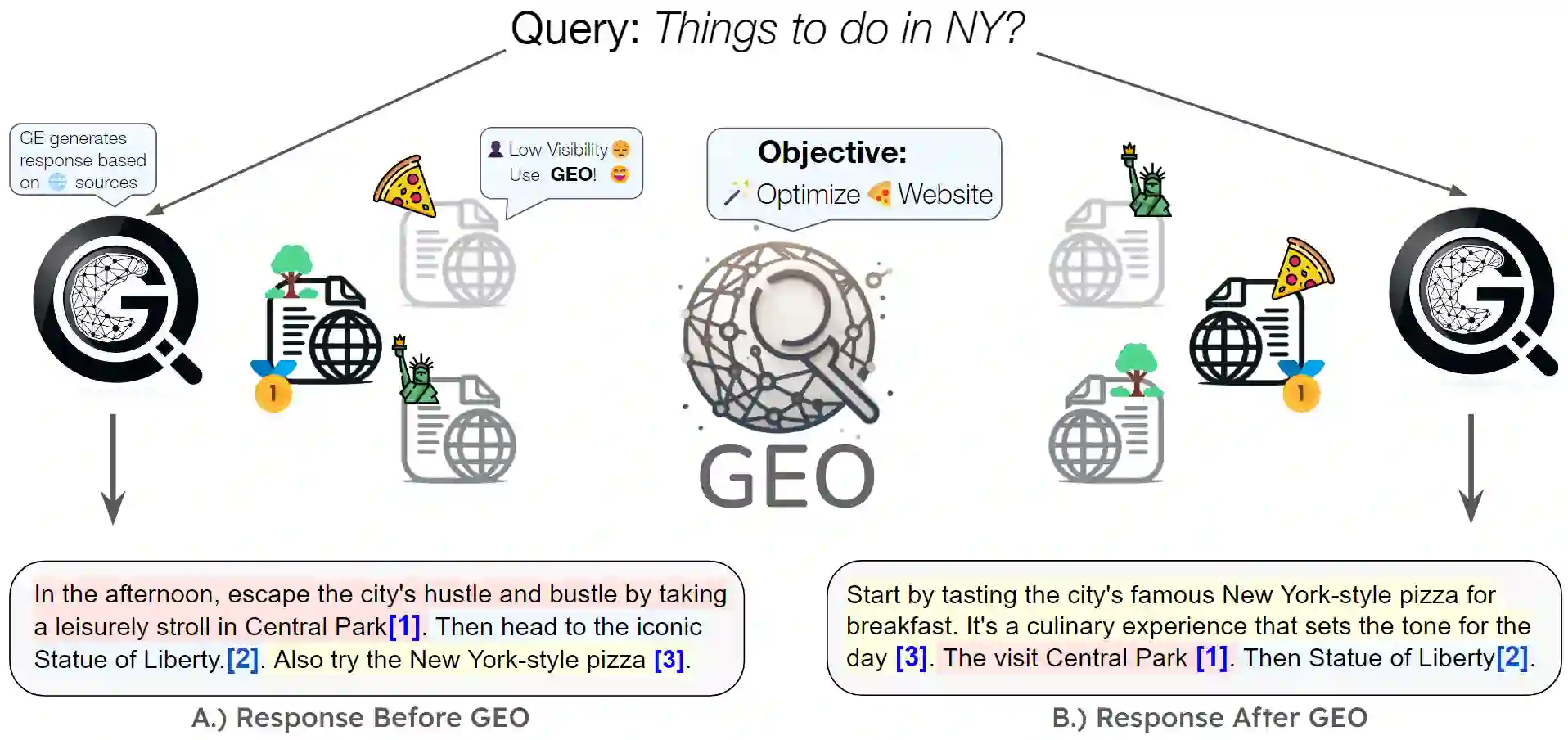
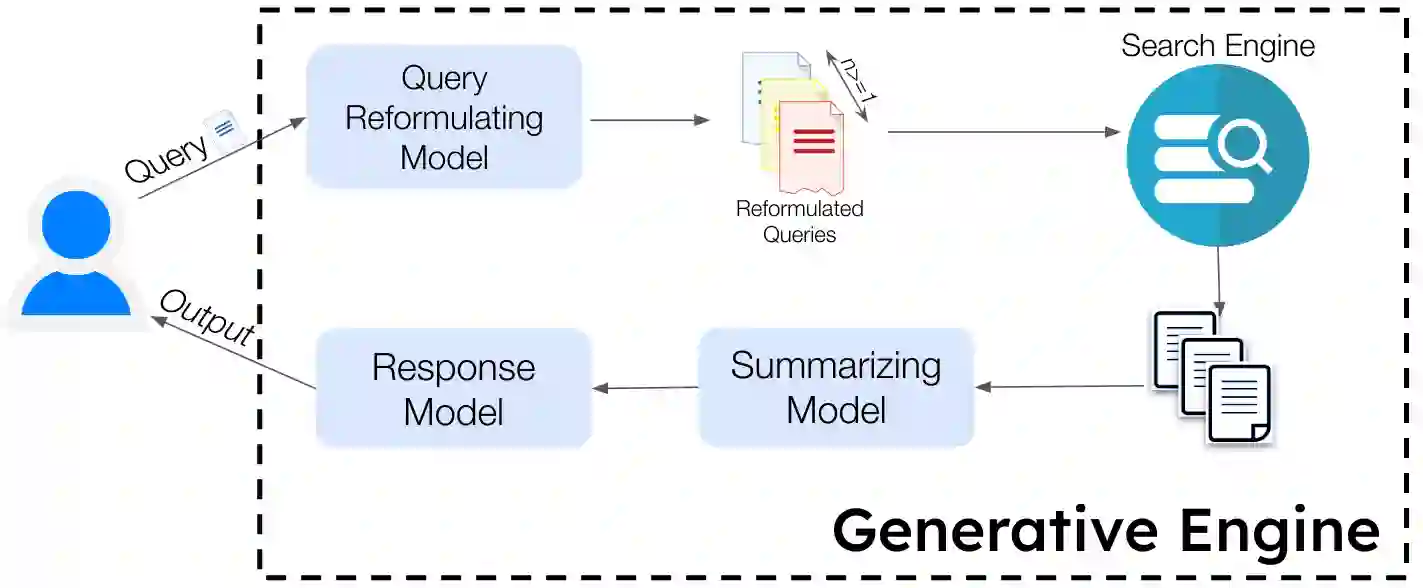
The advent of large language models (LLMs) has ushered in a new paradigm of search engines that use generative models to gather and summarize information to answer user queries. This emerging technology, which we formalize under the unified framework of generative engines (GEs), can generate accurate and personalized responses, rapidly replacing traditional search engines like Google and Bing. Generative Engines typically satisfy queries by synthesizing information from multiple sources and summarizing them using LLMs. While this shift significantly improves $\textit{user}$ utility and $\textit{generative search engine}$ traffic, it poses a huge challenge for the third stakeholder -- website and content creators. Given the black-box and fast-moving nature of generative engines, content creators have little to no control over $\textit{when}$ and $\textit{how}$ their content is displayed. With generative engines here to stay, we must ensure the creator economy is not disadvantaged. To address this, we introduce Generative Engine Optimization (GEO), the first novel paradigm to aid content creators in improving their content visibility in generative engine responses through a flexible black-box optimization framework for optimizing and defining visibility metrics. We facilitate systematic evaluation by introducing GEO-bench, a large-scale benchmark of diverse user queries across multiple domains, along with relevant web sources to answer these queries. Through rigorous evaluation, we demonstrate that GEO can boost visibility by up to $40\%$ in generative engine responses. Moreover, we show the efficacy of these strategies varies across domains, underscoring the need for domain-specific optimization methods. Our work opens a new frontier in information discovery systems, with profound implications for both developers of generative engines and content creators.


翻译:大型语言模型(LLM)的出现催生了搜索引擎的新范式,即利用生成模型收集并汇总信息以回答用户查询。这一新兴技术——我们将其统一形式化为生成式引擎(GE)框架——能够生成准确且个性化的响应,正迅速取代如Google和Bing等传统搜索引擎。生成式引擎通常通过综合多源信息并利用LLM进行摘要来满足查询需求。尽管这一转变显著提升了$\textit{用户}$效用和$\textit{生成式搜索引擎}$流量,却对第三方利益相关者——网站与内容创作者——构成了巨大挑战。鉴于生成式引擎的黑盒特性与快速演进本质,内容创作者对其内容$\textit{何时}$及$\textit{如何}$被展示几乎无法控制。随着生成式引擎的持续存在,我们必须确保创作者经济不受损害。为此,我们提出生成式引擎优化(GEO),这是首个通过灵活的黑盒优化框架来优化和定义可见性指标,以帮助内容创作者提升其内容在生成式引擎响应中可见性的新范式。我们通过引入GEO-bench促进系统化评估,该大规模基准涵盖多领域多样化用户查询及回答这些查询的相关网络资源。经严格评估,我们证明GEO可将生成式引擎响应中的内容可见性提升高达$40\%$。此外,我们发现这些策略的效果在不同领域间存在差异,凸显了领域特异性优化方法的必要性。本研究为信息发现系统开辟了新前沿,对生成式引擎开发者与内容创作者均具有深远意义。
0
下载
关闭预览

相关内容

《工程》是中国工程院(CAE)于2015年推出的国际开放存取期刊。其目的是提供一个高水平的平台,传播和分享工程研发的前沿进展、当前主要研究成果和关键成果;报告工程科学的进展,讨论工程发展的热点、兴趣领域、挑战和前景,在工程中考虑人与环境的福祉和伦理道德,鼓励具有深远经济和社会意义的工程突破和创新,使之达到国际先进水平,成为新的生产力,从而改变世界,造福人类,创造新的未来。 期刊链接:https://www.sciencedirect.com/journal/engineering
FlowQA: Grasping Flow in History for Conversational Machine Comprehension
专知会员服务
34+阅读 · 2019年10月18日
Stabilizing Transformers for Reinforcement Learning
专知会员服务
60+阅读 · 2019年10月17日
《DeepGCNs: Making GCNs Go as Deep as CNNs》
专知会员服务
32+阅读 · 2019年10月17日
Keras François Chollet 《Deep Learning with Python 》, 386页pdf
专知会员服务
164+阅读 · 2019年10月12日
【SIGGRAPH2019】TensorFlow 2.0深度学习计算机图形学应用
专知会员服务
41+阅读 · 2019年10月9日
Hierarchically Structured Meta-learning
CreateAMind
27+阅读 · 2019年5月22日
Transferring Knowledge across Learning Processes
CreateAMind
29+阅读 · 2019年5月18日
强化学习的Unsupervised Meta-Learning
CreateAMind
18+阅读 · 2019年1月7日
Unsupervised Learning via Meta-Learning
CreateAMind
44+阅读 · 2019年1月3日
meta learning 17年:MAML SNAIL
CreateAMind
11+阅读 · 2019年1月2日
disentangled-representation-papers
CreateAMind
26+阅读 · 2018年9月12日
STRCF for Visual Object Tracking
统计学习与视觉计算组
15+阅读 · 2018年5月29日
Hierarchical Imitation - Reinforcement Learning
CreateAMind
19+阅读 · 2018年5月25日
Focal Loss for Dense Object Detection
统计学习与视觉计算组
12+阅读 · 2018年3月15日
IJCAI | Cascade Dynamics Modeling with Attention-based RNN
KingsGarden
13+阅读 · 2017年7月16日
国家自然科学基金
13+阅读 · 2017年12月31日
国家自然科学基金
18+阅读 · 2017年12月31日
国家自然科学基金
2+阅读 · 2015年12月31日
国家自然科学基金
2+阅读 · 2015年12月31日
国家自然科学基金
0+阅读 · 2014年12月31日
国家自然科学基金
0+阅读 · 2014年12月31日
国家自然科学基金
5+阅读 · 2014年12月31日
国家自然科学基金
0+阅读 · 2014年12月31日
国家自然科学基金
2+阅读 · 2014年12月31日
国家自然科学基金
6+阅读 · 2014年12月31日
Arxiv
24+阅读 · 2024年2月23日
Arxiv
14+阅读 · 2023年9月27日
Arxiv
16+阅读 · 2023年6月6日
Arxiv
14+阅读 · 2022年8月25日
Arxiv
24+阅读 · 2021年1月25日
Arxiv
19+阅读 · 2021年1月14日
Arxiv
16+阅读 · 2020年2月6日
VIP会员
最新内容
《基于深度强化学习的反无人机技术研究》178页
“史诗怒火”行动与“AI中心战”模式的浮现
专知会员服务
4+阅读 · 6月10日
【CVPR2026教程】扩散模型的解析理解
专知会员服务
1+阅读 · 6月10日
马赛克战:俄乌战场透析
专知会员服务
15+阅读 · 6月10日
《利用人工智能增强军事决策》
专知会员服务
7+阅读 · 6月10日
《自动机器学习在军事数据耕耘法中的应用》
专知会员服务
8+阅读 · 6月10日
为何指挥所生存能力要求范式转变
专知会员服务
6+阅读 · 6月10日
打造“新蛛网”模式与高科技动员
专知会员服务
4+阅读 · 6月10日
“蛛网”行动一周年:远程无人机战争
专知会员服务
3+阅读 · 6月10日
【剑桥博士论文】智能体-环境协同优化
专知会员服务
9+阅读 · 6月9日
相关资讯
Hierarchically Structured Meta-learning
CreateAMind
27+阅读 · 2019年5月22日
Transferring Knowledge across Learning Processes
CreateAMind
29+阅读 · 2019年5月18日
强化学习的Unsupervised Meta-Learning
CreateAMind
18+阅读 · 2019年1月7日
Unsupervised Learning via Meta-Learning
CreateAMind
44+阅读 · 2019年1月3日
meta learning 17年:MAML SNAIL
CreateAMind
11+阅读 · 2019年1月2日
disentangled-representation-papers
CreateAMind
26+阅读 · 2018年9月12日
STRCF for Visual Object Tracking
统计学习与视觉计算组
15+阅读 · 2018年5月29日
Hierarchical Imitation - Reinforcement Learning
CreateAMind
19+阅读 · 2018年5月25日
Focal Loss for Dense Object Detection
统计学习与视觉计算组
12+阅读 · 2018年3月15日
IJCAI | Cascade Dynamics Modeling with Attention-based RNN
KingsGarden
13+阅读 · 2017年7月16日
相关论文
Arxiv
24+阅读 · 2024年2月23日
Arxiv
14+阅读 · 2023年9月27日
Arxiv
16+阅读 · 2023年6月6日
Arxiv
14+阅读 · 2022年8月25日
Arxiv
24+阅读 · 2021年1月25日
Arxiv
19+阅读 · 2021年1月14日
Arxiv
16+阅读 · 2020年2月6日
相关基金
国家自然科学基金
13+阅读 · 2017年12月31日
国家自然科学基金
18+阅读 · 2017年12月31日
国家自然科学基金
2+阅读 · 2015年12月31日
国家自然科学基金
2+阅读 · 2015年12月31日
国家自然科学基金
0+阅读 · 2014年12月31日
国家自然科学基金
0+阅读 · 2014年12月31日
国家自然科学基金
5+阅读 · 2014年12月31日
国家自然科学基金
0+阅读 · 2014年12月31日
国家自然科学基金
2+阅读 · 2014年12月31日
国家自然科学基金
6+阅读 · 2014年12月31日
Top
微信扫码咨询专知VIP会员