

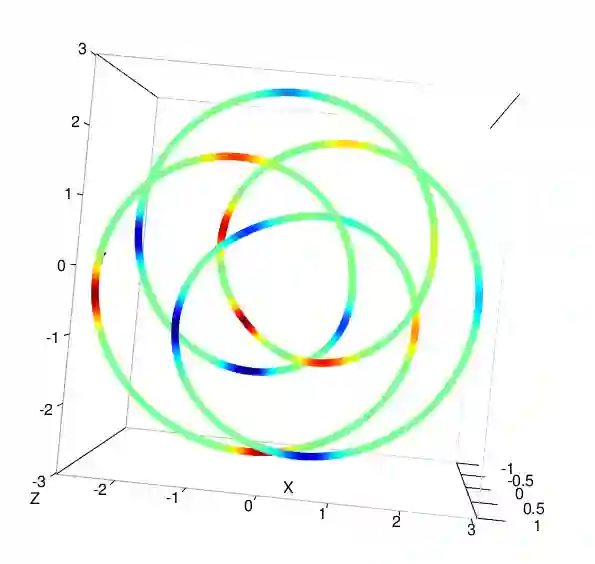
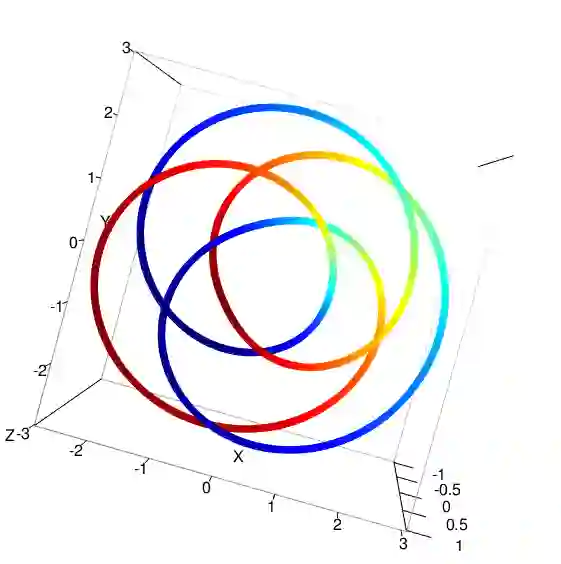
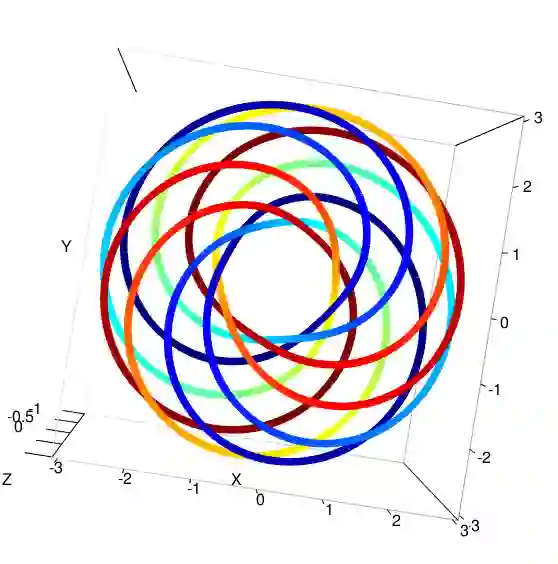
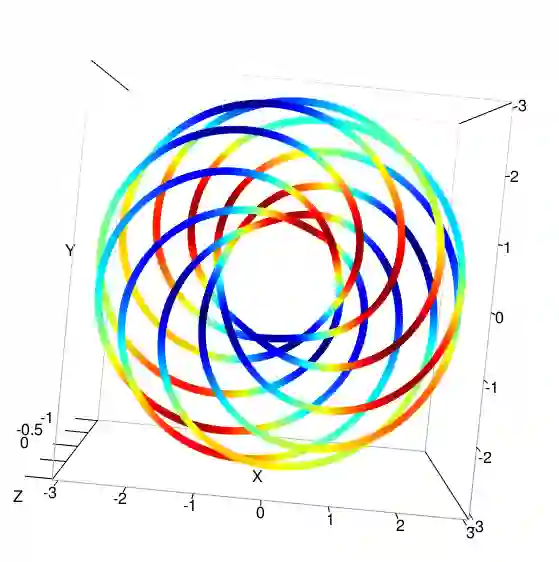
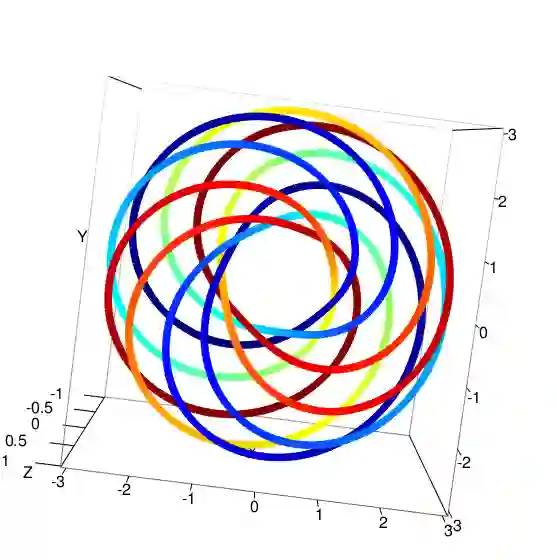
Amidst the growing interest in nonparametric regression, we address a significant challenge in Gaussian processes(GP) applied to manifold-based predictors. Existing methods primarily focus on low dimensional constrained domains for heat kernel estimation, limiting their effectiveness in higher-dimensional manifolds. Our research proposes an intrinsic approach for constructing GP on general manifolds such as orthogonal groups, unitary groups, Stiefel manifolds and Grassmannian manifolds. Our methodology estimates the heat kernel by simulating Brownian motion sample paths using the exponential map, ensuring independence from the manifold's embedding. The introduction of our strip algorithm, tailored for manifolds with extra symmetries, and the ball algorithm, designed for arbitrary manifolds, constitutes our significant contribution. Both algorithms are rigorously substantiated through theoretical proofs and numerical testing, with the strip algorithm showcasing remarkable efficiency gains over traditional methods. This intrinsic approach delivers several key advantages, including applicability to high dimensional manifolds, eliminating the requirement for global parametrization or embedding. We demonstrate its practicality through regression case studies (torus knots and eight dimensional projective spaces) and by developing binary classifiers for real world datasets (gorilla skulls planar images and diffusion tensor images). These classifiers outperform traditional methods, particularly in limited data scenarios.
翻译:在非参数回归日益受到关注的背景下,我们针对流形上高斯过程(GP)面临的一个重大挑战展开研究。现有方法主要侧重于低维约束域上的热核估计,限制了其在更高维流形上的有效性。我们的研究提出了一种构建一般流形(如正交群、酉群、Stiefel流形和Grassmann流形)上高斯过程的内在方法。该方法通过指数映射模拟布朗运动样本路径来估计热核,确保了对流形嵌入的独立性。我们引入了针对具有额外对称性流形的条带算法和针对任意流形的球算法,这是本研究的重要贡献。两个算法均通过理论证明和数值测试得到严格验证,其中条带算法在效率上相较于传统方法展现出显著优势。这种内在方法带来了若干关键优势,包括可适用于高维流形,无需全局参数化或嵌入。我们通过回归案例研究(环面纽结和八维射影空间)以及为真实世界数据集(大猩猩头骨平面图像和扩散张量图像)开发二元分类器,展示了该方法的实用性。这些分类器在数据稀缺场景下尤其优于传统方法。




相关内容




 微信扫码咨询专知VIP会员