

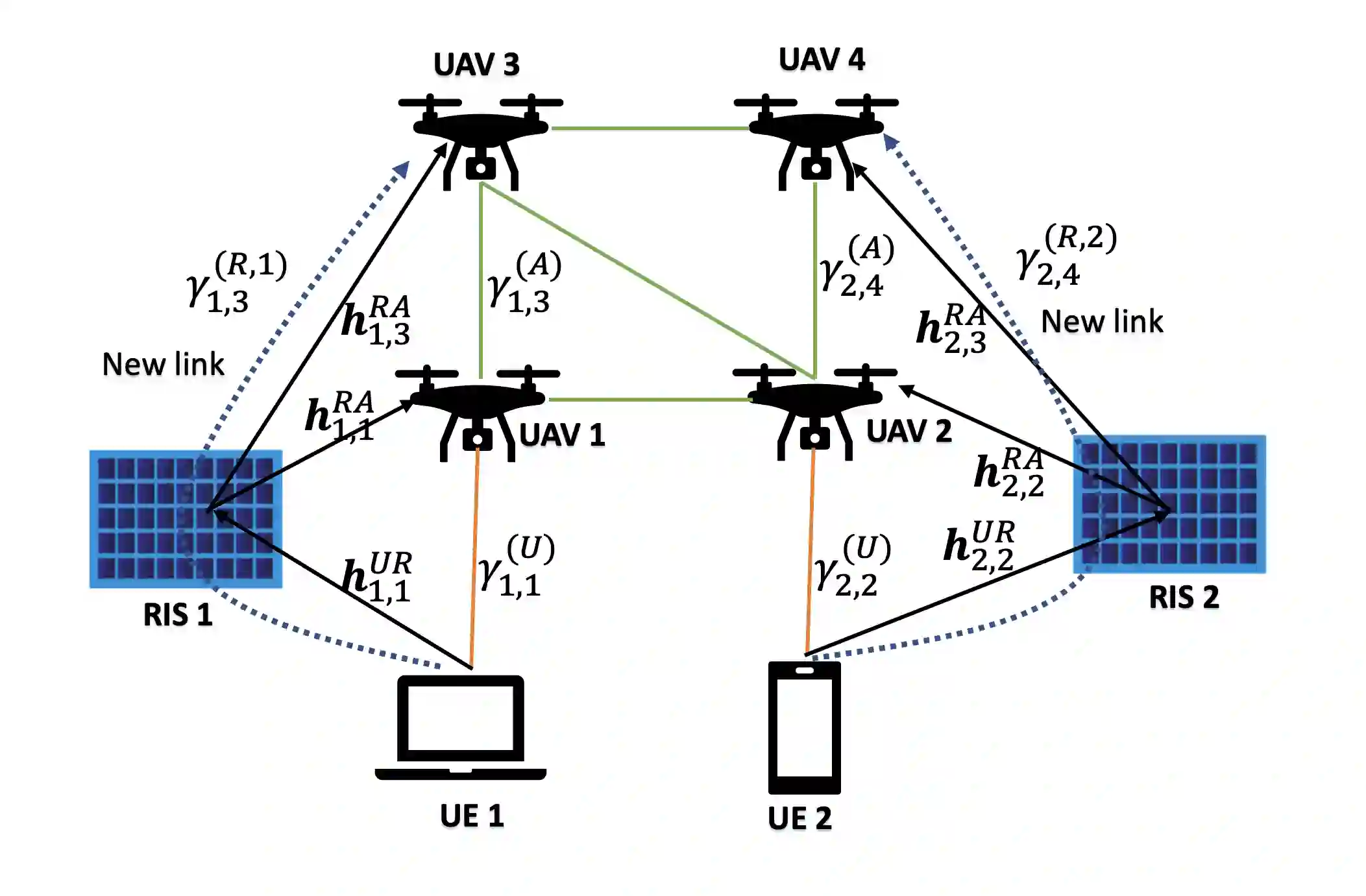
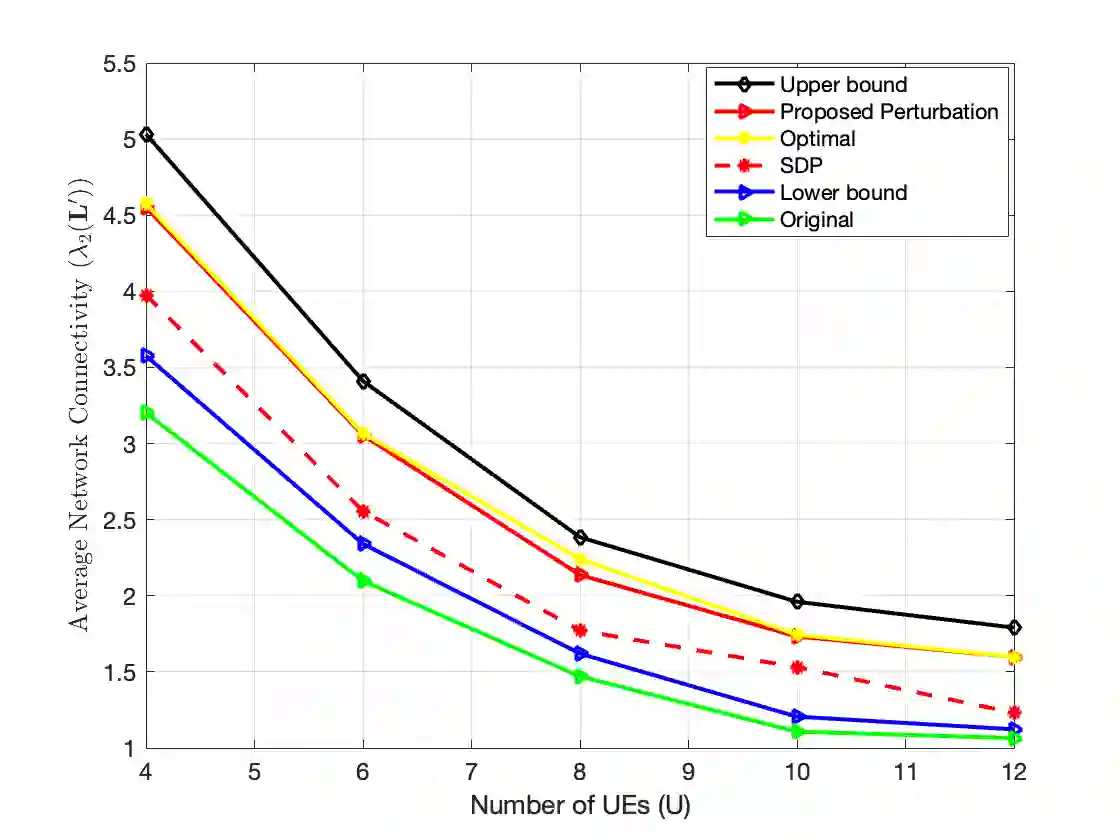
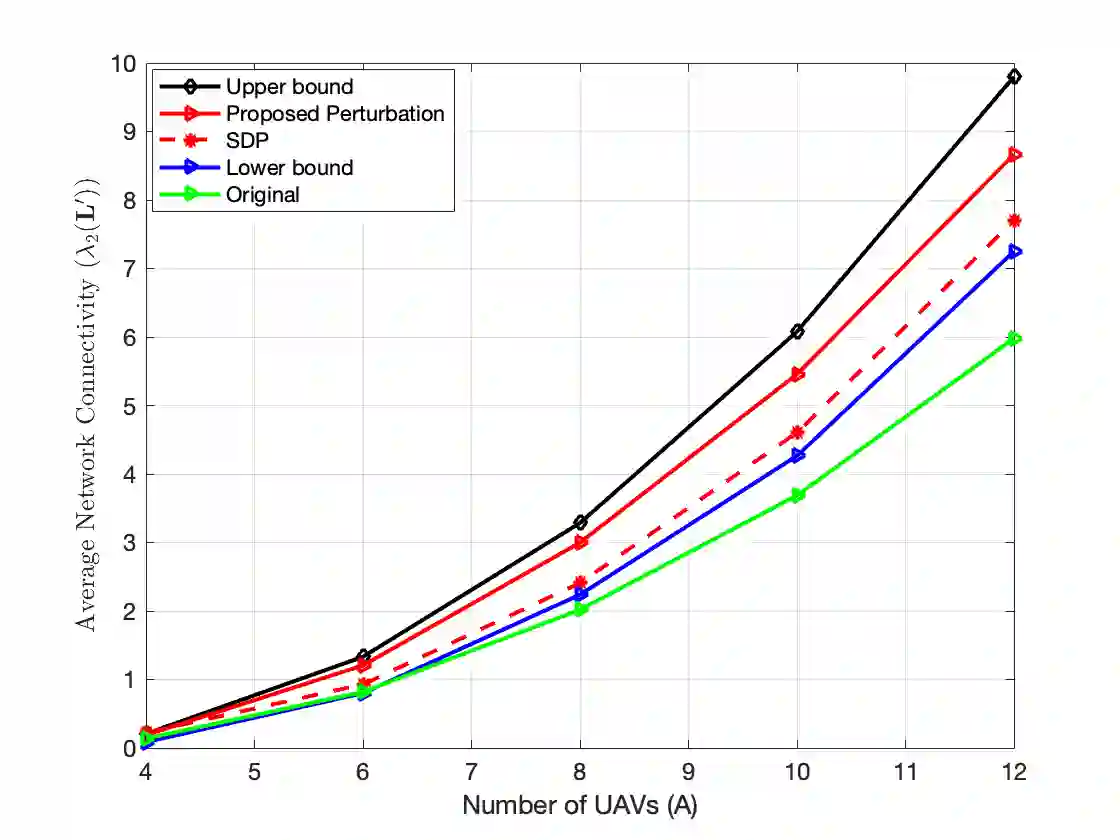
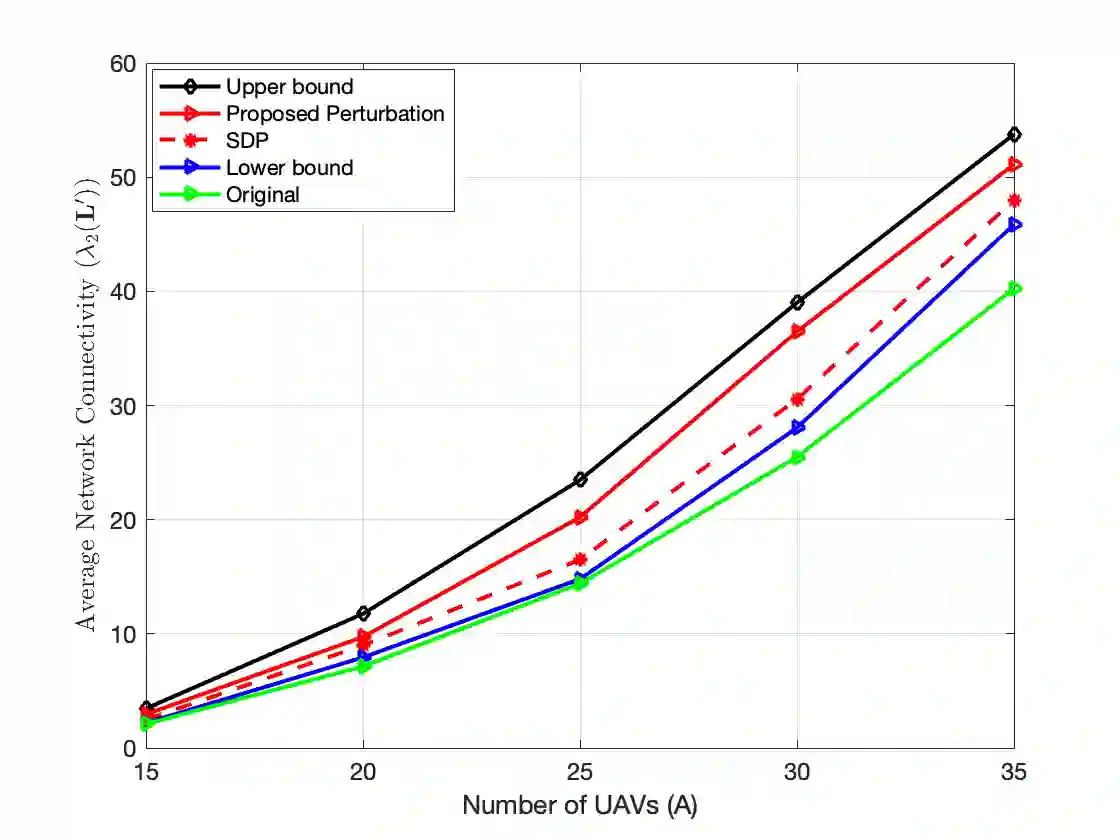
Reconfigurable intelligent surfaces (RISs) are expected to make future 6G networks more connected and resilient against node failures, due to their ability to introduce controllable phase-shifts onto impinging electromagnetic waves and impose link redundancy. Meanwhile, unmanned aerial vehicles (UAVs) are prone to failure due to limited energy, random failures, or targeted failures, which causes network disintegration that results in information delivery loss. In this paper, we show that the integration between UAVs and RISs for improving network connectivity is crucial. We utilize RISs to provide path diversity and alternative connectivity options for information flow from user equipments (UEs) to less critical UAVs by adding more links to the network, thereby making the network more resilient and connected. To that end, we first define the criticality of UAV nodes, which reflects the importance of some nodes over other nodes. We then employ the algebraic connectivity metric, which is adjusted by the reflected links of the RISs and their criticality weights, to formulate the problem of maximizing the network connectivity. Such problem is a computationally expensive combinatorial optimization. To tackle this problem, we propose a relaxation method such that the discrete scheduling constraint of the problem is relaxed and becomes continuous. Leveraging this, we propose two efficient solutions, namely semi-definite programming (SDP) optimization and perturbation heuristic, which both solve the problem in polynomial time. For the perturbation heuristic, we derive the lower and upper bounds of the algebraic connectivity obtained by adding new links to the network. Finally, we corroborate the effectiveness of the proposed solutions through extensive simulation experiments.
翻译:可重构智能表面(RIS)凭借其可控入射电磁波相位偏移及引入链路冗余的能力,有望使未来6G网络更具连通性与抗节点失效韧性。与此同时,无人机(UAV)因能量受限、随机故障或定向攻击而易发生失效,导致网络分裂并造成信息传递损失。本文证明无人机与可重构智能表面的融合对于提升网络连通性至关重要。我们通过可重构智能表面为网络增加链路,为用户设备(UE)向非关键无人机传输信息流提供路径分集与替代连接方案,从而增强网络韧性与连通性。为此,首先定义无人机节点关键性指标,该指标反映不同节点的重要程度差异;随后采用经可重构智能表面反射链路及其关键性权重修正的代数连通度指标,建立最大化网络连通性的数学模型。该问题属于计算代价高昂的组合优化问题,通过松弛方法将问题中的离散调度约束转化为连续形式进行求解。基于此,我们提出两种高效解法:半定规划(SDP)优化法与摄动启发式算法,两者均可在多项式时间内完成求解。针对摄动启发式算法,推导了新增链路后代数连通度的上下界。最后通过大量仿真实验验证了所提方案的有效性。




相关内容





 微信扫码咨询专知VIP会员