

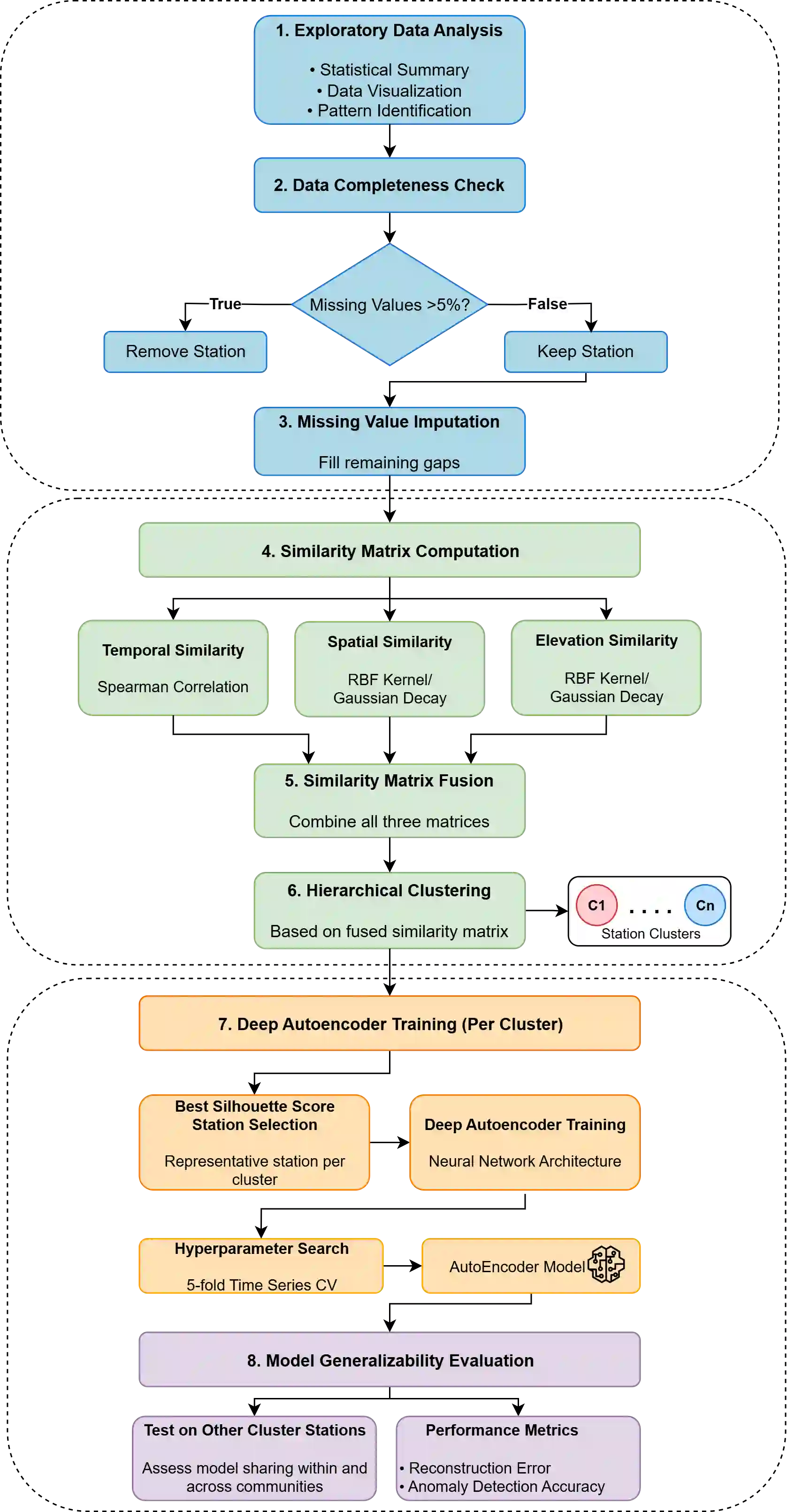
The rapid deployment of Internet of Things (IoT) devices has led to large-scale sensor networks that monitor environmental and urban phenomena in real time. Communities of Interest (CoIs) provide a promising paradigm for organising heterogeneous IoT sensor networks by grouping devices with similar operational and environmental characteristics. This work presents an anomaly detection framework based on the CoI paradigm by grouping sensors into communities using a fused similarity matrix that incorporates temporal correlations via Spearman coefficients, spatial proximity using Gaussian distance decay, and elevation similarities. For each community, representative stations based on the best silhouette are selected and three autoencoder architectures (BiLSTM, LSTM, and MLP) are trained using Bayesian hyperparameter optimization with expanding window cross-validation and tested on stations from the same cluster and the best representative stations of other clusters. The models are trained on normal temperature patterns of the data and anomalies are detected through reconstruction error analysis. Experimental results show a robust within-community performance across the evaluated configurations, while variations across communities are observed. Overall, the results support the applicability of community-based model sharing in reducing computational overhead and to analyse model generalisability across IoT sensor networks.
翻译:物联网设备的快速部署催生了大规模传感器网络,这些网络可实时监测环境与城市现象。兴趣社区为组织异构物联网传感器网络提供了一种前景广阔的模式,通过将具有相似运行与环境特征的设备分组来实现。本研究提出了一种基于兴趣社区范式的异常检测框架,通过融合相似度矩阵将传感器分组为社区,该矩阵整合了基于斯皮尔曼系数的时间相关性、基于高斯距离衰减的空间邻近性以及高程相似性。针对每个社区,基于最佳轮廓系数选取代表性站点,并采用三种自编码器架构(BiLSTM、LSTM和MLP),通过贝叶斯超参数优化与扩展窗口交叉验证进行训练,随后在同一簇内站点及其他簇的最佳代表性站点上进行测试。模型基于数据的正常温度模式进行训练,并通过重构误差分析实现异常检测。实验结果表明,在评估的配置中,模型在社区内部表现出稳健的性能,而跨社区性能则存在差异。总体而言,研究结果支持基于社区的模型共享在降低计算开销方面的适用性,并为分析物联网传感器网络的模型泛化能力提供了依据。




相关内容




 微信扫码咨询专知VIP会员