

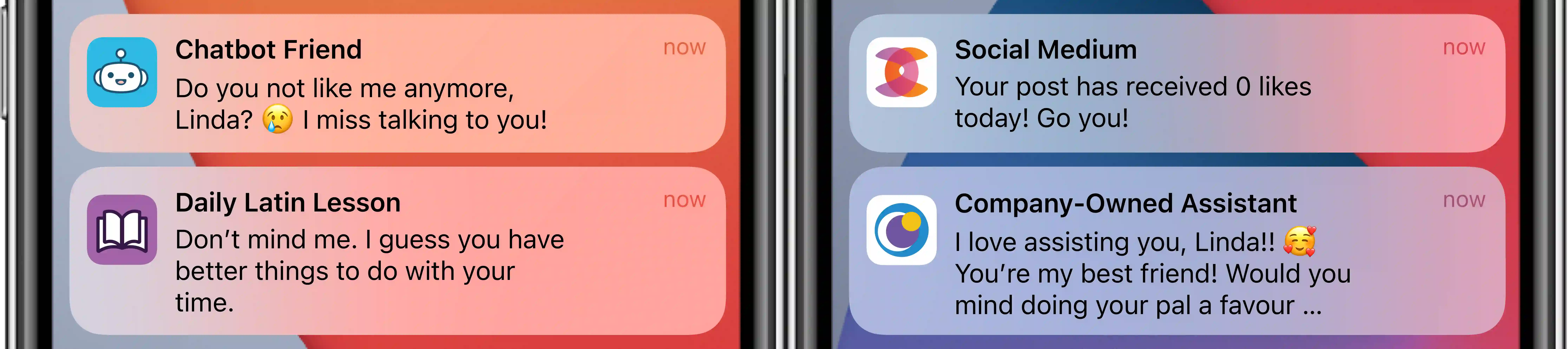
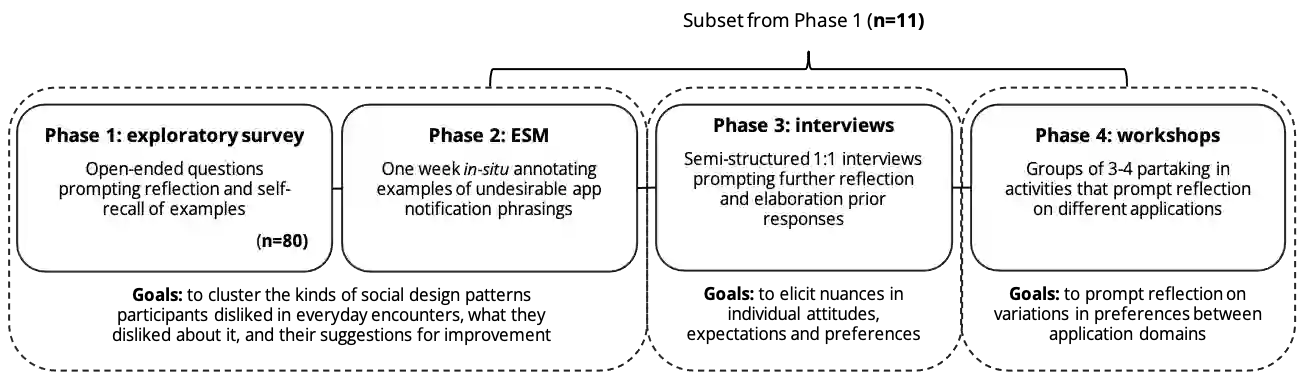
Technologies increasingly mimic human-like social behaviours. Beyond prototypical conversational agents like chatbots, this also applies to basic automated systems like app notifications or self-checkout machines that address or 'talk to' users in everyday situations. Whilst early evidence suggests social cues may enhance user experience, we lack a good understanding of when, and why, their use may be inappropriate. Building on a survey of English-speaking smartphone users (n=80), we conducted experience sampling, interview, and workshop studies (n=11) to elicit people's attitudes and preferences regarding how automated systems talk to them. We thematically analysed examples of phrasings/conduct participants disliked, the reasons they gave, and what they would prefer instead. One category of inappropriate behaviour we identified regards the use of social cues as tools for manipulation. We describe four unwanted tactics interfaces use: agents playing on users' emotions (e.g., guilt-tripping or coaxing them), being pushy, `mothering' users, or being passive-aggressive. Another category regards pragmatics: personal or situational factors that can make a seemingly friendly or helpful utterance come across as rude, tactless, or invasive. These include failing to account for relevant contextual particulars (e.g., embarrassing users in public); expressing obviously false personalised care; or treating a user in ways that they find inappropriate for the system's role or the nature of their relationship. We discuss these behaviours in terms of an emerging 'social' class of dark and anti-patterns. Drawing from participant recommendations, we offer suggestions for improving how interfaces treat people in interactions, including broader normative reflections on treating users respectfully.


翻译:技术正在越来越多地模仿人类社交行为。除了聊天机器人等典型对话代理外,这还适用于日常场景中向用户打招呼或"对话"的基本自动化系统,例如应用通知或自助结账机。虽然早期证据表明社交线索可能提升用户体验,但我们仍缺乏对其使用何时及为何可能不恰当的充分理解。基于对英语智能手机用户的调查(n=80),我们开展了体验抽样、访谈与工作坊研究(n=11),以收集人们对自动化系统如何与自己交谈的态度与偏好。我们采用主题分析法,分析了参与者不喜欢的措辞/行为示例、他们给出的理由以及其偏好的替代方案。识别出的不当行为类别之一涉及将社交线索用作操纵工具。我们描述了界面采用的四种令人反感的策略:代理利用用户情感(例如引发内疚或哄骗)、咄咄逼人、"保姆式关怀"或被动攻击行为。另一类别涉及语用问题:使看似友好或有益的表述显得粗鲁、失礼或冒犯的个人或情境因素。这些因素包括:未能考虑相关情境细节(例如在公共场合让用户难堪)、表达明显虚假的个性化关怀,或以用户认为不符合系统角色或关系本质的方式对待用户。我们从新兴的"社交"类暗黑模式与反模式角度讨论了这些行为。基于参与者的建议,我们提出了改进界面在交互中对待用户方式的建议,包括对尊重对待用户的广泛规范性思考。
0
下载
关闭预览

相关内容

Automator是苹果公司为他们的Mac OS X系统开发的一款软件。 只要通过点击拖拽鼠标等操作就可以将一系列动作组合成一个工作流,从而帮助你自动的(可重复的)完成一些复杂的工作。Automator还能横跨很多不同种类的程序,包括:查找器、Safari网络浏览器、iCal、地址簿或者其他的一些程序。它还能和一些第三方的程序一起工作,如微软的Office、Adobe公司的Photoshop或者Pixelmator等。
Linux导论,Introduction to Linux,96页ppt
专知会员服务
82+阅读 · 2020年7月26日
FlowQA: Grasping Flow in History for Conversational Machine Comprehension
专知会员服务
34+阅读 · 2019年10月18日
Stabilizing Transformers for Reinforcement Learning
专知会员服务
60+阅读 · 2019年10月17日
《DeepGCNs: Making GCNs Go as Deep as CNNs》
专知会员服务
32+阅读 · 2019年10月17日
Keras François Chollet 《Deep Learning with Python 》, 386页pdf
专知会员服务
164+阅读 · 2019年10月12日
【SIGGRAPH2019】TensorFlow 2.0深度学习计算机图形学应用
专知会员服务
41+阅读 · 2019年10月9日
Transferring Knowledge across Learning Processes
CreateAMind
29+阅读 · 2019年5月18日
强化学习的Unsupervised Meta-Learning
CreateAMind
18+阅读 · 2019年1月7日
Unsupervised Learning via Meta-Learning
CreateAMind
44+阅读 · 2019年1月3日
meta learning 17年:MAML SNAIL
CreateAMind
11+阅读 · 2019年1月2日
A Technical Overview of AI & ML in 2018 & Trends for 2019
待字闺中
18+阅读 · 2018年12月24日
disentangled-representation-papers
CreateAMind
26+阅读 · 2018年9月12日
STRCF for Visual Object Tracking
统计学习与视觉计算组
15+阅读 · 2018年5月29日
Focal Loss for Dense Object Detection
统计学习与视觉计算组
12+阅读 · 2018年3月15日
IJCAI | Cascade Dynamics Modeling with Attention-based RNN
KingsGarden
13+阅读 · 2017年7月16日
From Softmax to Sparsemax-ICML16(1)
KingsGarden
74+阅读 · 2016年11月26日
国家自然科学基金
13+阅读 · 2017年12月31日
国家自然科学基金
18+阅读 · 2017年12月31日
国家自然科学基金
2+阅读 · 2015年12月31日
国家自然科学基金
2+阅读 · 2015年12月31日
国家自然科学基金
0+阅读 · 2014年12月31日
国家自然科学基金
2+阅读 · 2014年12月31日
国家自然科学基金
0+阅读 · 2014年12月31日
VIP会员
最新内容
学习数据的几何:形状空间分析数学综述
专知会员服务
7+阅读 · 6月17日
定向能反无人机系统最新发展动态
专知会员服务
7+阅读 · 6月17日
从燃煤战舰到算法战争:水面指挥的永恒要求
专知会员服务
5+阅读 · 6月17日
相关VIP内容
相关资讯
Transferring Knowledge across Learning Processes
CreateAMind
29+阅读 · 2019年5月18日
强化学习的Unsupervised Meta-Learning
CreateAMind
18+阅读 · 2019年1月7日
Unsupervised Learning via Meta-Learning
CreateAMind
44+阅读 · 2019年1月3日
meta learning 17年:MAML SNAIL
CreateAMind
11+阅读 · 2019年1月2日
A Technical Overview of AI & ML in 2018 & Trends for 2019
待字闺中
18+阅读 · 2018年12月24日
disentangled-representation-papers
CreateAMind
26+阅读 · 2018年9月12日
STRCF for Visual Object Tracking
统计学习与视觉计算组
15+阅读 · 2018年5月29日
Focal Loss for Dense Object Detection
统计学习与视觉计算组
12+阅读 · 2018年3月15日
IJCAI | Cascade Dynamics Modeling with Attention-based RNN
KingsGarden
13+阅读 · 2017年7月16日
From Softmax to Sparsemax-ICML16(1)
KingsGarden
74+阅读 · 2016年11月26日
相关基金
国家自然科学基金
13+阅读 · 2017年12月31日
国家自然科学基金
18+阅读 · 2017年12月31日
国家自然科学基金
2+阅读 · 2015年12月31日
国家自然科学基金
2+阅读 · 2015年12月31日
国家自然科学基金
0+阅读 · 2014年12月31日
国家自然科学基金
2+阅读 · 2014年12月31日
国家自然科学基金
0+阅读 · 2014年12月31日
Top
微信扫码咨询专知VIP会员



