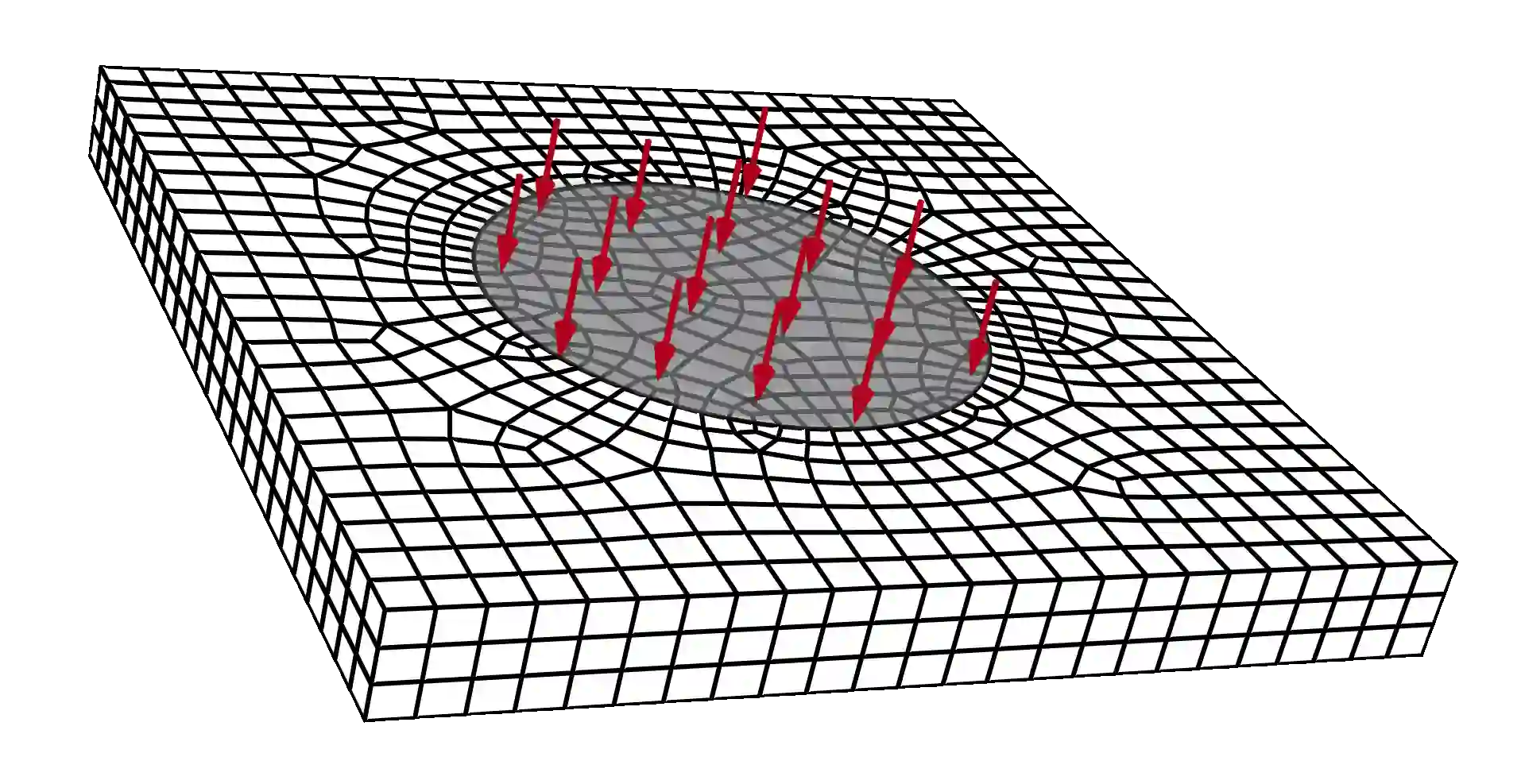
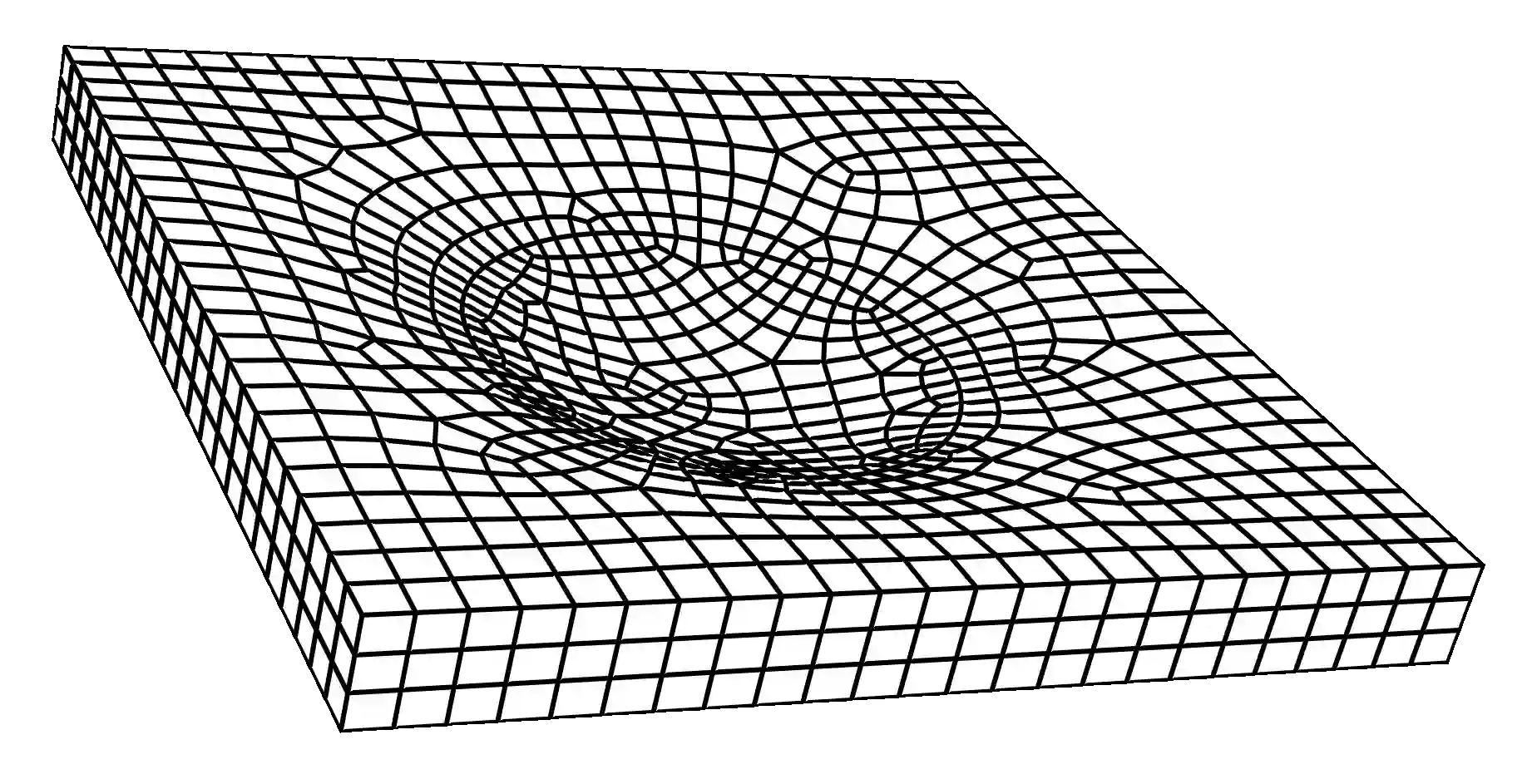
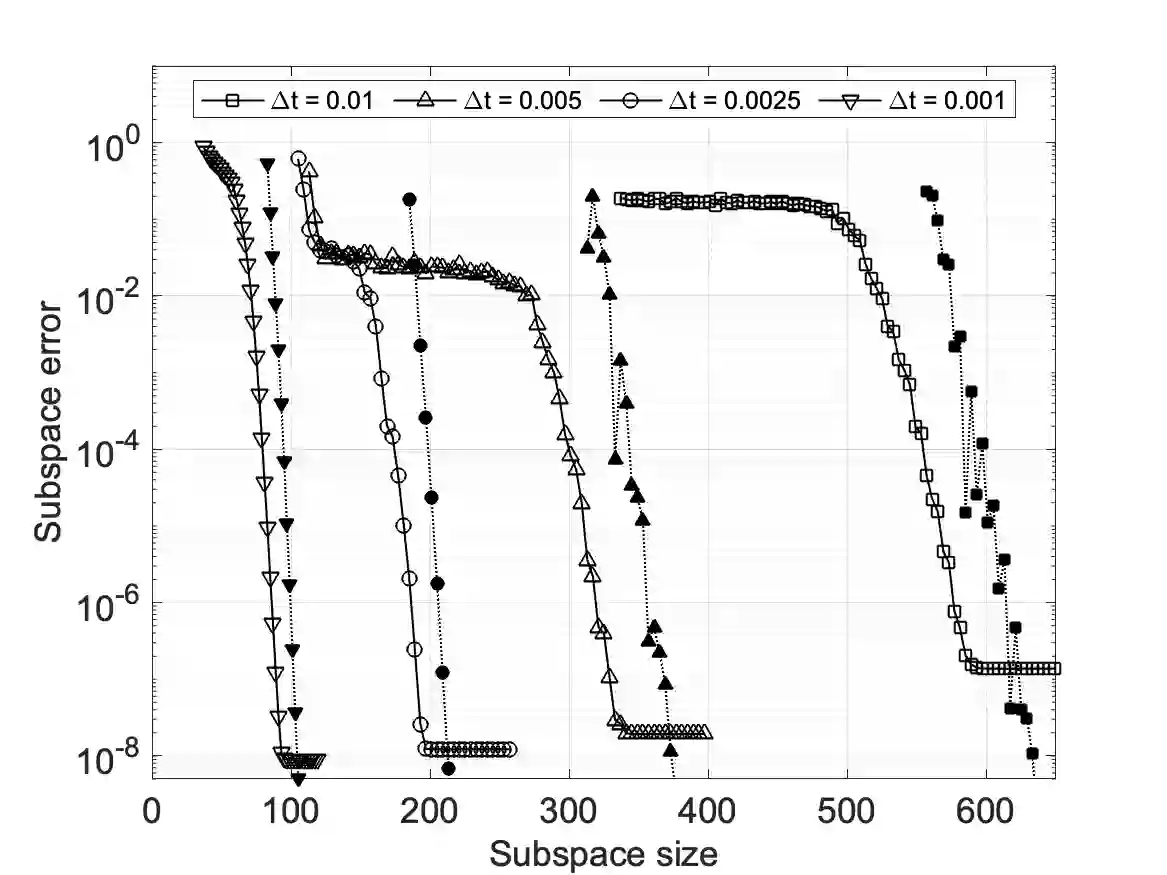
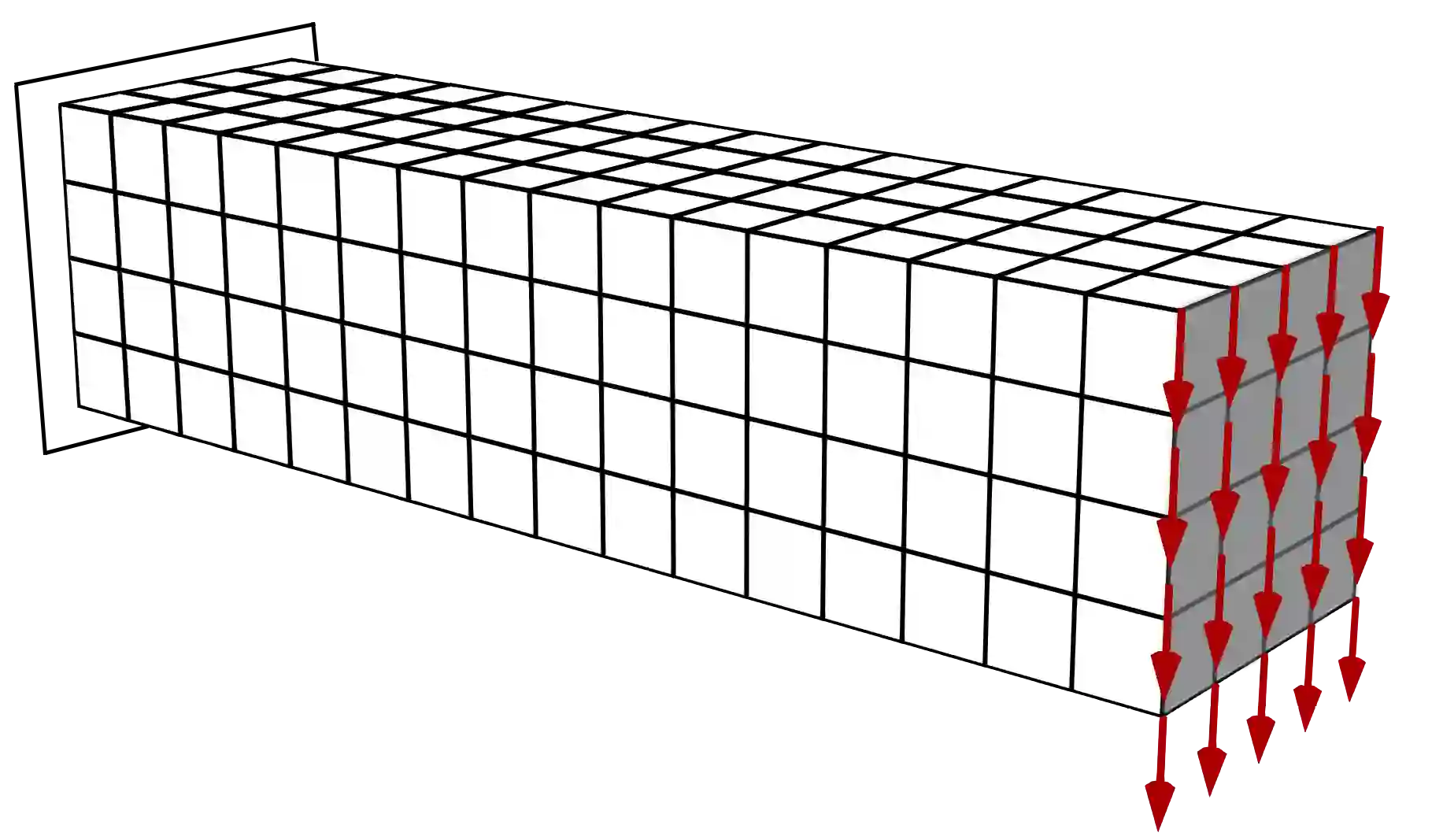
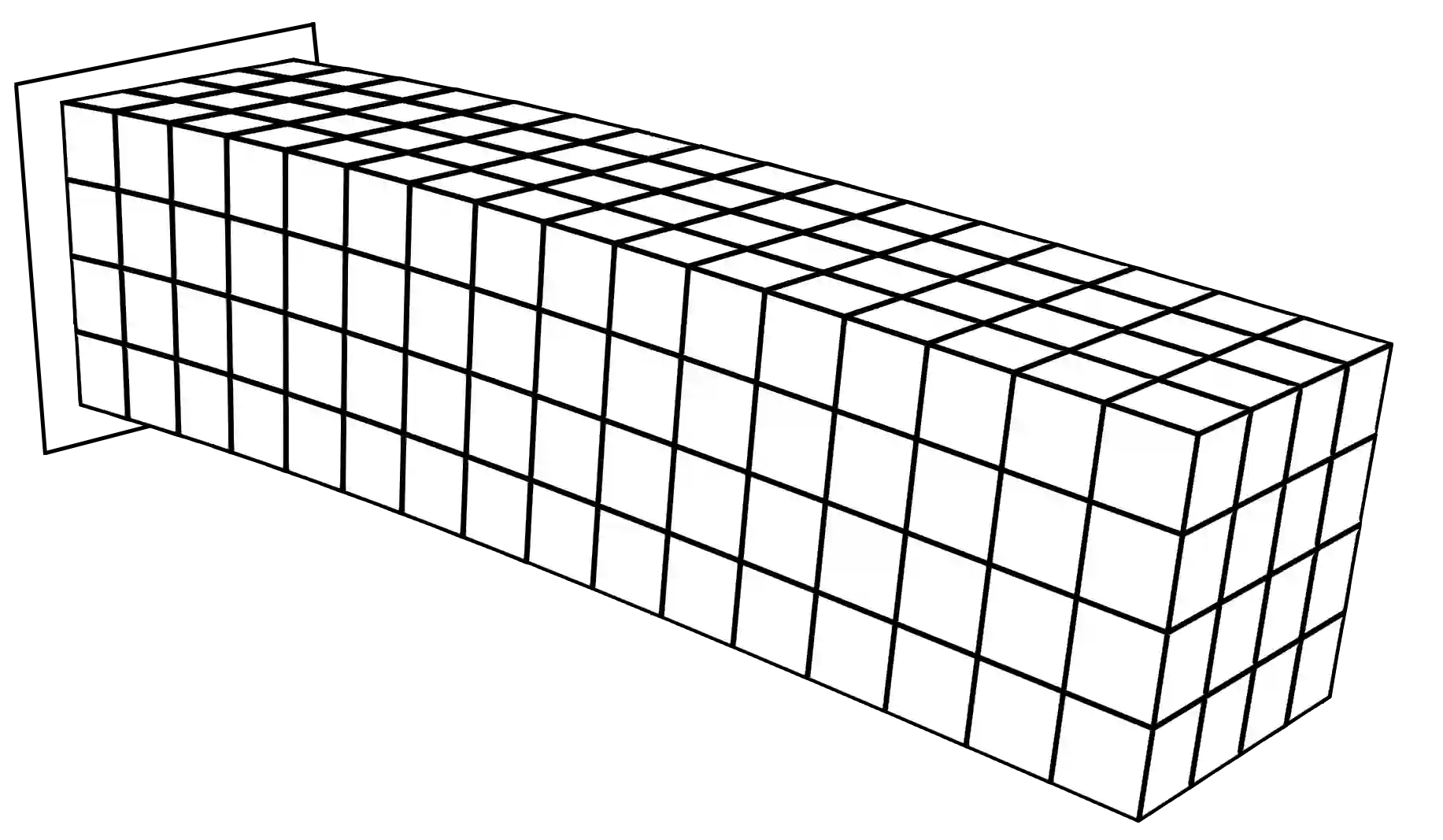
We propose a computationally efficient and systematically convergent approach for elastodynamics simulations. We recast the second-order dynamical equation of elastodynamics into an equivalent first-order system of coupled equations, so as to express the solution in the form of a Magnus expansion. With any spatial discretization, it entails computing the exponential of a matrix acting upon a vector. We employ an adaptive Krylov subspace approach to inexpensively and and accurately evaluate the action of the exponential matrix on a vector. In particular, we use an apriori error estimate to predict the optimal Kyrlov subspace size required for each time-step size. We show that the Magnus expansion truncated after its first term provides quadratic and superquadratic convergence in the time-step for nonlinear and linear elastodynamics, respectively. We demonstrate the accuracy and efficiency of the proposed method for one linear (linear cantilever beam) and three nonlinear (nonlinear cantilever beam, soft tissue elastomer, and hyperelastic rubber) benchmark systems. For a desired accuracy in energy, displacement, and velocity, our method allows for $10-100\times$ larger time-steps than conventional time-marching schemes such as Newmark-$\beta$ method. Computationally, it translates to a $\sim$$1000\times$ and $\sim$$10-100\times$ speed-up over conventional time-marching schemes for linear and nonlinear elastodynamics, respectively.


翻译:我们提出了一种计算高效且系统收敛的弹性动力学模拟方法。通过将弹性动力学二阶运动方程转化为等价的耦合方程一阶系统,我们将解表示为马格努斯展开形式。在任意空间离散化条件下,该方法需计算矩阵指数作用于向量的结果。我们采用自适应Krylov子空间方法,以低成本且高精度地评估指数矩阵对向量的作用。特别地,我们利用先验误差估计预测每个时间步长所需的最优Krylov子空间维度。研究表明,截断至首项的马格努斯展开在非线性与线性弹性动力学中分别实现时间步长的二次与超二次收敛。我们通过一个线性(线性悬臂梁)和三个非线性(非线性悬臂梁、软组织弹性体、超弹性橡胶)基准系统验证了该方法的精度与效率。在能量、位移和速度达到目标精度的条件下,本方法允许采用比Newmark-β法等传统时间推进方法大10-100倍的时间步长。计算效率方面,该方法在线性弹性动力学中实现约1000倍加速,在非线性弹性动力学中实现约10-100倍加速。
0
下载
关闭预览

相关内容

【ACL2020】多模态信息抽取,365页ppt
专知会员服务
151+阅读 · 2020年7月6日
Keras François Chollet 《Deep Learning with Python 》, 386页pdf
专知会员服务
164+阅读 · 2019年10月12日
强化学习最新教程,17页pdf
专知会员服务
182+阅读 · 2019年10月11日
【SIGGRAPH2019】TensorFlow 2.0深度学习计算机图形学应用
专知会员服务
41+阅读 · 2019年10月9日
RL解决'BipedalWalkerHardcore-v2' (SOTA)
CreateAMind
31+阅读 · 2019年7月17日
强化学习的Unsupervised Meta-Learning
CreateAMind
18+阅读 · 2019年1月7日
meta learning 17年:MAML SNAIL
CreateAMind
11+阅读 · 2019年1月2日
disentangled-representation-papers
CreateAMind
26+阅读 · 2018年9月12日
论文浅尝 | 利用 RNN 和 CNN 构建基于 FreeBase 的问答系统
开放知识图谱
11+阅读 · 2018年4月25日
Layer Normalization原理及其TensorFlow实现
深度学习每日摘要
32+阅读 · 2017年6月17日
国家自然科学基金
2+阅读 · 2015年12月31日
国家自然科学基金
0+阅读 · 2015年12月31日
国家自然科学基金
1+阅读 · 2015年12月31日
国家自然科学基金
47+阅读 · 2015年12月31日
国家自然科学基金
0+阅读 · 2015年12月31日
国家自然科学基金
3+阅读 · 2015年12月31日
国家自然科学基金
0+阅读 · 2014年12月31日
国家自然科学基金
0+阅读 · 2014年12月31日
国家自然科学基金
1+阅读 · 2014年12月31日
国家自然科学基金
5+阅读 · 2014年12月31日
Arxiv
18+阅读 · 2021年3月16日
A survey on deep hashing for image retrieval
Arxiv
15+阅读 · 2020年6月10日
Optimization for deep learning: theory and algorithms
Arxiv
106+阅读 · 2019年12月19日
Augmentation for small object detection
Arxiv
13+阅读 · 2019年2月19日
Arxiv
11+阅读 · 2018年7月31日
VIP会员
最新内容
从燃煤战舰到算法战争:水面指挥的永恒要求
专知会员服务
0+阅读 · 23分钟前
《通过小型无人机系统将情报能力“作战化”》
消耗优势:美军的“精确规模化”概念
专知会员服务
8+阅读 · 6月15日
相关资讯
RL解决'BipedalWalkerHardcore-v2' (SOTA)
CreateAMind
31+阅读 · 2019年7月17日
强化学习的Unsupervised Meta-Learning
CreateAMind
18+阅读 · 2019年1月7日
meta learning 17年:MAML SNAIL
CreateAMind
11+阅读 · 2019年1月2日
disentangled-representation-papers
CreateAMind
26+阅读 · 2018年9月12日
论文浅尝 | 利用 RNN 和 CNN 构建基于 FreeBase 的问答系统
开放知识图谱
11+阅读 · 2018年4月25日
Layer Normalization原理及其TensorFlow实现
深度学习每日摘要
32+阅读 · 2017年6月17日
相关基金
国家自然科学基金
2+阅读 · 2015年12月31日
国家自然科学基金
0+阅读 · 2015年12月31日
国家自然科学基金
1+阅读 · 2015年12月31日
国家自然科学基金
47+阅读 · 2015年12月31日
国家自然科学基金
0+阅读 · 2015年12月31日
国家自然科学基金
3+阅读 · 2015年12月31日
国家自然科学基金
0+阅读 · 2014年12月31日
国家自然科学基金
0+阅读 · 2014年12月31日
国家自然科学基金
1+阅读 · 2014年12月31日
国家自然科学基金
5+阅读 · 2014年12月31日
Top
微信扫码咨询专知VIP会员