

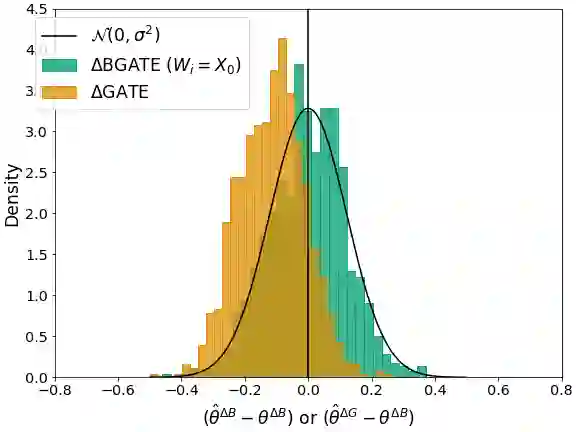
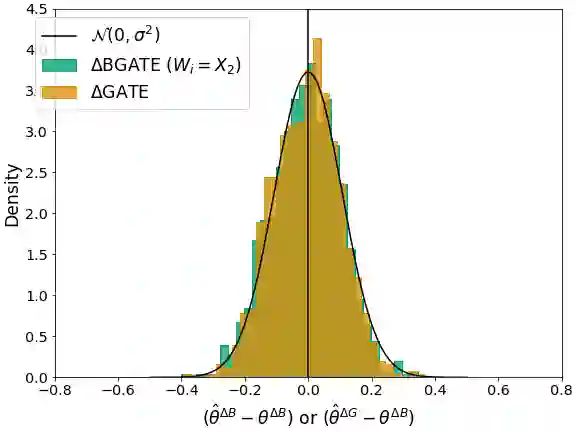
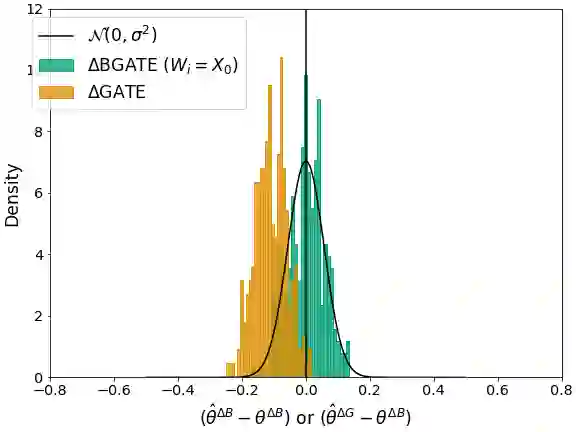
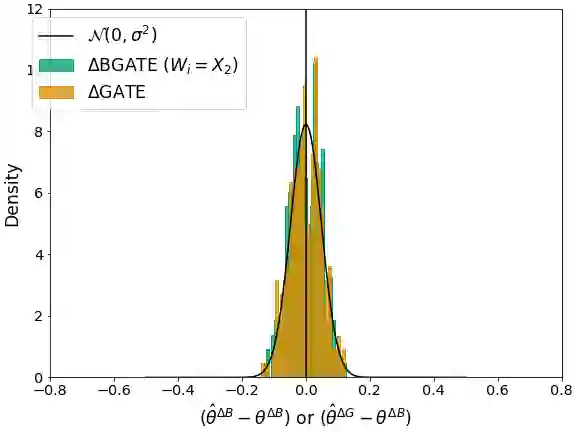
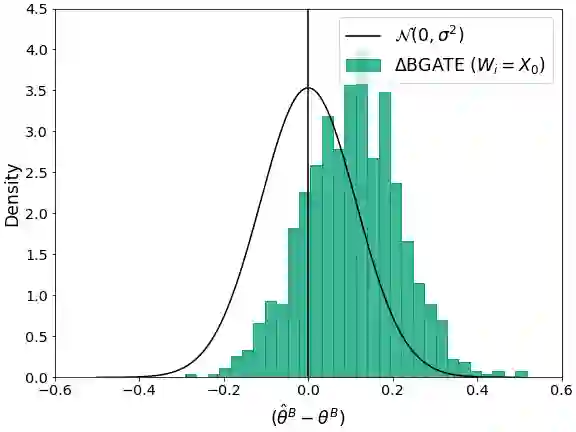
It is valuable for any decision maker to know the impact of decisions (treatments) on average and for subgroups. The causal machine learning literature has recently provided tools for estimating group average treatment effects (GATE) to understand treatment heterogeneity better. This paper addresses the challenge of interpreting such differences in treatment effects between groups while accounting for variations in other covariates. We propose a new parameter, the balanced group average treatment effect (BGATE), which measures a GATE with a specific distribution of a priori-determined covariates. By taking the difference of two BGATEs, we can analyse heterogeneity more meaningfully than by comparing two GATEs. The estimation strategy for this parameter is based on double/debiased machine learning for discrete treatments in an unconfoundedness setting, and the estimator is shown to be $\sqrt{N}$-consistent and asymptotically normal under standard conditions. Adding additional identifying assumptions allows specific balanced differences in treatment effects between groups to be interpreted causally, leading to the causal balanced group average treatment effect. We explore the finite sample properties in a small-scale simulation study and demonstrate the usefulness of these parameters in an empirical example.
翻译:对于任何决策者而言,了解决策(处理)对整体及子群的平均影响都具有重要价值。因果机器学习领域近期提供了估算群体平均处理效应(GATE)的工具,以更深入地理解处理异质性。本文旨在解决在考虑其他协变量差异时,如何解释不同群体间处理效应差异这一挑战性问题。我们提出一个新参数——平衡群体平均处理效应(BGATE),该参数通过预设协变量的特定分布来度量GATE。通过比较两个BGATE的差值,可以比直接比较两个GATE更有效地分析异质性。该参数的估计策略基于无混杂假设条件下离散处理的双重/去偏机器学习框架,且理论上证明了该估计量在标准条件下具有$\sqrt{N}$一致性和渐近正态性。通过附加识别性假设,群体间处理效应的特定平衡差值可获得因果解释,进而定义因果平衡群体平均处理效应。我们通过小规模仿真实验探索了参数的有限样本性质,并在实证案例中展示了这些参数的应用价值。




相关内容




 微信扫码咨询专知VIP会员