

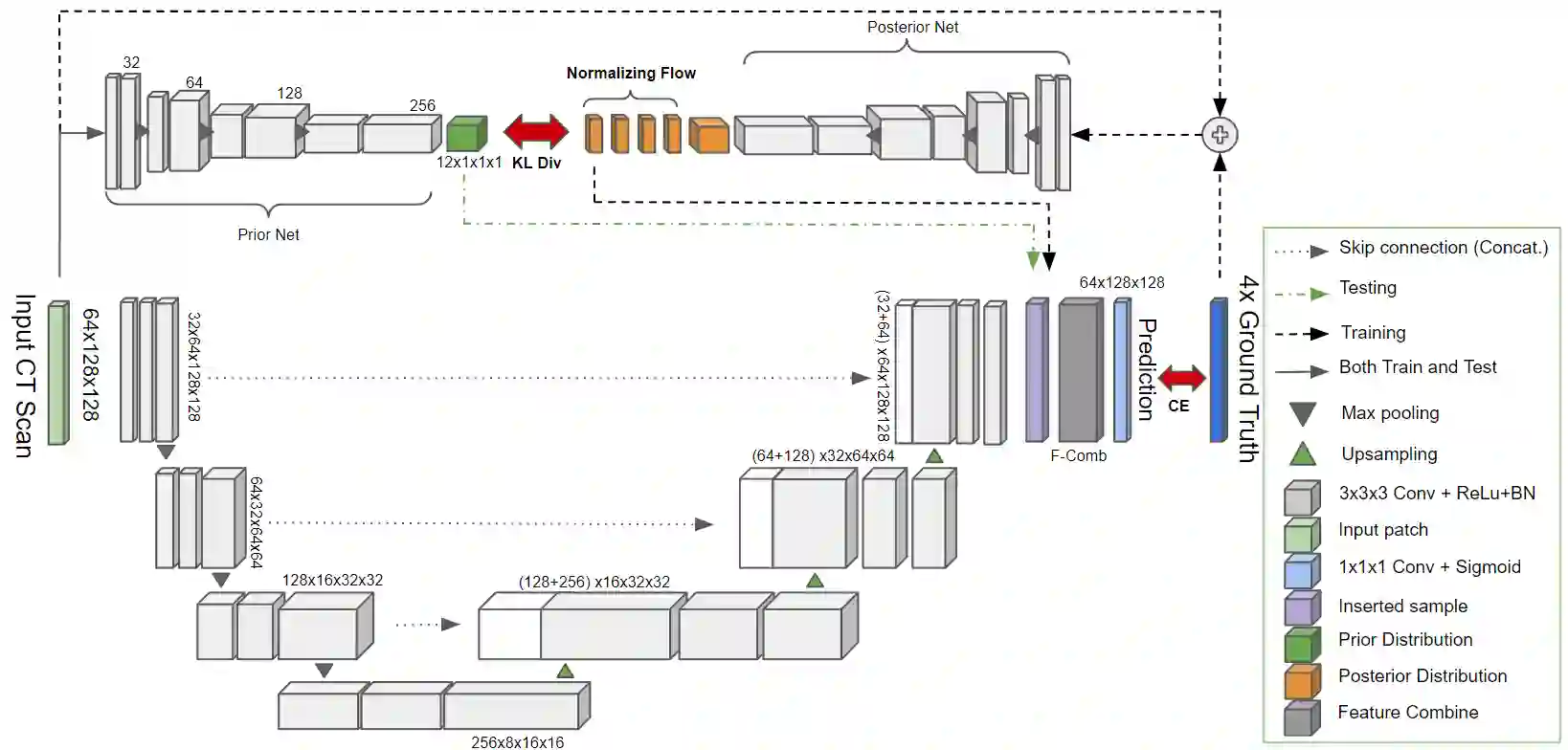
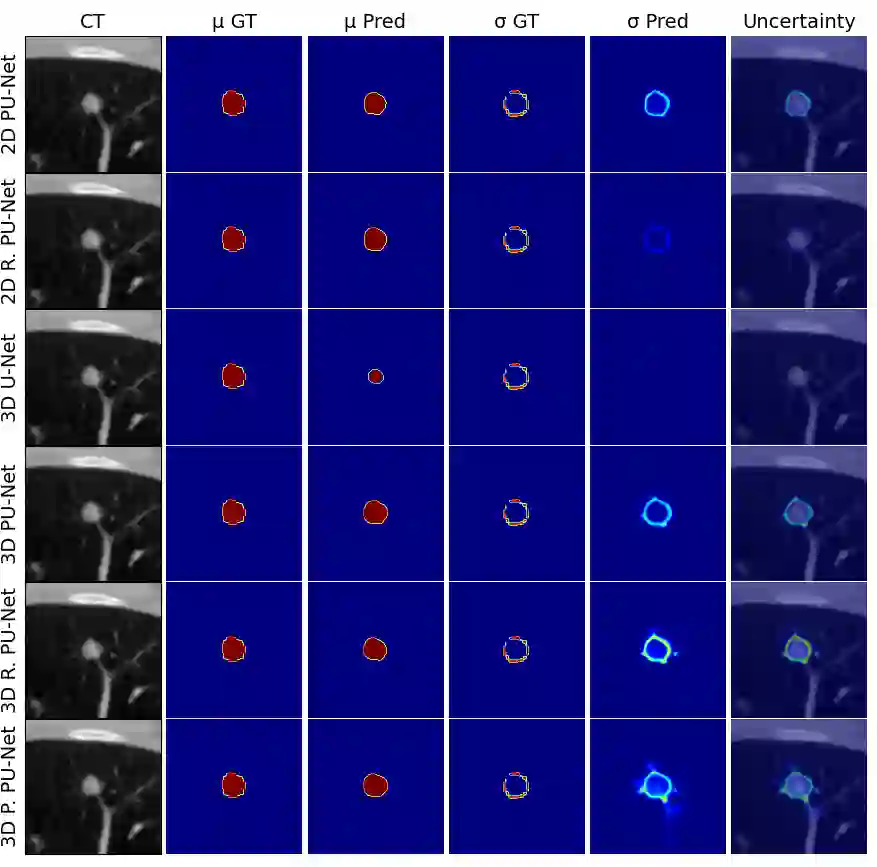
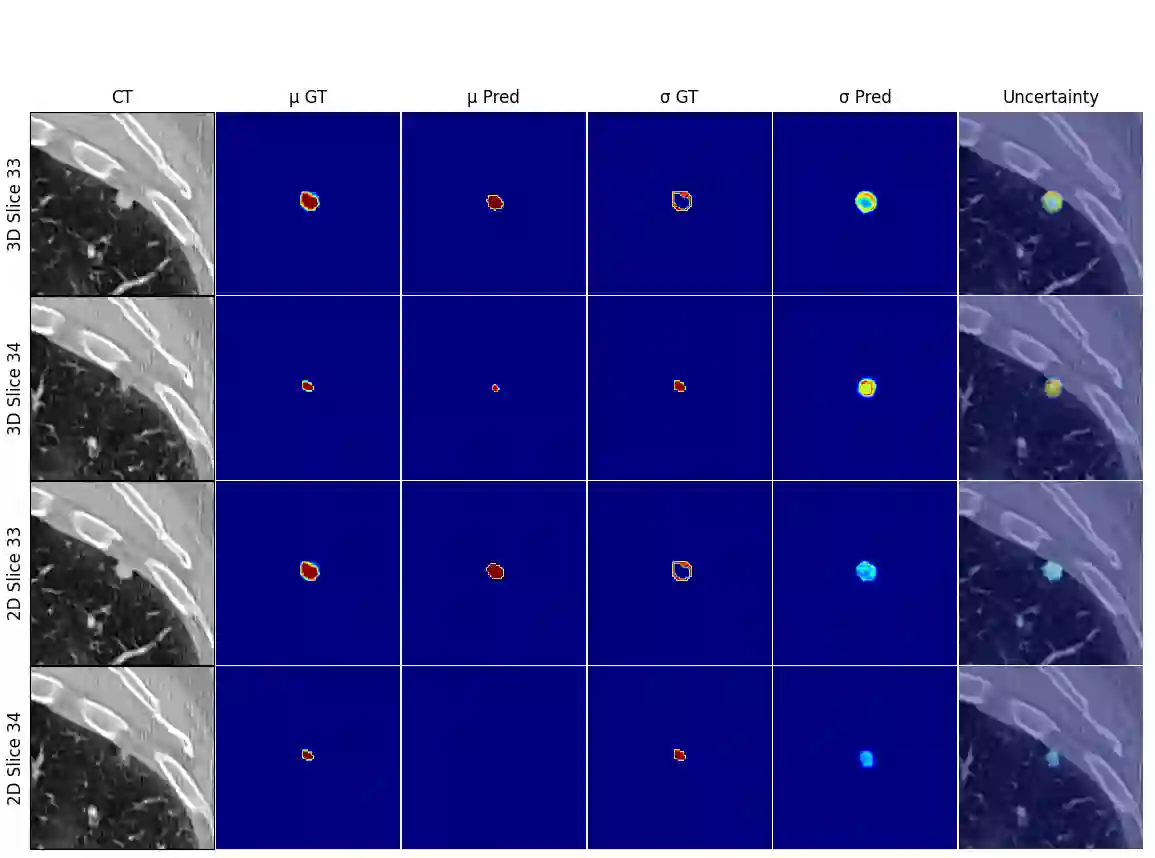
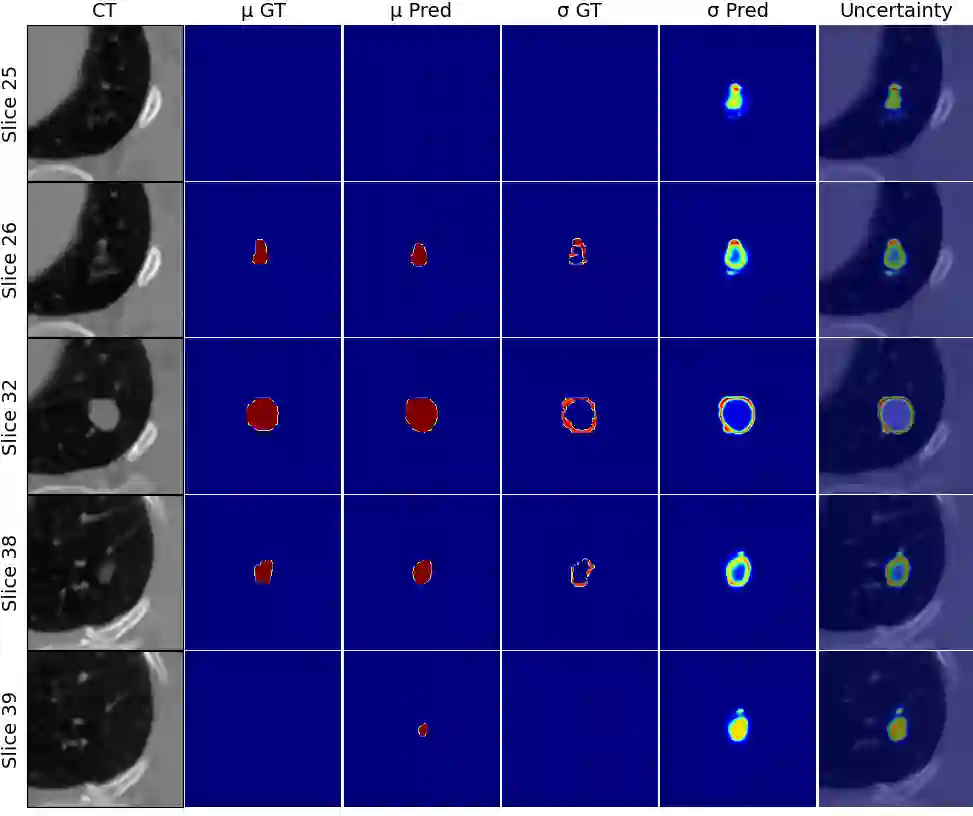
Uncertainty quantification in medical images has become an essential addition to segmentation models for practical application in the real world. Although there are valuable developments in accurate uncertainty quantification methods using 2D images and slices of 3D volumes, in clinical practice, the complete 3D volumes (such as CT and MRI scans) are used to evaluate and plan the medical procedure. As a result, the existing 2D methods miss the rich 3D spatial information when resolving the uncertainty. A popular approach for quantifying the ambiguity in the data is to learn a distribution over the possible hypotheses. In recent work, this ambiguity has been modeled to be strictly Gaussian. Normalizing Flows (NFs) are capable of modelling more complex distributions and thus, better fit the embedding space of the data. To this end, we have developed a 3D probabilistic segmentation framework augmented with NFs, to enable capturing the distributions of various complexity. To test the proposed approach, we evaluate the model on the LIDC-IDRI dataset for lung nodule segmentation and quantify the aleatoric uncertainty introduced by the multi-annotator setting and inherent ambiguity in the CT data. Following this approach, we are the first to present a 3D Squared Generalized Energy Distance (GED) of 0.401 and a high 0.468 Hungarian-matched 3D IoU. The obtained results reveal the value in capturing the 3D uncertainty, using a flexible posterior distribution augmented with a Normalizing Flow. Finally, we present the aleatoric uncertainty in a visual manner with the aim to provide clinicians with additional insight into data ambiguity and facilitating more informed decision-making.
翻译:在医学图像中,不确定性量化已成为实际应用中分割模型的重要补充。尽管利用二维图像和三维体切片开发了准确的不确定性量化方法,但在临床实践中,完整的三维体(如CT和MRI扫描)被用于评估和规划医疗程序。因此,现有二维方法在解决不确定性时会丢失丰富的三维空间信息。量化数据模糊性的一种流行方法是学习可能假设的分布。最近的研究中,这种模糊性被严格建模为高斯分布。归一化流(NFs)能够对更复杂的分布进行建模,从而更好地拟合数据的嵌入空间。为此,我们开发了一个增强归一化流的3D概率分割框架,以捕获不同复杂度的分布。为测试所提出的方法,我们在LIDC-IDRI数据集上评估了肺结节分割模型,并量化了多标注者设置及CT数据固有模糊性引入的偶然不确定性。采用该方法,我们首次实现了3D平方广义能量距离(GED)为0.401,以及高为0.468的匈牙利匹配3D IoU。所得结果揭示了利用归一化流增强的灵活后验分布捕获3D不确定性的价值。最后,我们以可视化方式呈现偶然不确定性,旨在为临床医生提供数据模糊性的额外见解,促进更明智的决策。





相关内容





 微信扫码咨询专知VIP会员