

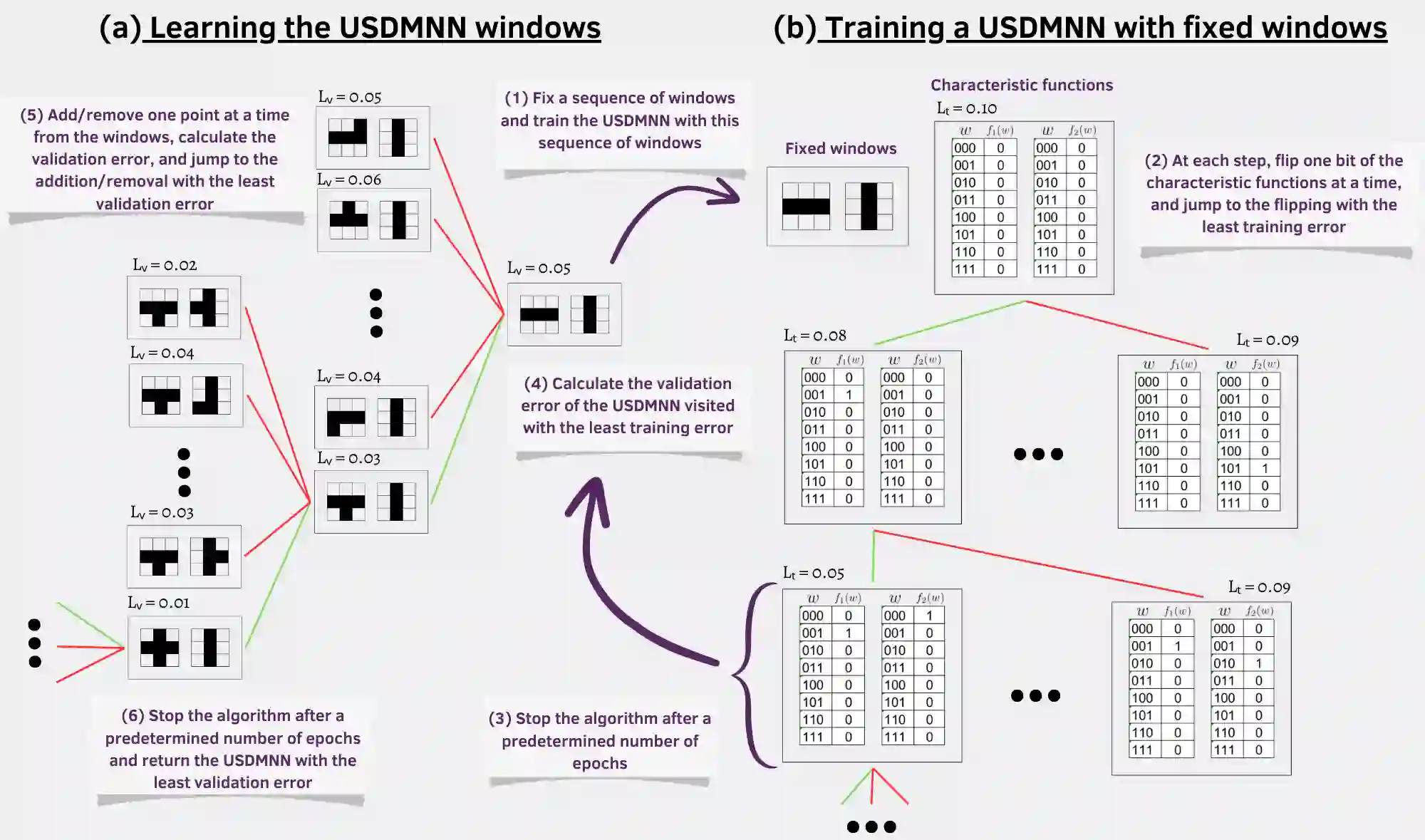
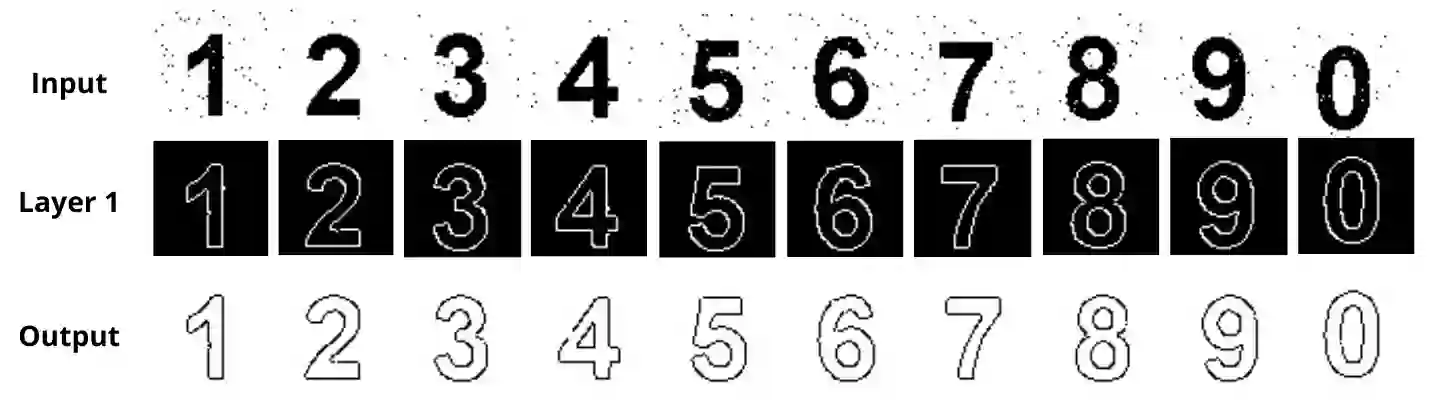
There have been attempts to insert mathematical morphology (MM) operators into convolutional neural networks (CNN), and the most successful endeavor to date has been the morphological neural networks (MNN). Although MNN have performed better than CNN in solving some problems, they inherit their black-box nature. Furthermore, in the case of binary images, they are approximations that loose the Boolean lattice structure of MM operators and, thus, it is not possible to represent a specific class of W-operators with desired properties. In a recent work, we proposed the Discrete Morphological Neural Networks (DMNN) for binary image transformation to represent specific classes of W-operators and estimate them via machine learning. We also proposed a stochastic lattice descent algorithm (SLDA) to learn the parameters of Canonical Discrete Morphological Neural Networks (CDMNN), whose architecture is composed only of operators that can be decomposed as the supremum, infimum, and complement of erosions and dilations. In this paper, we propose an algorithm to learn unrestricted sequential DMNN, whose architecture is given by the composition of general W-operators. We illustrate the algorithm in a practical example.
翻译:已有研究尝试将数学形态学(MM)算子融入卷积神经网络(CNN),而迄今为止最成功的尝试是形态神经网络(MNN)。尽管MNN在解决某些问题时表现优于CNN,但它们继承了CNN的“黑箱”特性。此外,在处理二值图像时,MNN因近似而丢失了MM算子的布尔格结构,故无法表示具有特定属性的W-算子类。近期工作中,我们提出了用于二值图像变换的离散形态神经网络(DMNN),以表示特定W-算子类并通过机器学习进行估计。我们还提出了一种随机格下降算法(SLDA),用于学习规范离散形态神经网络(CDMNN)的参数——此类网络的架构仅由可分解为腐蚀与膨胀的并、交及补运算的算子组成。本文提出了一种用于学习无约束序列DMNN的算法,其架构由一般W-算子的复合构成。我们通过实际案例对该算法进行了验证。




相关内容




 微信扫码咨询专知VIP会员