

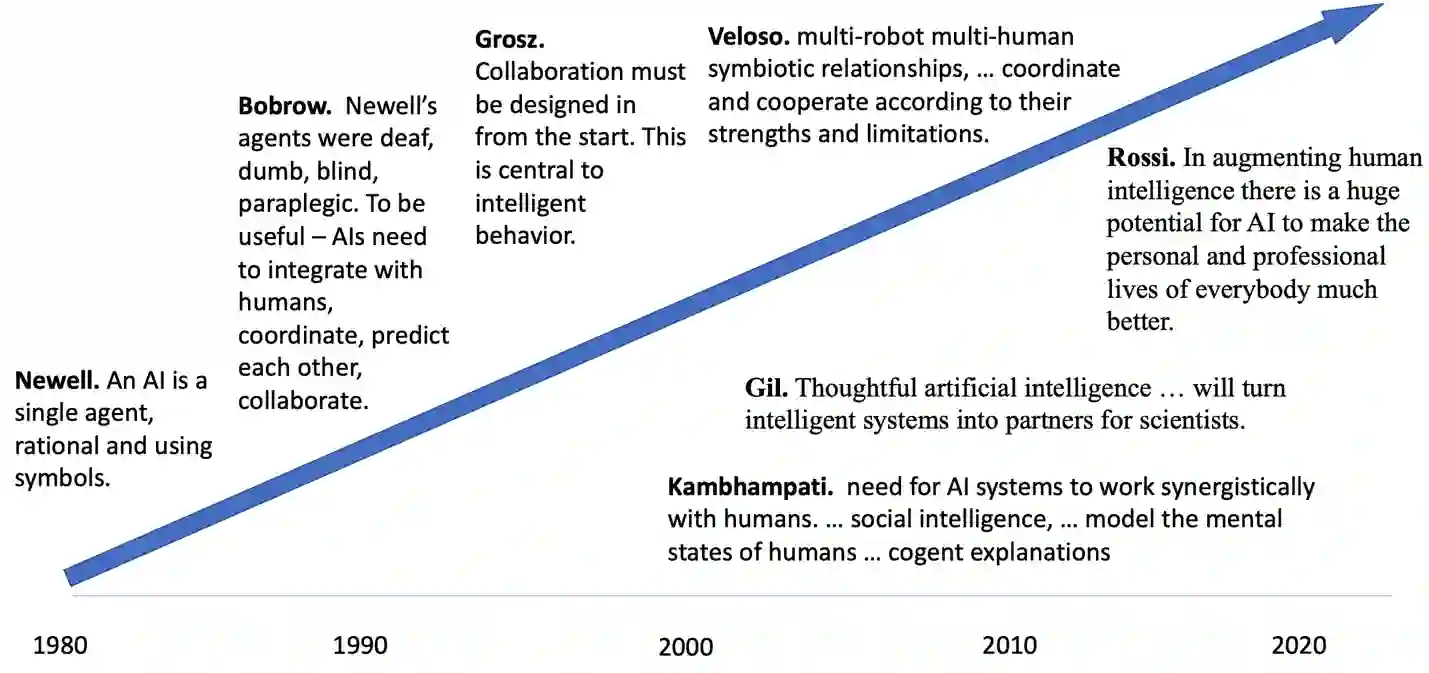
The vision of AI collaborators has long been a staple of science fiction, where artificial agents understand nuances of collaboration and human communication. They bring advantages to their human collaborators and teams by contributing their special talents. Government advisory groups and leaders in AI have advocated for years that AIs should be human compatible and be capable of effective collaboration. Nonetheless, robust AIs that can collaborate like talented people remain out of reach. This position paper draws on a cognitive analysis of what effective and robust collaboration requires of human and artificial agents. It sketches a history of public and AI visions for artificial collaborators, starting with early visions of intelligence augmentation (IA) and artificial intelligence (AI). It is intended as motivation and context for a second position paper on collaborative AI (Stefik & Price, 2023). The second paper reviews the multi-disciplinary state-of-the-art and proposes a roadmap for bootstrapping collaborative AIs.
翻译:人工智能协作者的愿景长期以来一直是科幻小说的核心内容,在这些故事中,人工智能体能够理解协作与人类沟通的微妙之处。它们通过发挥自身特殊才能,为人类协作者和团队带来优势。政府咨询机构和人工智能领域的领导者多年来一直倡导,人工智能应具备与人类兼容的特性,并能够实现有效协作。然而,能够像优秀人类一样协作的稳健人工智能仍然遥不可及。本文基于认知分析,探讨了有效且稳健的协作对人类和人工智能体提出的要求。文章勾勒了公众与人工智能领域对人工协作者愿景的历史脉络,从早期的智能增强(IA)和人工智能(AI)愿景开始。本文旨在为后续关于协作式人工智能的立场论文(Stefik & Price, 2023)提供动机和背景背景。该论文将综述多学科领域的最新进展,并提出启动协作式人工智能的路线图。




相关内容



 微信扫码咨询专知VIP会员