

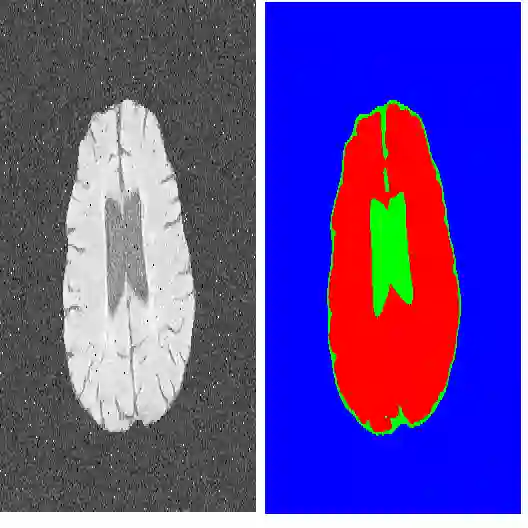
Current mask processing operations rely on interpolation algorithms that do not produce extra pixels, such as nearest neighbor (NN) interpolation, as opposed to algorithms that do produce extra pixels, like bicubic (BIC) or bilinear (BIL) interpolation. In our previous study, the author proposed an alternative approach to NN-based mask processing and evaluated its effects on deep learning training outcomes. In this study, the author evaluated the effects of both BIC-based image and mask processing and BIC-and-NN-based image and mask processing versus NN-based image and mask processing. The evaluation revealed that the BIC-BIC model/network was an 8.9578 % (with image size 256 x 256) and a 1.0496 % (with image size 384 x 384) increase of the NN-NN network compared to the NN-BIC network which was an 8.3127 % (with image size 256 x 256) and a 0.2887 % (with image size 384 x 384) increase of the NN-NN network.
翻译:当前掩模处理操作依赖不产生额外像素的插值算法(如最近邻插值NN),而非双三次(BIC)或双线性(BIL)等产生额外像素的算法。在作者先前研究中,提出了基于NN的掩模处理替代方案,并评估其对深度学习训练结果的影响。本研究评估了基于BIC的图像与掩模联合处理、基于BIC与NN的图像与掩模联合处理相对于基于NN的图像与掩模处理的效果。评估结果表明,BIC-BIC模型/网络相较于NN-NN网络的性能提升为8.9578%(图像尺寸256×256)和1.0496%(图像尺寸384×384),而NN-BIC网络相较于NN-NN网络的提升为8.3127%(图像尺寸256×256)和0.2887%(图像尺寸384×384)。




相关内容




 微信扫码咨询专知VIP会员