

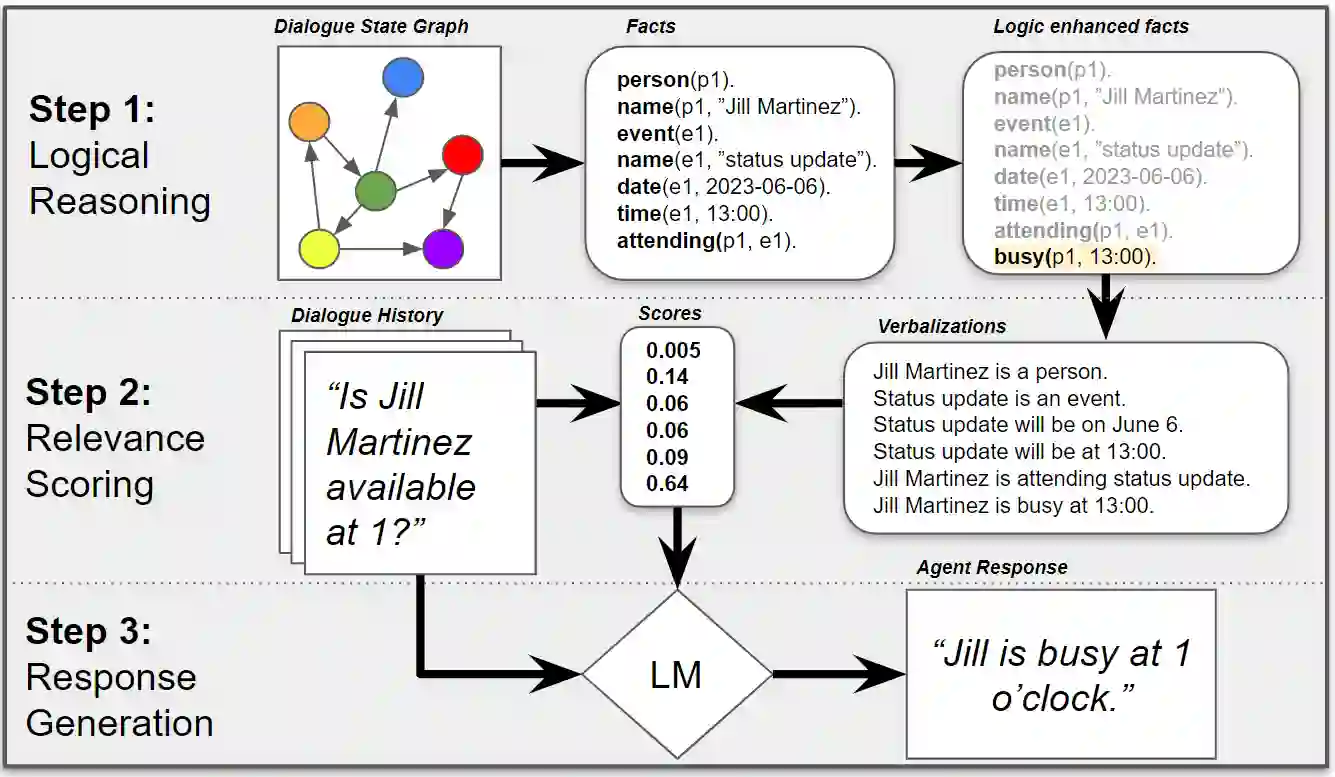
Constructing responses in task-oriented dialogue systems typically relies on information sources such the current dialogue state or external databases. This paper presents a novel approach to knowledge-grounded response generation that combines retrieval-augmented language models with logical reasoning. The approach revolves around a knowledge graph representing the current dialogue state and background information, and proceeds in three steps. The knowledge graph is first enriched with logically derived facts inferred using probabilistic logical programming. A neural model is then employed at each turn to score the conversational relevance of each node and edge of this extended graph. Finally, the elements with highest relevance scores are converted to a natural language form, and are integrated into the prompt for the neural conversational model employed to generate the system response. We investigate the benefits of the proposed approach on two datasets (KVRET and GraphWOZ) along with a human evaluation. Experimental results show that the combination of (probabilistic) logical reasoning with conversational relevance scoring does increase both the factuality and fluency of the responses.
翻译:面向任务的对话系统中的回复构建通常依赖于当前对话状态或外部数据库等信息源。本文提出了一种新颖的知识驱动型回复生成方法,该方法将检索增强语言模型与逻辑推理相结合。该方法围绕一个表征当前对话状态与背景信息的知识图谱展开,共包含三个步骤:首先,利用概率逻辑编程推理出的事实对知识图谱进行逻辑增强;其次,在每个对话轮次中,采用神经模型对该扩展图谱中每个节点和边的对话相关性进行评分;最后,将具有最高相关性评分的元素转换为自然语言形式,并整合到用于生成系统回复的神经对话模型的提示中。我们在两个数据集(KVRET和GraphWOZ)上结合人工评估验证了所提方法的优越性。实验结果表明,(概率)逻辑推理与对话相关性评分的结合确实能同时提升回复的事实准确性与流畅度。




相关内容





 微信扫码咨询专知VIP会员