

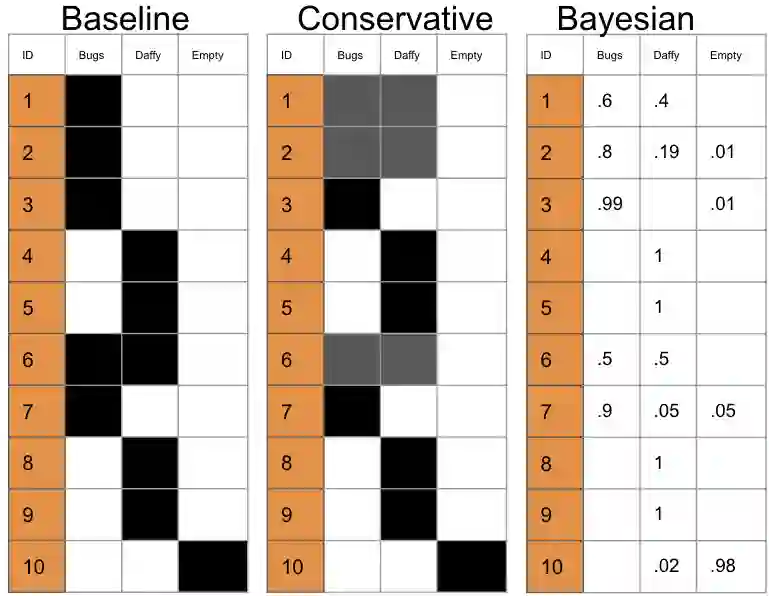
Risk-limiting audits (RLAs) are the established techniques for verifying large elections. While they provide rigorous guarantees of correctness, widespread adoption has been impeded by both efficiency concerns and the fact they offer statistical, rather than absolute, conclusions. We define new families of audits that help to address these issues. Our new audits are enabled by revisiting the standard notion of a cast-vote record so that it can declare multiple possible mark interpretations rather than a single decision; this can reflect the presence of ambiguous marks, which appear regularly on hand-marked ballots. We show that this simple expedient can offer significant efficiency improvements with only minor changes to existing auditing infrastructure. We establish that these "Bayesian" comparison audits are indeed risk-limiting in the formal sense of (Fuller, Harrison, and Russell, 2022). We then define a new type of post-election audit we call a contested audit. These call for each candidate to provide a cast-vote record table advancing their own claim to victory. We prove that these audits offer remarkable sample efficiency: they guarantee negligible risk with only a constant number of ballot inspections. This is a first for an audit with provable soundness. These results are formulated in a game-based security model that specify quantitative soundness and completeness guarantees. Finally, we observe that these audits provide a direct means to handle contestation of election results affirmed by conventional RLAs.
翻译:风险限制审计(RLAs)是验证大规模选举的成熟技术。尽管它们提供了严格的正确性保证,但效率和仅提供统计结论而非绝对结论的问题阻碍了其广泛采用。我们定义了新的审计家族以帮助解决这些问题。我们的新审计通过重新审视选票记录的标准概念得以实现:允许其声明多种可能的标记解释而非单一决策;这可以反映手工标记选票中常见的不明确标记。我们证明这种简单策略只需对现有审计基础设施进行微小调整即可显著提升效率。我们证实这些"贝叶斯"比较审计在(Fuller, Harrison, and Russell, 2022)的严格意义下确实满足风险限制特性。接着我们定义了一种新型选举后审计——争议审计。该审计要求每位候选人提供一份支持自身胜选主张的选票记录表。我们证明这些审计具有卓越的样本效率:仅需恒定数量的选票检查即可保证可忽略的风险。这是可证明完备性的审计领域首次实现这一成果。这些结果在一个基于博弈的安全模型中被形式化,该模型规定了量化可靠性与完备性保证。最后,我们指出这些审计为处理传统RLA确认的选举结果争议提供了直接手段。




相关内容




 微信扫码咨询专知VIP会员