

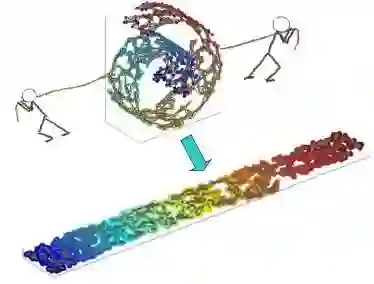
It has become standard to use gradient-based dimensionality reduction (DR) methods like tSNE and UMAP when explaining what AI models have learned. This makes sense: these methods are fast, robust, and have an uncanny ability to find semantic patterns in high-dimensional data without supervision. Despite this, gradient-based DR methods lack the most important quality that an explainability method should possess: themselves being explainable. That is, given a UMAP output, it is currently unclear what one can say about the corresponding input. We work towards closing this question by relating UMAP to classical DR techniques. Specifically, we show that one can fully recover methods like PCA, MDS, and ISOMAP in the modern DR paradigm: by applying attractions and repulsions onto a randomly initialized dataset. We also show that, with a small change, Locally Linear Embeddings (LLE) can indistinguishably reproduce UMAP outputs. This implies that the UMAP effective objective is minimized by this modified version of LLE (and vice versa). Given this, we discuss what must be true of UMAP emebddings and present avenues for future work.
翻译:在解释人工智能模型所学内容时,使用基于梯度的降维方法(如tSNE和UMAP)已成为标准做法。这是合理的:这些方法快速、鲁棒,且具有在无监督情况下从高维数据中发现语义模式的非凡能力。尽管如此,基于梯度的降维方法缺乏可解释性方法应具备的最重要特质:其自身可被解释。也就是说,给定一个UMAP输出,目前尚不清楚能对相应的输入作出何种推断。我们通过将UMAP与经典降维技术相关联来推进这一问题的解决。具体而言,我们证明了可以在现代降维范式中完全恢复如PCA、MDS和ISOMAP等方法:通过对随机初始化的数据集施加吸引力和排斥力来实现。我们还表明,通过微小调整,局部线性嵌入(LLE)可以不可区分地复现UMAP输出。这意味着UMAP的有效目标函数可通过这种修改版的LLE最小化(反之亦然)。基于此,我们讨论了UMAP嵌入必须具备的特性,并提出了未来工作的方向。




相关内容



 微信扫码咨询专知VIP会员