

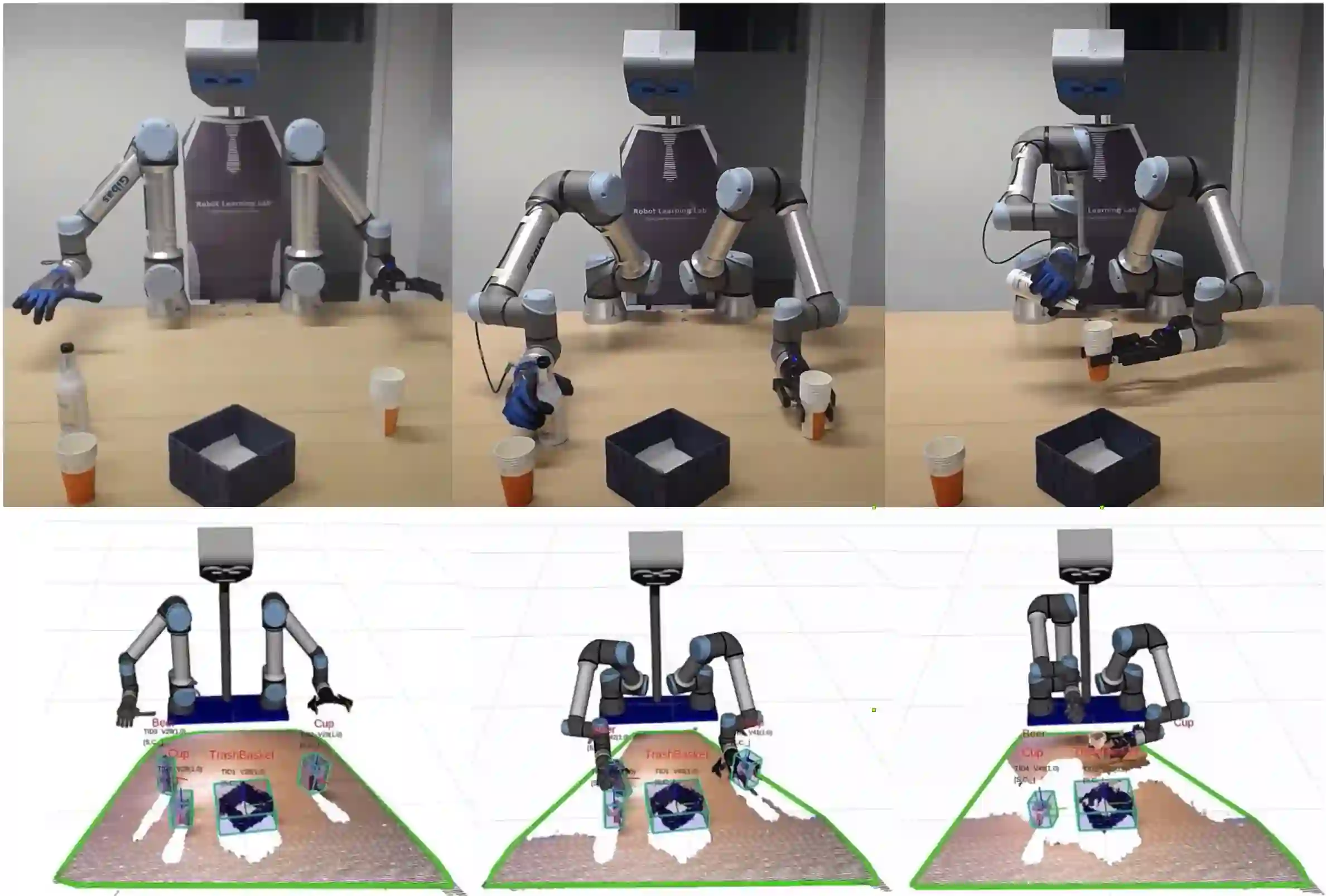
Simultaneous object recognition and pose estimation are two key functionalities for robots to safely interact with humans as well as environments. Although both object recognition and pose estimation use visual input, most state-of-the-art tackles them as two separate problems since the former needs a view-invariant representation while object pose estimation necessitates a view-dependent description. Nowadays, multi-view Convolutional Neural Network (MVCNN) approaches show state-of-the-art classification performance. Although MVCNN object recognition has been widely explored, there has been very little research on multi-view object pose estimation methods, and even less on addressing these two problems simultaneously. The pose of virtual cameras in MVCNN methods is often predefined in advance, leading to bound the application of such approaches. In this paper, we propose an approach capable of handling object recognition and pose estimation simultaneously. In particular, we develop a deep object-agnostic entropy estimation model, capable of predicting the best viewpoints of a given 3D object. The obtained views of the object are then fed to the network to simultaneously predict the pose and category label of the target object. Experimental results showed that the views obtained from such positions are descriptive enough to achieve a good accuracy score. Furthermore, we designed a real-life serve drink scenario to demonstrate how well the proposed approach worked in real robot tasks. Code is available online at: github.com/SubhadityaMukherjee/more_mvcnn
翻译:同步实现物体识别与姿态估计是机器人安全地与人类及环境交互的两项关键功能。尽管物体识别与姿态估计均依赖视觉输入,但现有主流方法将二者视为独立问题,因为前者需要视角不变表征,而后者则依赖视角相关的描述。当前,多视角卷积神经网络在分类任务中展现出最先进性能。尽管MVCNN物体识别已被广泛探索,但关于多视角物体姿态估计方法的研究极少,同时解决这两个问题的研究更少。MVCNN方法中虚拟相机的姿态常需预先定义,这限制了此类方法的应用范围。本文提出一种可同时处理物体识别与姿态估计的方法。具体而言,我们开发了深度物体无关熵估计模型,能够预测给定三维物体的最优视角。所获得的物体视角图像随后输入网络,同步预测目标物体的姿态与类别标签。实验结果表明,从这些位置获取的视角具有足够描述性,能够获得良好的精度评分。此外,我们设计了真实场景中的倒饮料任务,验证了所提方法在真实机器人任务中的有效性。代码开源地址:github.com/SubhadityaMukherjee/more_mvcnn








相关内容


 微信扫码咨询专知VIP会员