

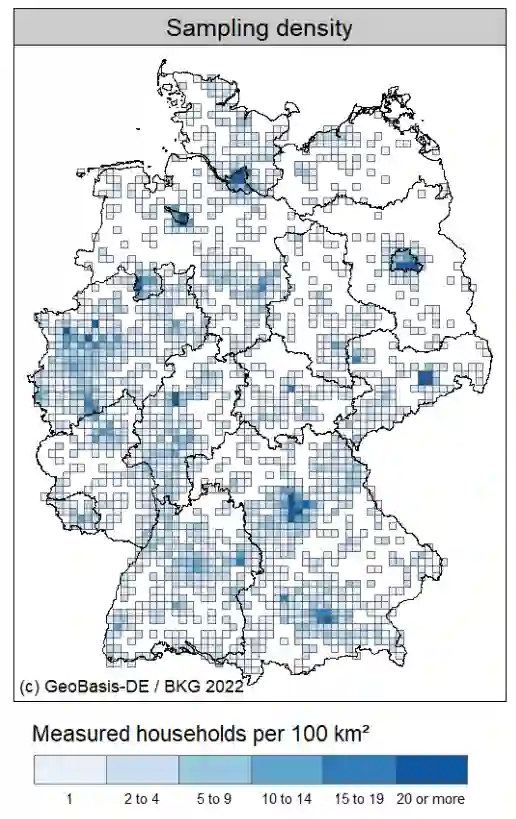
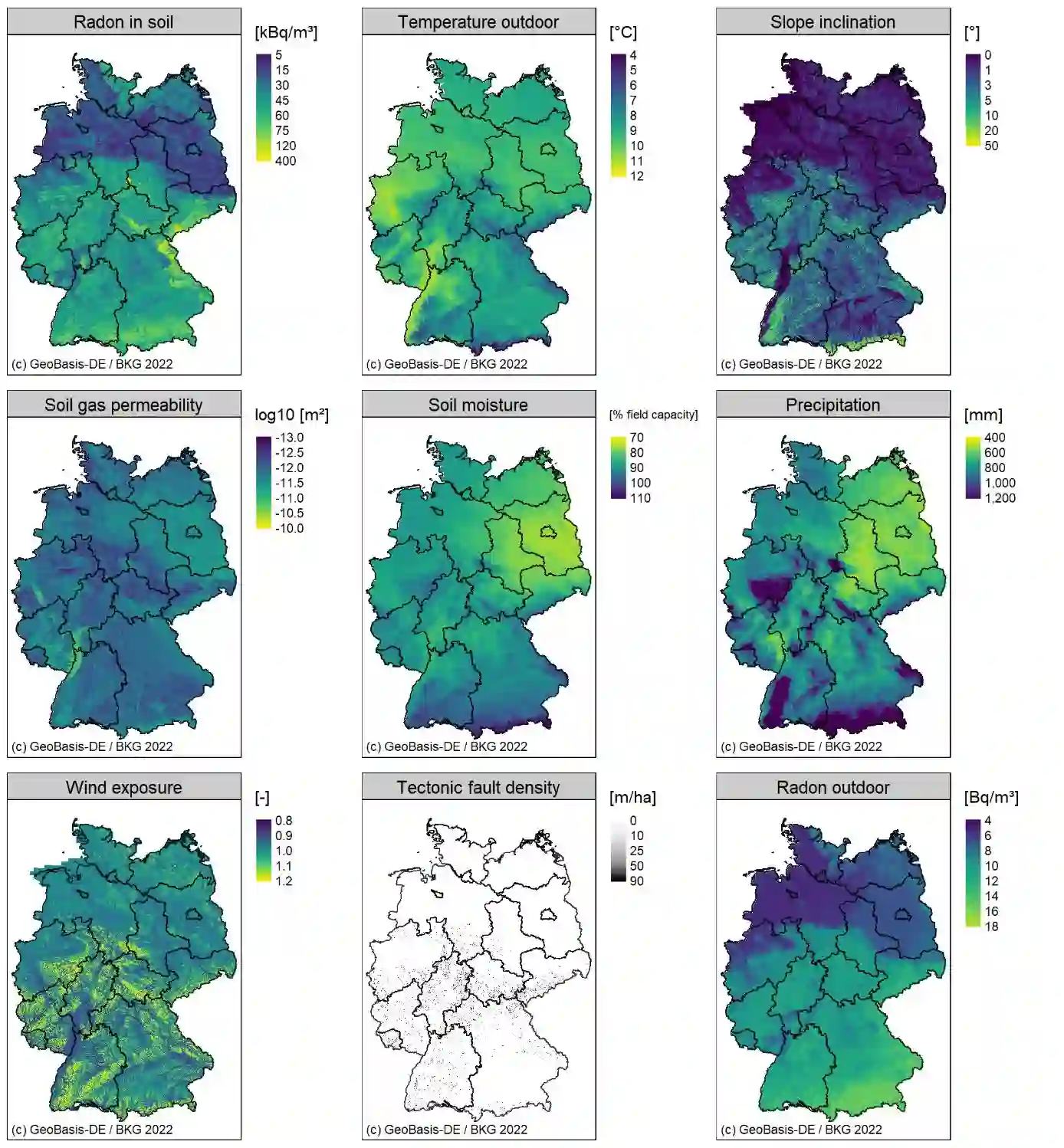
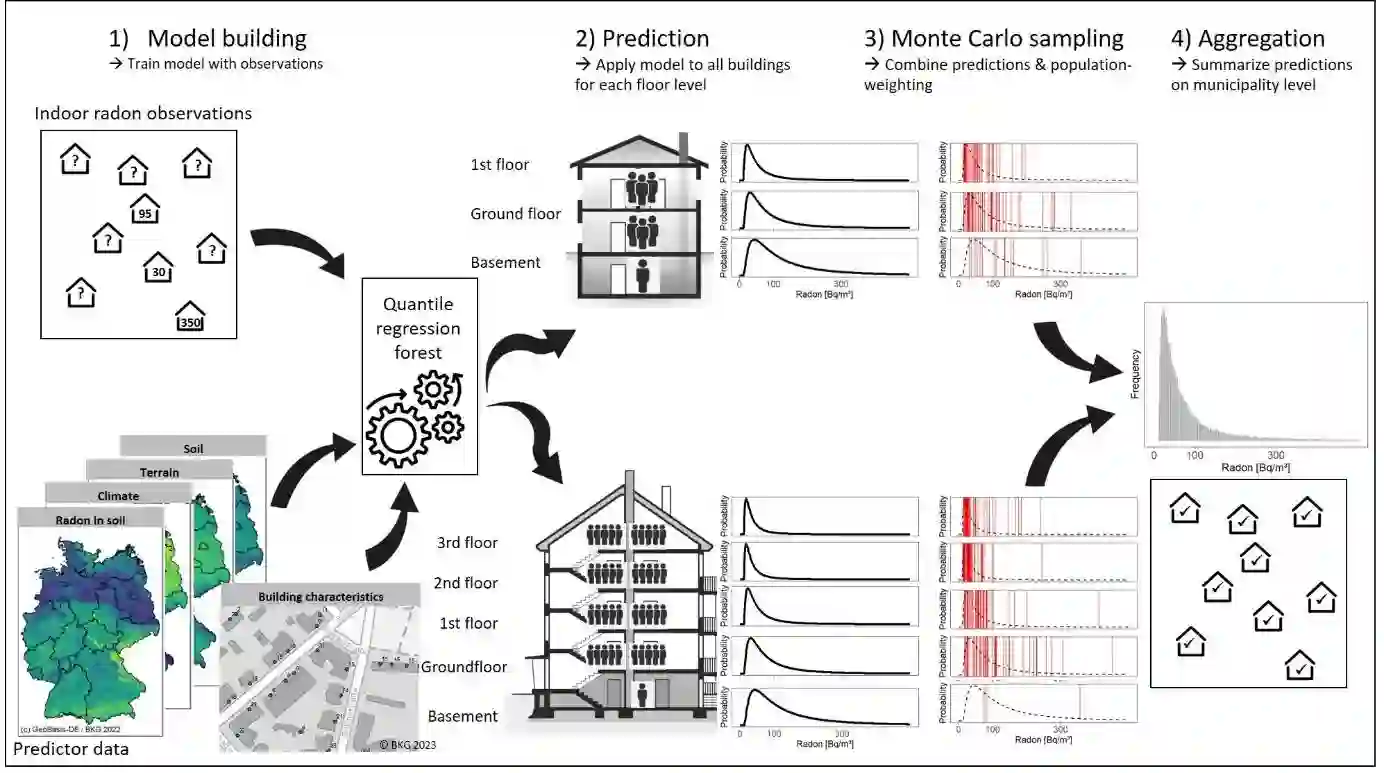
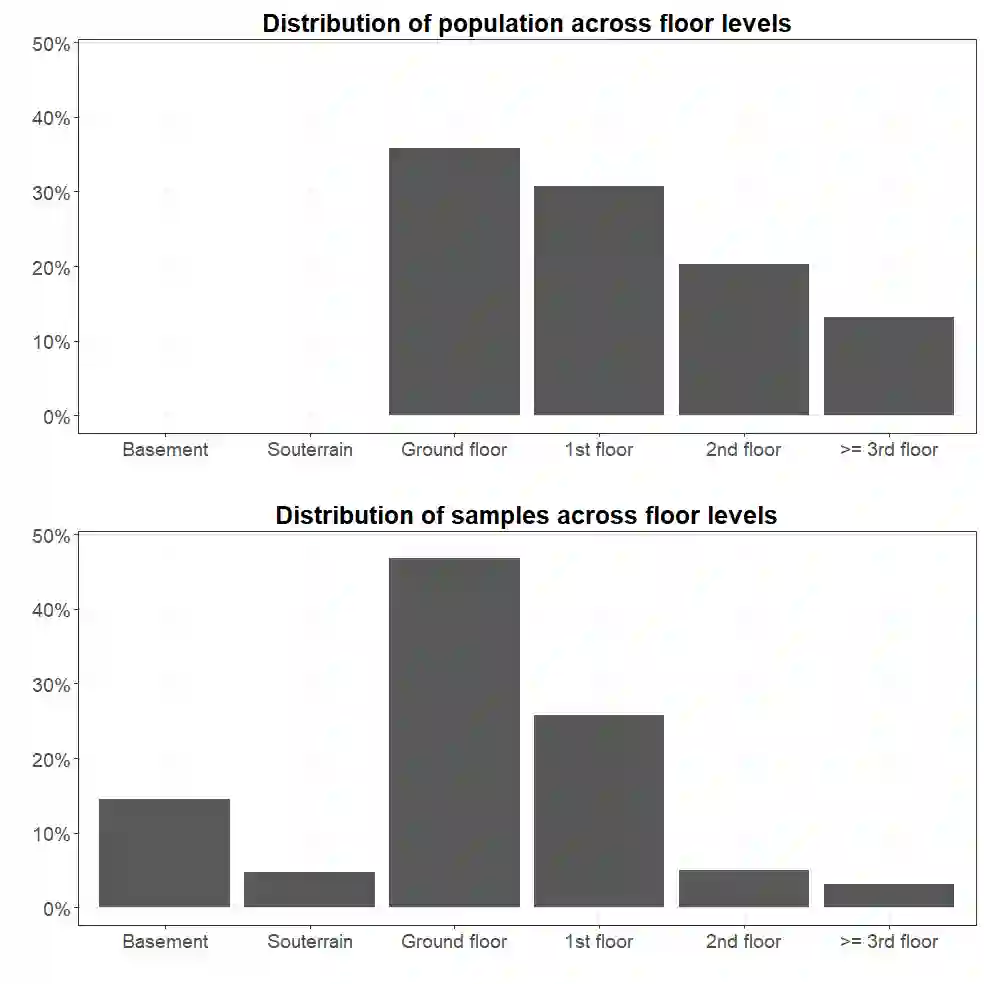
Radon is a carcinogenic, radioactive gas that can accumulate indoors. Therefore, accurate knowledge of indoor radon concentration is crucial for assessing radon-related health effects or identifying radon-prone areas. Indoor radon concentration at the national scale is usually estimated on the basis of extensive measurement campaigns. However, characteristics of the sample often differ from the characteristics of the population due to the large number of relevant factors that control the indoor radon concentration such as the availability of geogenic radon or floor level. Furthermore, the sample size usually does not allow estimation with high spatial resolution. We propose a model-based approach that allows a more realistic estimation of indoor radon distribution with a higher spatial resolution than a purely data-based approach. A two-stage modelling approach was applied: 1) a quantile regression forest using environmental and building data as predictors was applied to estimate the probability distribution function of indoor radon for each floor level of each residential building in Germany; (2) a probabilistic Monte Carlo sampling technique enabled the combination and population weighting of floor-level predictions. In this way, the uncertainty of the individual predictions is effectively propagated into the estimate of variability at the aggregated level. The results show an approximate lognormal distribution with an arithmetic mean of 63 Bq/m3, a geometric mean of 41 Bq/m3 and a 95 %ile of 180 Bq/m3. The exceedance probability for 100 Bq/m3 and 300 Bq/m3 are 12.5 % (10.5 million people) and 2.2 % (1.9 million people), respectively.
翻译:氡是一种具有致癌性的放射性气体,易在室内积聚。因此,准确掌握室内氡浓度对于评估氡相关健康影响或识别氡高风险区域至关重要。国家尺度的室内氡浓度通常基于大规模测量活动进行估算。然而,由于影响室内氡浓度的因素众多(如地质成因氡的可用性或楼层高度),样本特征往往与总体特征存在差异。此外,样本量通常无法支持高空间分辨率估算。我们提出了一种基于模型的方法,相较于纯数据驱动方法,能够以更高空间分辨率实现更真实的室内氡分布估算。采用两阶段建模方法:1)以环境与建筑数据为预测变量,应用分位数回归森林模型估算德国每栋住宅楼各楼层的室内氡概率分布函数;2)通过概率蒙特卡洛采样技术实现楼层预测值的合并与群体加权。通过这种方式,单个预测的不确定性可有效传递至聚合层次的变异性估计中。结果表明,室内氡浓度近似服从对数正态分布,算术均值为63 Bq/m³,几何均值为41 Bq/m³,95%分位值为180 Bq/m³。超过100 Bq/m³和300 Bq/m³的概率分别为12.5%(涉及1050万人)和2.2%(涉及190万人)。




相关内容




 微信扫码咨询专知VIP会员