

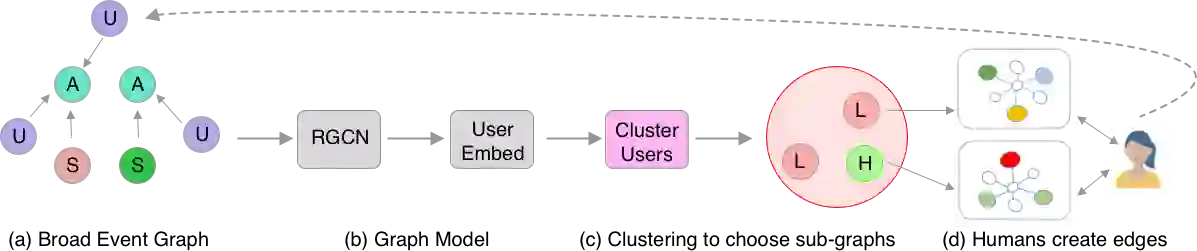
The rise of social media has enabled the widespread propagation of fake news, text that is published with an intent to spread misinformation and sway beliefs. Rapidly detecting fake news, especially as new events arise, is important to prevent misinformation. While prior works have tackled this problem using supervised learning systems, automatedly modeling the complexities of the social media landscape that enables the spread of fake news is challenging. On the contrary, having humans fact check all news is not scalable. Thus, in this paper, we propose to approach this problem interactively, where humans can interact to help an automated system learn a better social media representation quality. On real world events, our experiments show performance improvements in detecting factuality of news sources, even after few human interactions.
翻译:社交媒体的兴起使得虚假新闻得以广泛传播——这类文本旨在散布错误信息并影响公众观点。随着新事件的不断涌现,快速检测虚假新闻对于防止错误信息至关重要。虽然先前的研究利用监督学习系统来解决这一问题,但自动建模促进虚假新闻传播的社交媒体环境的复杂性仍具挑战性。与此相反,依赖人工核查所有新闻则难以规模化。因此,本文提出一种交互式方法,让人类能够与自动化系统交互,以帮助其学习更高质量的社交媒体表示。基于真实世界事件的实验表明,即使经过少量人机交互,该方法也能显著提升新闻来源事实性检测的性能。




相关内容





 微信扫码咨询专知VIP会员