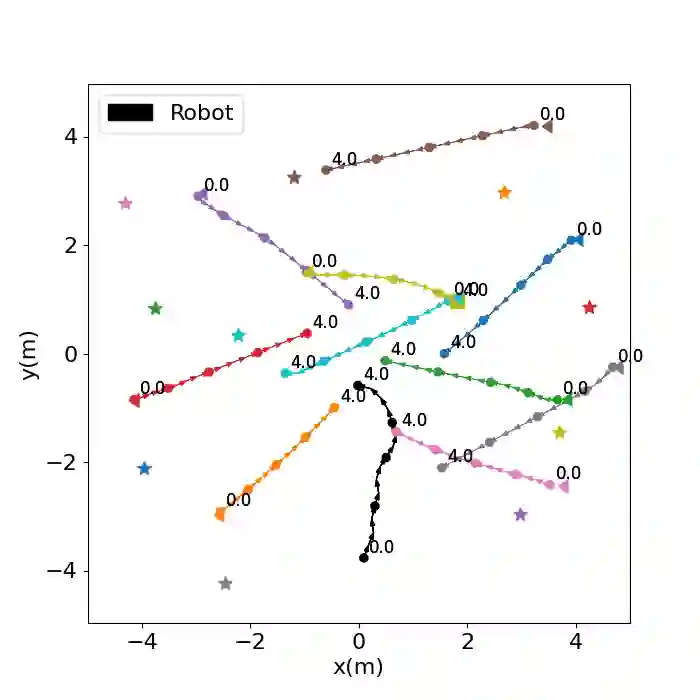
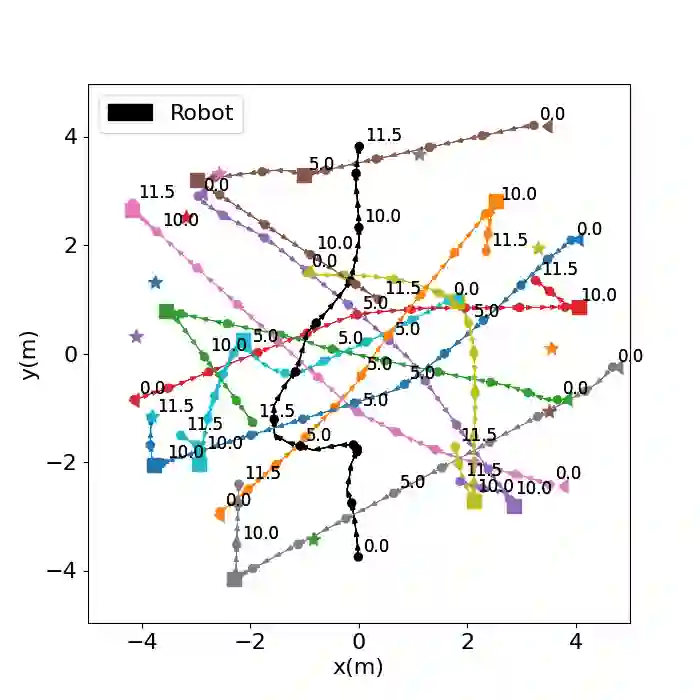
Autonomous navigation in crowded environments is an open problem with many applications, essential for the coexistence of robots and humans in the smart cities of the future. In recent years, deep reinforcement learning approaches have proven to outperform model-based algorithms. Nevertheless, even though the results provided are promising, the works are not able to take advantage of the capabilities that their models offer. They usually get trapped in local optima in the training process, that prevent them from learning the optimal policy. They are not able to visit and interact with every possible state appropriately, such as with the states near the goal or near the dynamic obstacles. In this work, we propose using intrinsic rewards to balance between exploration and exploitation and explore depending on the uncertainty of the states instead of on the time the agent has been trained, encouraging the agent to get more curious about unknown states. We explain the benefits of the approach and compare it with other exploration algorithms that may be used for crowd navigation. Many simulation experiments are performed modifying several algorithms of the state-of-the-art, showing that the use of intrinsic rewards makes the robot learn faster and reach higher rewards and success rates (fewer collisions) in shorter navigation times, outperforming the state-of-the-art.


翻译:自主导航于拥挤环境是一个具有众多应用的开放性问题,对于未来智能城市中机器人与人类的共存至关重要。近年来,深度强化学习方法已被证明优于基于模型的算法。然而,尽管已有成果前景可观,现有工作却未能充分利用其模型所具备的能力。它们在训练过程中往往陷入局部最优,进而阻碍最优策略的学习。这些方法无法充分访问每种可能的状态并与之交互,例如接近目标或动态障碍物的状态。本研究提出利用内在奖励来平衡探索与利用,根据状态的不确定性而非智能体的训练时间进行探索,激励智能体对未知状态产生更多好奇。我们阐述了该方法的优势,并将其与可用于人群导航的其他探索算法进行比较。通过修改多项先进算法进行大量仿真实验,结果表明,采用内在奖励能使机器人在更短的导航时间内更快学习、获得更高奖励与成功率(更少碰撞),从而超越现有技术水平。
0
下载
关闭预览

相关内容

Linux导论,Introduction to Linux,96页ppt
专知会员服务
82+阅读 · 2020年7月26日
100+篇《自监督学习(Self-Supervised Learning)》论文最新合集
专知会员服务
167+阅读 · 2020年3月18日
强化学习最新教程,17页pdf
专知会员服务
182+阅读 · 2019年10月11日
[综述]深度学习下的场景文本检测与识别
专知会员服务
78+阅读 · 2019年10月10日
【哈佛大学商学院课程Fall 2019】机器学习可解释性
专知会员服务
105+阅读 · 2019年10月9日
【SIGGRAPH2019】TensorFlow 2.0深度学习计算机图形学应用
专知会员服务
41+阅读 · 2019年10月9日
VCIP 2022 Call for Demos
CCF多媒体专委会
1+阅读 · 2022年6月6日
强化学习三篇论文 避免遗忘等
CreateAMind
20+阅读 · 2019年5月24日
Hierarchically Structured Meta-learning
CreateAMind
27+阅读 · 2019年5月22日
Transferring Knowledge across Learning Processes
CreateAMind
29+阅读 · 2019年5月18日
逆强化学习-学习人先验的动机
CreateAMind
16+阅读 · 2019年1月18日
强化学习的Unsupervised Meta-Learning
CreateAMind
18+阅读 · 2019年1月7日
Unsupervised Learning via Meta-Learning
CreateAMind
44+阅读 · 2019年1月3日
disentangled-representation-papers
CreateAMind
26+阅读 · 2018年9月12日
ResNet, AlexNet, VGG, Inception:各种卷积网络架构的理解
全球人工智能
20+阅读 · 2017年12月17日
国家自然科学基金
0+阅读 · 2014年12月31日
国家自然科学基金
0+阅读 · 2014年12月31日
国家自然科学基金
0+阅读 · 2013年12月31日
国家自然科学基金
0+阅读 · 2012年12月31日
国家自然科学基金
0+阅读 · 2011年12月31日
国家自然科学基金
0+阅读 · 2011年12月31日
Arxiv
0+阅读 · 2023年3月30日
Arxiv
24+阅读 · 2021年3月4日
Arxiv
20+阅读 · 2020年6月8日
VIP会员
最新内容
AgentOps综述:智能体系统运维框架
专知会员服务
0+阅读 · 今天15:30
《美陆军最新条令:兵力防护》
专知会员服务
2+阅读 · 今天14:43
《人工智能的挑战:算法战的想象与现实》
专知会员服务
3+阅读 · 今天14:26
首场人工智能战争:Maven如何重塑武装冲突
专知会员服务
3+阅读 · 今天14:12
《通往人工通用智能之路上的均衡策略》
专知会员服务
7+阅读 · 6月3日
《Palantir的科技生态系统》
专知会员服务
17+阅读 · 6月2日
相关VIP内容
相关资讯
VCIP 2022 Call for Demos
CCF多媒体专委会
1+阅读 · 2022年6月6日
强化学习三篇论文 避免遗忘等
CreateAMind
20+阅读 · 2019年5月24日
Hierarchically Structured Meta-learning
CreateAMind
27+阅读 · 2019年5月22日
Transferring Knowledge across Learning Processes
CreateAMind
29+阅读 · 2019年5月18日
逆强化学习-学习人先验的动机
CreateAMind
16+阅读 · 2019年1月18日
强化学习的Unsupervised Meta-Learning
CreateAMind
18+阅读 · 2019年1月7日
Unsupervised Learning via Meta-Learning
CreateAMind
44+阅读 · 2019年1月3日
disentangled-representation-papers
CreateAMind
26+阅读 · 2018年9月12日
ResNet, AlexNet, VGG, Inception:各种卷积网络架构的理解
全球人工智能
20+阅读 · 2017年12月17日
相关基金
国家自然科学基金
0+阅读 · 2014年12月31日
国家自然科学基金
0+阅读 · 2014年12月31日
国家自然科学基金
0+阅读 · 2013年12月31日
国家自然科学基金
0+阅读 · 2012年12月31日
国家自然科学基金
0+阅读 · 2011年12月31日
国家自然科学基金
0+阅读 · 2011年12月31日
Top
微信扫码咨询专知VIP会员