

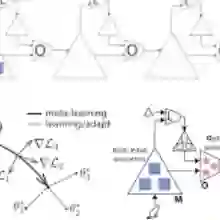
Simulating object deformations is a critical challenge across many scientific domains, including robotics, manufacturing, and structural mechanics. Learned Graph Network Simulators (GNSs) offer a promising alternative to traditional mesh-based physics simulators. Their speed and inherent differentiability make them particularly well suited for applications that require fast and accurate simulations, such as robotic manipulation or manufacturing optimization. However, existing learned simulators typically rely on single-step observations, which limits their ability to exploit temporal context. Without this information, these models fail to infer, e.g., material properties. Further, they rely on auto-regressive rollouts, which quickly accumulate error for long trajectories. We instead frame mesh-based simulation as a trajectory-level meta-learning problem. Using Conditional Neural Processes, our method enables rapid adaptation to new simulation scenarios from limited initial data while capturing their latent simulation properties. We utilize movement primitives to directly predict fast, stable and accurate simulations from a single model call. The resulting approach, Movement-primitive Meta-MeshGraphNet (M3GN), provides higher simulation accuracy at a fraction of the runtime cost compared to state-of-the-art GNSs across several tasks.
翻译:模拟物体形变是机器人学、制造工程和结构力学等多个科学领域的关键挑战。基于学习的图网络模拟器(GNSs)为传统基于网格的物理模拟器提供了有前景的替代方案。其高速性和固有的可微特性使其特别适用于需要快速精确模拟的应用场景,如机器人操控或制造优化。然而,现有学习型模拟器通常依赖单步观测,这限制了其利用时序上下文信息的能力。缺乏此类信息会导致模型无法推断材料属性等关键参数。此外,这些模型依赖自回归展开机制,在长轨迹模拟中会快速累积误差。本研究将基于网格的模拟重新构建为轨迹级元学习问题。通过条件神经过程,我们的方法能够利用有限初始数据快速适应新模拟场景,同时捕捉其潜在的模拟特性。我们采用运动基元技术,通过单次模型调用直接预测快速、稳定且精确的模拟结果。由此产生的运动基元元网格图网络方法(M3GN)在多项任务中,相比最先进的图网络模拟器,能以更低的运行时成本实现更高的模拟精度。




相关内容

 微信扫码咨询专知VIP会员