

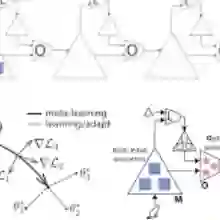
Scalable and generalizable physics-aware deep learning has long been considered a significant challenge with various applications across diverse domains ranging from robotics to molecular dynamics. Central to almost all physical systems are symplectic forms, the geometric backbone that underpins fundamental invariants like energy and momentum. In this work, we introduce a novel deep learning framework, MetaSym. In particular, MetaSym combines a strong symplectic inductive bias obtained from a symplectic encoder, and an autoregressive decoder with meta-attention. This principled design ensures that core physical invariants remain intact, while allowing flexible, data efficient adaptation to system heterogeneities. We benchmark MetaSym with highly varied and realistic datasets, such as a high-dimensional spring-mesh system Otness et al. (2021), an open quantum system with dissipation and measurement backaction, and robotics-inspired quadrotor dynamics. Crucially, we fine-tune and deploy MetaSym on real-world quadrotor data, demonstrating robustness to sensor noise and real-world uncertainty. Across all tasks, MetaSym achieves superior few-shot adaptation and outperforms larger state-of-the-art (SOTA) models.
翻译:可扩展且泛化性强的物理感知深度学习长期以来一直被认为是一个重大挑战,在从机器人学到分子动力学的多个领域具有广泛应用。几乎所有物理系统的核心都是辛形式,这种几何结构是支撑能量和动量等基本不变量的基础。本文提出了一种新颖的深度学习框架MetaSym。该框架特别融合了通过辛编码器获得的强辛归纳偏置,以及具备元注意力机制的自回归解码器。这种原理性设计在保持核心物理不变量完整的同时,允许灵活且数据高效地适应系统异质性。我们使用高度多样化且贴近现实的基准数据集对MetaSym进行评估,包括高维弹簧网格系统(Otness等人,2021)、具有耗散与测量反作用的开放量子系统,以及受机器人学启发的四旋翼动力学系统。关键的是,我们在真实世界四旋翼数据上对MetaSym进行微调与部署,验证了其对传感器噪声和现实不确定性的鲁棒性。在所有任务中,MetaSym均实现了卓越的小样本适应能力,并超越了规模更大的前沿模型。




相关内容



 微信扫码咨询专知VIP会员