

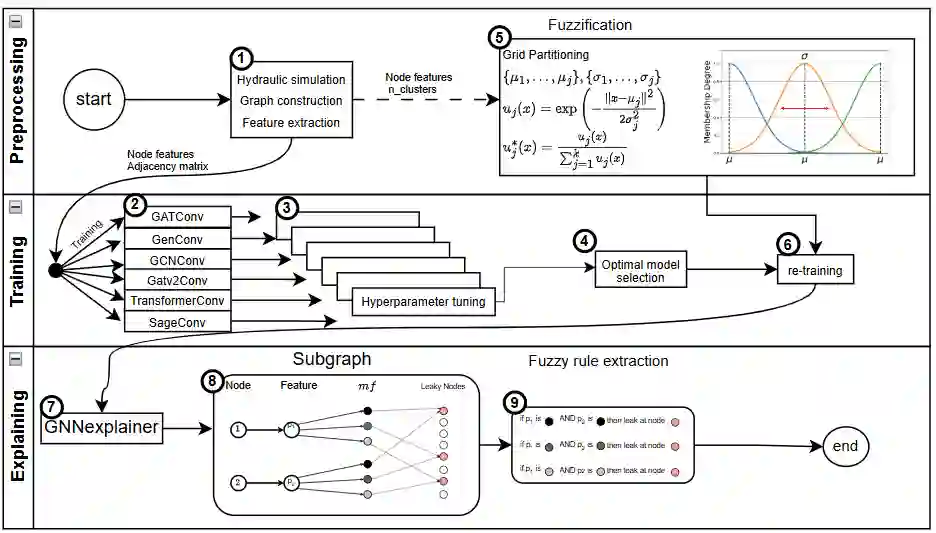
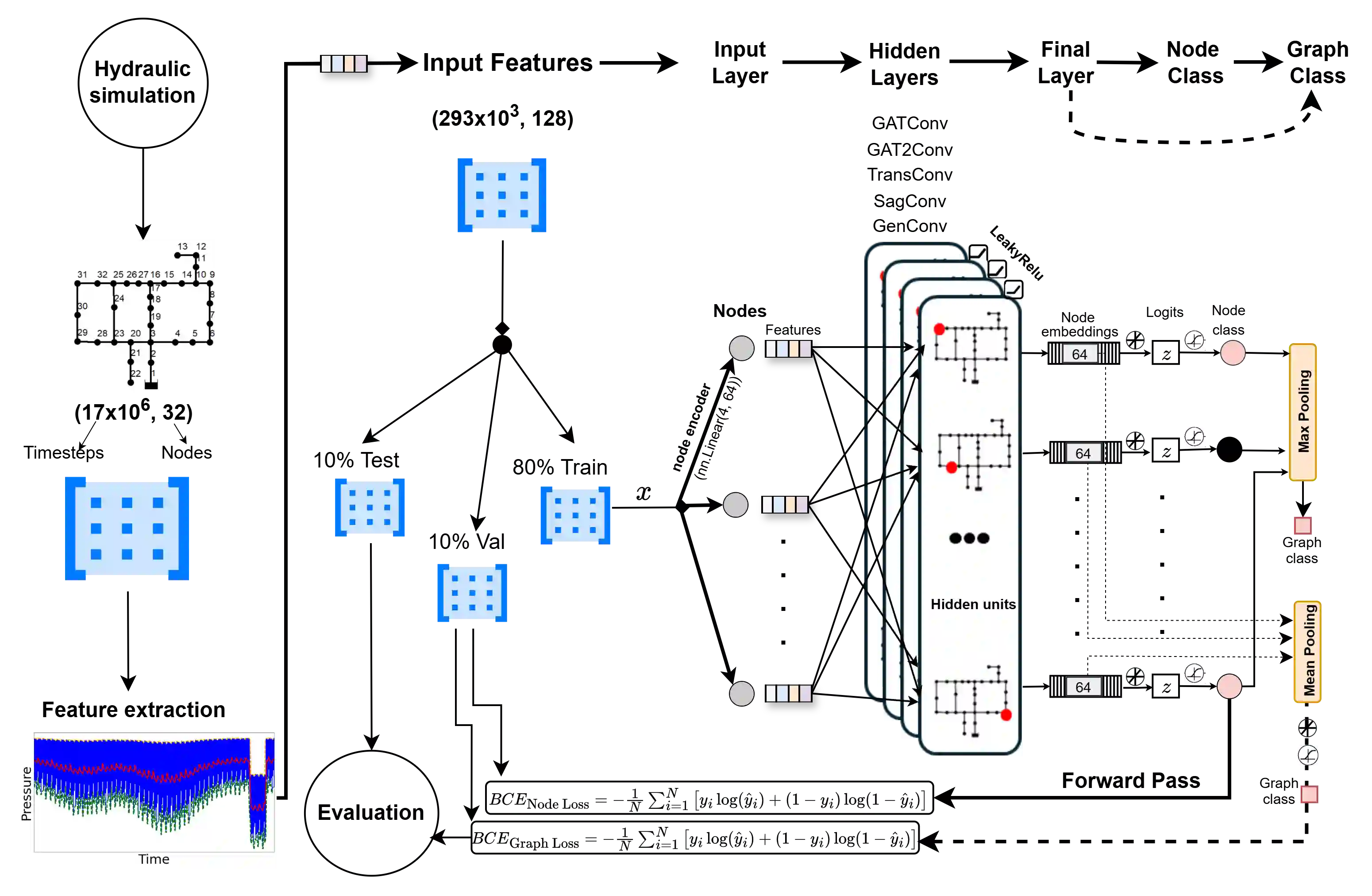
Timely leak detection in water distribution networks is critical for conserving resources and maintaining operational efficiency. Although Graph Neural Networks (GNNs) excel at capturing spatial-temporal dependencies in sensor data, their black-box nature and the limited work on graph-based explainable models for water networks hinder practical adoption. We propose an explainable GNN framework that integrates mutual information to identify critical network regions and fuzzy logic to provide clear, rule-based explanations for node classification tasks. After benchmarking several GNN architectures, we selected the generalized graph convolution network (GENConv) for its superior performance and developed a fuzzy-enhanced variant that offers intuitive explanations for classified leak locations. Our fuzzy graph neural network (FGENConv) achieved Graph F1 scores of 0.889 for detection and 0.814 for localization, slightly below the crisp GENConv 0.938 and 0.858, respectively. Yet it compensates by providing spatially localized, fuzzy rule-based explanations. By striking the right balance between precision and explainability, the proposed fuzzy network could enable hydraulic engineers to validate predicted leak locations, conserve human resources, and optimize maintenance strategies. The code is available at github.com/pasqualedem/GNNLeakDetection.
翻译:及时检测供水管网泄漏对于节约资源和维持运行效率至关重要。尽管图神经网络(GNNs)在捕捉传感器数据时空依赖性方面表现出色,但其黑箱特性以及针对供水网络的图结构可解释模型研究有限,阻碍了实际应用。我们提出了一种可解释的GNN框架,该框架集成互信息以识别关键网络区域,并利用模糊逻辑为节点分类任务提供清晰的、基于规则的解释。在对多种GNN架构进行基准测试后,我们选择了性能优异的广义图卷积网络(GENConv),并开发了一种模糊增强变体,可为分类的泄漏位置提供直观解释。我们的模糊图神经网络(FGENConv)在图F1分数上分别达到检测0.889和定位0.814,略低于标准GENConv的0.938和0.858,但其通过提供空间局部化的、基于模糊规则的解释进行补偿。通过在精度与可解释性之间取得适当平衡,所提出的模糊网络能够帮助水力工程师验证预测的泄漏位置、节约人力资源并优化维护策略。代码可在github.com/pasqualedem/GNNLeakDetection获取。




相关内容



 微信扫码咨询专知VIP会员