

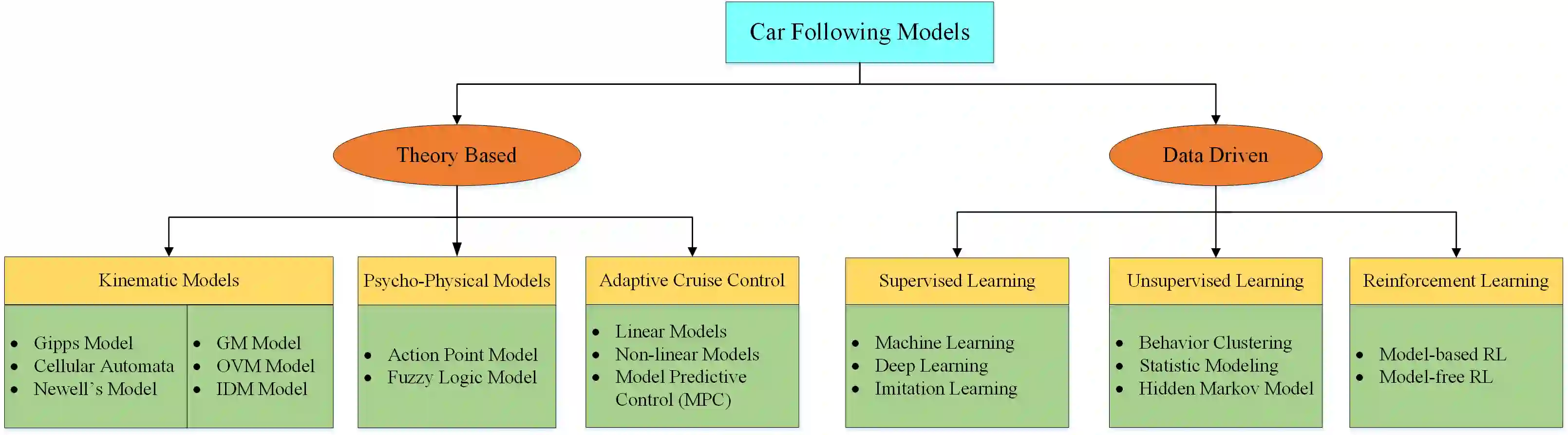
Car-following (CF) algorithms are crucial components of traffic simulations and have been integrated into many production vehicles equipped with Advanced Driving Assistance Systems (ADAS). Insights from the model of car-following behavior help us understand the causes of various macro phenomena that arise from interactions between pairs of vehicles. Car-following models encompass multiple disciplines, including traffic engineering, physics, dynamic system control, cognitive science, machine learning, and reinforcement learning. This paper presents an extensive survey that highlights the differences, complementarities, and overlaps among microscopic traffic flow and control models based on their underlying principles and design logic. It reviews representative algorithms, ranging from theory-based kinematic models, Psycho-Physical Models, and Adaptive cruise control models to data-driven algorithms like Reinforcement Learning (RL) and Imitation Learning (IL). The manuscript discusses the strengths and limitations of these models and explores their applications in different contexts. This review synthesizes existing researches across different domains to fill knowledge gaps and offer guidance for future research by identifying the latest trends in car following models and their applications.
翻译:跟驰(Car-following, CF)算法是交通仿真的关键组成部分,已被集成到许多配备先进驾驶辅助系统(Advanced Driving Assistance Systems, ADAS)的量产车辆中。对跟驰行为模型的见解有助于理解由车辆间相互作用产生的各种宏观现象的成因。跟驰模型涵盖多个学科,包括交通工程、物理学、动态系统控制、认知科学、机器学习以及强化学习。本文基于其基本原理和设计逻辑,对微观交通流与控制模型之间的差异、互补性和重叠性进行了广泛综述。它回顾了代表性算法,范围从基于理论的运动学模型、心理物理模型(Psycho-Physical Models)和自适应巡航控制模型,到诸如强化学习(Reinforcement Learning, RL)和模仿学习(Imitation Learning, IL)等数据驱动算法。本文讨论了这些模型的优势与局限,并探究了它们在不同情境下的应用。本综述综合了跨领域的现有研究,以填补知识空白,并通过识别跟驰模型及其应用的最新趋势,为未来研究提供指导。




相关内容





 微信扫码咨询专知VIP会员