

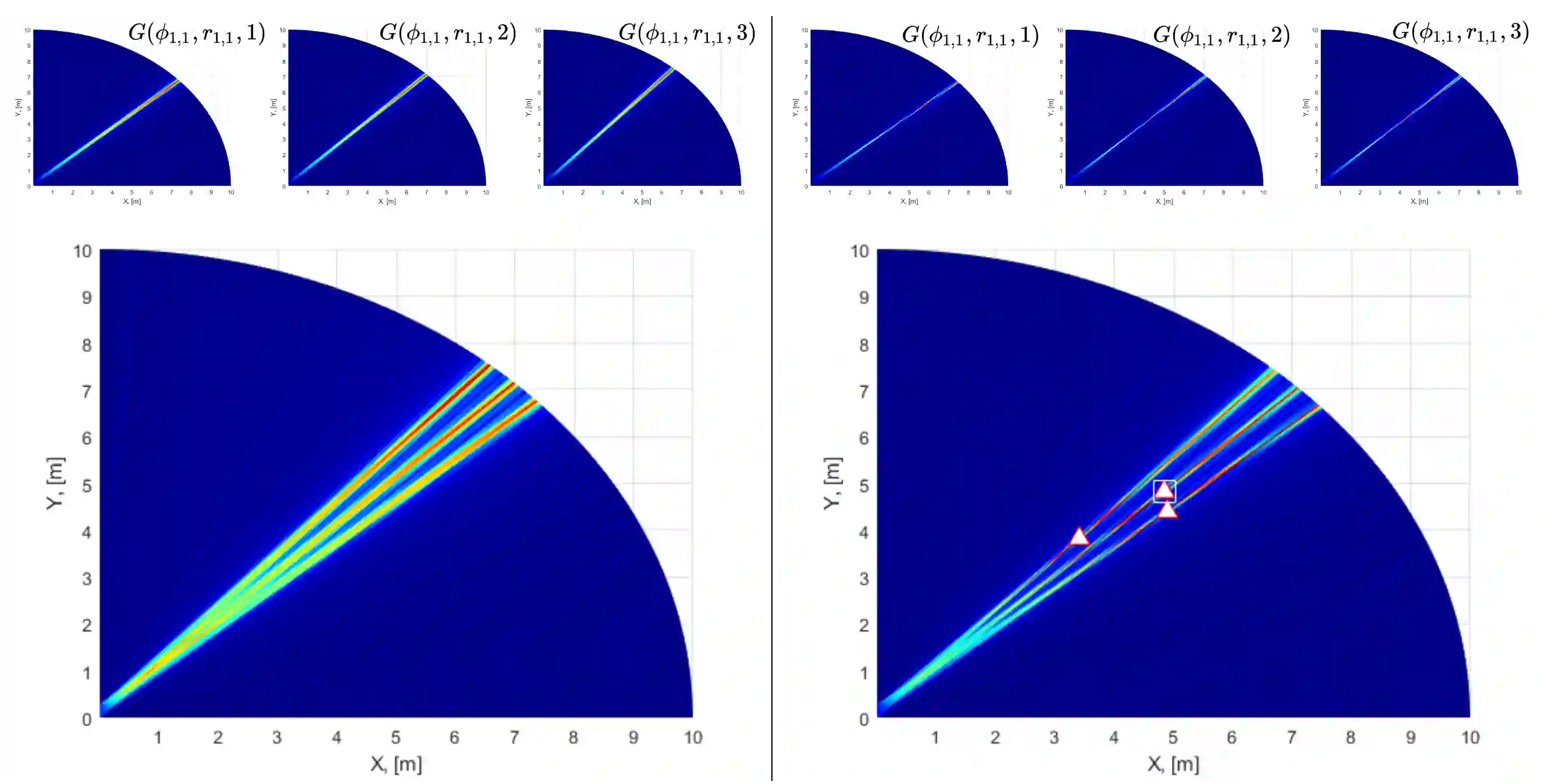
Terahertz (THz) band is expected to be one of the key enabling technologies of the sixth generation (6G) wireless networks because of its abundant available bandwidth and very narrow beam width. Due to high frequency operations, electrically small array apertures are employed, and the signal wavefront becomes spherical in the near-field. Therefore, near-field signal model should be considered for channel acquisition in THz systems. Unlike prior works which mostly ignore the impact of near-field beam-split (NB) and consider either narrowband scenario or far-field models, this paper introduces both a model-based and a model-free techniques for wideband THz channel estimation in the presence of NB. The model-based approach is based on orthogonal matching pursuit (OMP) algorithm, for which we design an NB-aware dictionary. The key idea is to exploit the angular and range deviations due to the NB. We then employ the OMP algorithm, which accounts for the deviations thereby ipso facto mitigating the effect of NB. We further introduce a federated learning (FL)-based approach as a model-free solution for channel estimation in a multi-user scenario to achieve reduced complexity and training overhead. Through numerical simulations, we demonstrate the effectiveness of the proposed channel estimation techniques for wideband THz systems in comparison with the existing state-of-the-art techniques.
翻译:太赫兹(THz)频段因其丰富的可用带宽和极窄的波束宽度,有望成为第六代(6G)无线网络的关键使能技术之一。由于高频段操作,系统中采用电小阵列孔径,信号波前在近场区域呈现球面特性。因此,在THz系统的信道获取中必须考虑近场信号模型。不同于现有大部分忽略近场波束分裂(NB)影响且仅考虑窄带场景或远场模型的工作,本文针对存在NB效应的宽带THz信道估计问题,分别提出了基于模型和无模型的两种技术方案。基于模型的方法采用正交匹配追踪(OMP)算法,并为此设计了NB感知字典。其核心思想是利用NB引起的角度和距离偏差,进而运用充分考虑了这些偏差影响的OMP算法,从而自动减轻NB效应。此外,我们进一步引入基于联邦学习(FL)的方法作为无模型解决方案,用于多用户场景下的信道估计,以实现更低的复杂度和训练开销。通过数值仿真,我们证明了所提出的信道估计技术相较于现有最先进技术在宽带THz系统中的有效性。




相关内容




 微信扫码咨询专知VIP会员