

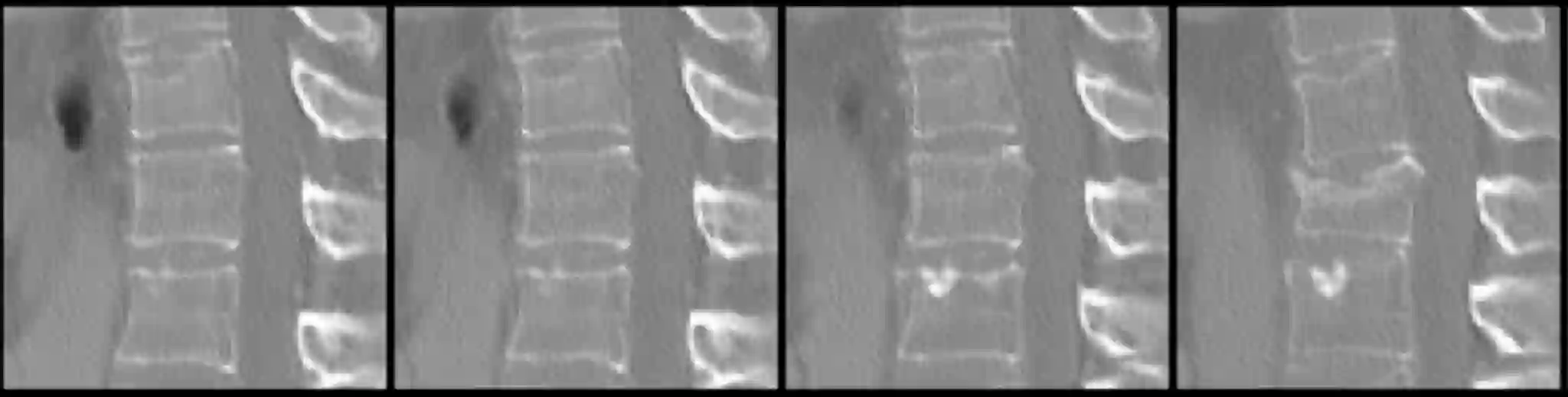
Vertebral fractures are a consequence of osteoporosis, with significant health implications for affected patients. Unfortunately, grading their severity using CT exams is hard and subjective, motivating automated grading methods. However, current approaches are hindered by imbalance and scarcity of data and a lack of interpretability. To address these challenges, this paper proposes a novel approach that leverages unlabelled data to train a generative Diffusion Autoencoder (DAE) model as an unsupervised feature extractor. We model fracture grading as a continuous regression, which is more reflective of the smooth progression of fractures. Specifically, we use a binary, supervised fracture classifier to construct a hyperplane in the DAE's latent space. We then regress the severity of the fracture as a function of the distance to this hyperplane, calibrating the results to the Genant scale. Importantly, the generative nature of our method allows us to visualize different grades of a given vertebra, providing interpretability and insight into the features that contribute to automated grading.
翻译:椎体骨折是骨质疏松的后果,对患者健康具有重大影响。不幸的是,利用CT检查对其严重程度进行分级既困难又主观,这推动了自动化分级方法的发展。然而,当前方法受到数据不平衡、稀缺以及缺乏可解释性的阻碍。为应对这些挑战,本文提出了一种新方法,利用未标记数据训练生成式扩散自编码器(DAE)模型作为无监督特征提取器。我们将骨折分级建模为连续回归,这更能反映骨折的平滑进展。具体而言,我们使用二值监督骨折分类器在DAE的潜在空间中构建一个超平面。随后,我们将骨折的严重程度回归为到该超平面距离的函数,并将结果校准至Genant量表。重要的是,我们方法的生成性质使我们能够可视化给定椎体的不同等级,从而提供可解释性,并深入理解有助于自动化分级的特征。




相关内容



 微信扫码咨询专知VIP会员