

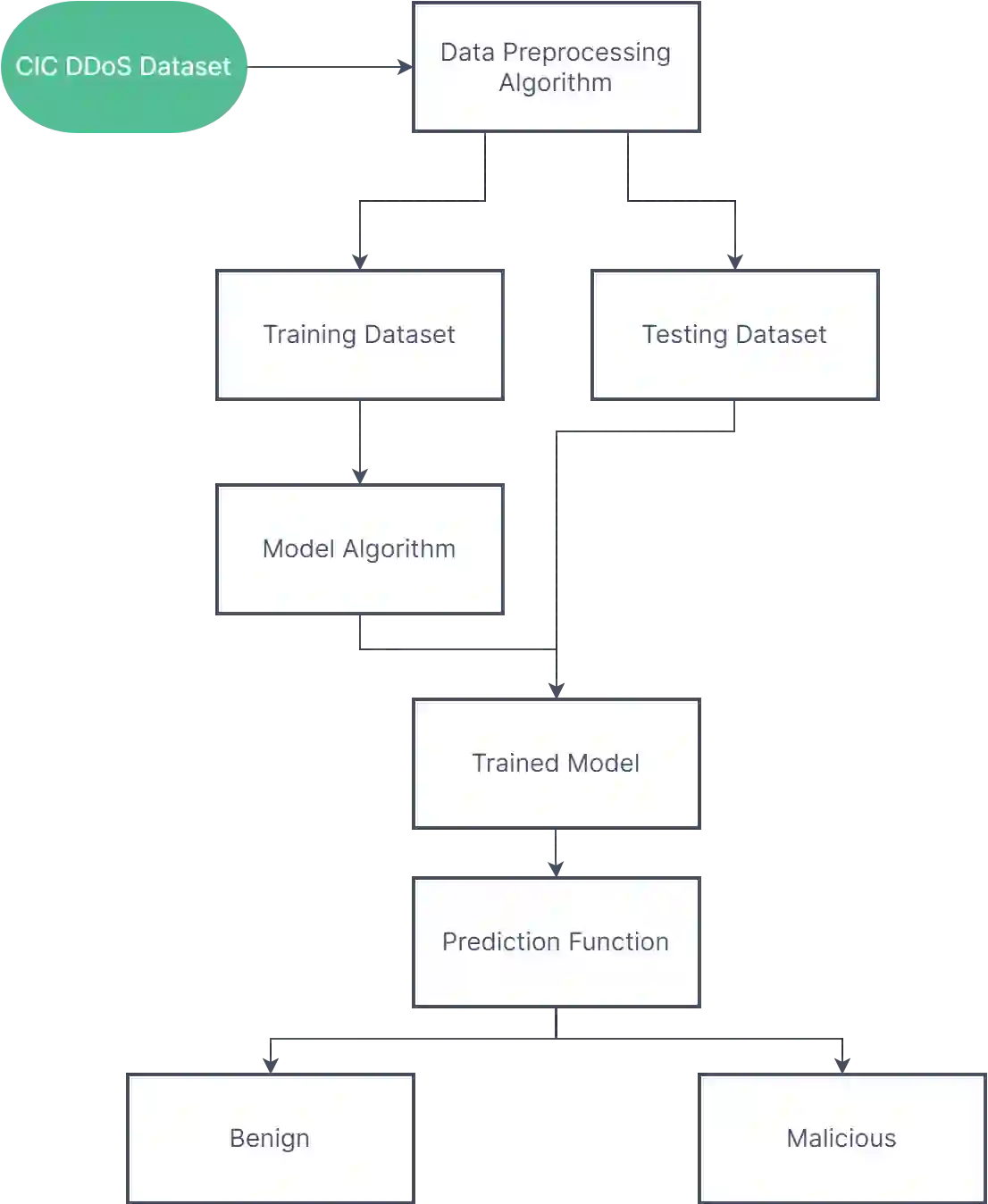
Cybersecurity attacks are becoming increasingly sophisticated and pose a growing threat to individuals, and private and public sectors. Distributed Denial of Service attacks are one of the most harmful of these threats in today's internet, disrupting the availability of essential services. This project presents a novel deep learning-based approach for detecting DDoS attacks in network traffic using the industry-recognized DDoS evaluation dataset from the University of New Brunswick, which contains packet captures from real-time DDoS attacks, creating a broader and more applicable model for the real world. The algorithm employed in this study exploits the properties of Convolutional Neural Networks (CNN) and common deep learning algorithms to build a novel mitigation technique that classifies benign and malicious traffic. The proposed model preprocesses the data by extracting packet flows and normalizing them to a fixed length which is fed into a custom architecture containing layers regulating node dropout, normalization, and a sigmoid activation function to out a binary classification. This allows for the model to process the flows effectively and look for the nodes that contribute to DDoS attacks while dropping the "noise" or the distractors. The results of this study demonstrate the effectiveness of the proposed algorithm in detecting DDOS attacks, achieving an accuracy of .9883 on 2000 unseen flows in network traffic, while being scalable for any network environment.
翻译:网络安全攻击手段日益复杂,对个人及公私领域构成持续增长的威胁。分布式拒绝服务攻击是当今互联网最具危害性的威胁之一,它破坏了关键服务的可用性。本项目提出了一种基于深度学习的新型检测方法,利用新不伦瑞克大学业界公认的DDoS评估数据集(该数据集包含实时DDoS攻击的流量捕获数据),可构建更具广泛适用性的真实世界模型。本研究采用的算法充分运用卷积神经网络(CNN)特性与通用深度学习算法,构建了区分良性流量与恶意流量的新型缓解技术。该模型通过提取数据包流并归一化为固定长度进行数据预处理,随后输入包含节点随机失活层、归一化层及Sigmoid激活函数的定制化架构,最终输出二分类结果。这种设计使模型能有效处理数据流,精准识别参与DDoS攻击的节点,同时过滤"噪声"或干扰因素。实验结果表明,该算法在检测DDoS攻击方面效果显著:在2000个未见网络流量样本上实现了0.9883的准确率,且具备任意网络环境下的可扩展性。





相关内容




 微信扫码咨询专知VIP会员