

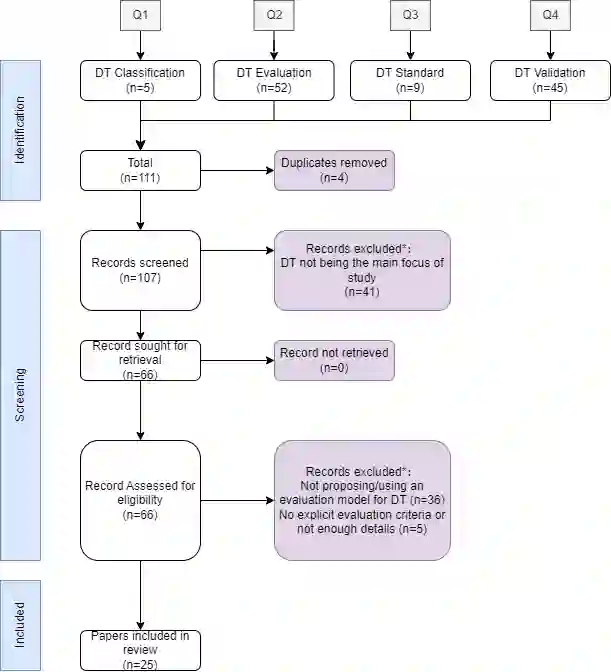
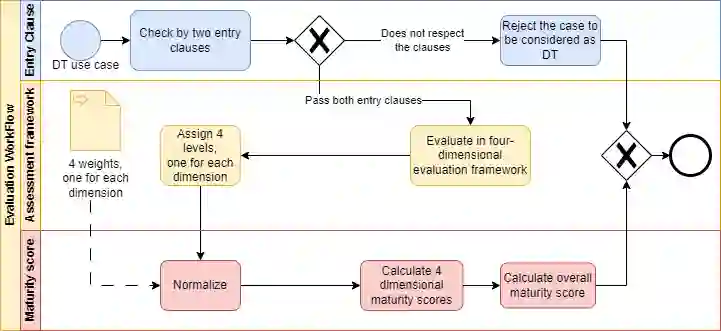
Despite the growing popularity of digital twin (DT) developments, there is a lack of common understanding and definition for important concepts of DT. It is needed to address this gap by building a shared understanding of DT before it becomes an obstacle for future work. With this challenge in view, the objective of our study is to assess the existing DT from various domains on a common basis and to unify the knowledge and understanding of DT developers and stakeholders before practice. To achieve this goal, we conducted a systematic literature review and analyzed 25 selected papers to identify and discuss the characteristics of existing DT's. The review shows an inconsistency and case-specific choices of dimensions in assessing DT. Therefore, this article proposes a four-dimensional evaluation framework to assess the maturity of digital twins across different domains, focusing on the characteristics of digital models. The four identified dimensions in this model are Capability, Cooperability, Coverage, and Lifecycle. Additionally, a weight mechanism is implemented inside the model to adapt the importance of each dimension for different application requirements. Several case studies are devised to validate the proposed model in general, industrial and scientific cases.
翻译:尽管数字孪生(DT)开发日益普及,但对于DT的重要概念仍缺乏共同理解和统一定义。在DT可能成为未来工作障碍之前,有必要通过建立共享理解来填补这一空白。基于这一挑战,本研究的目标是在通用基础上评估不同领域的现有DT,并在实践前统一DT开发者和利益相关者的知识与认知。为实现这一目标,我们进行了系统性文献综述,分析了25篇精选论文,以识别并讨论现有DT的特性。综述结果显示,DT评估维度存在不一致性和特定案例的选择偏好。因此,本文提出一个四维评估框架,用于评估跨领域数字孪生的成熟度,重点聚焦数字模型特性。该模型中的四个维度分别为:能力(Capability)、协同性(Cooperability)、覆盖度(Coverage)和生命周期(Lifecycle)。此外,模型内部嵌入权重机制,可根据不同应用需求调整各维度的重要性。我们通过多个案例研究,在通用场景、工业场景和科学场景中验证了所提模型的有效性。




相关内容





 微信扫码咨询专知VIP会员