

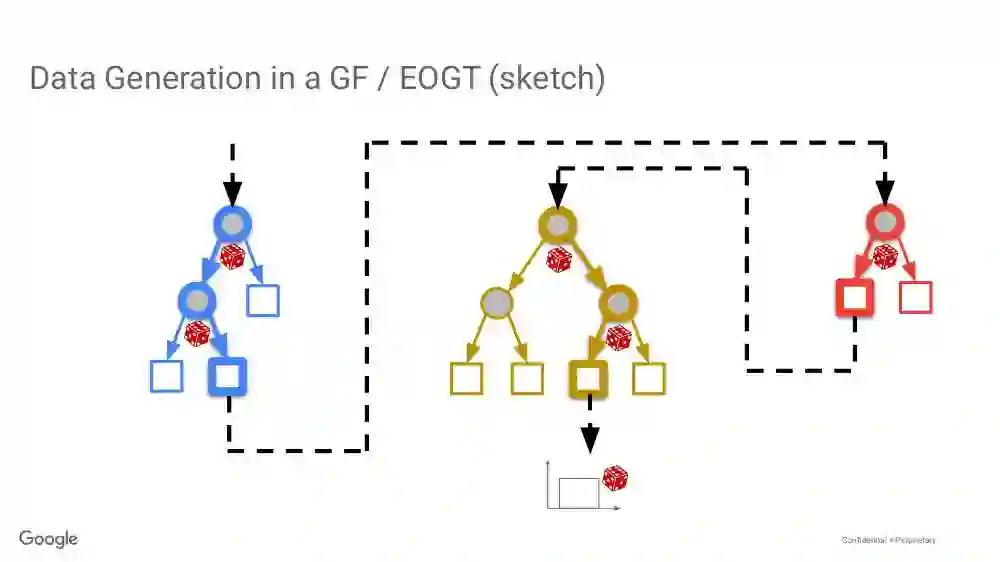
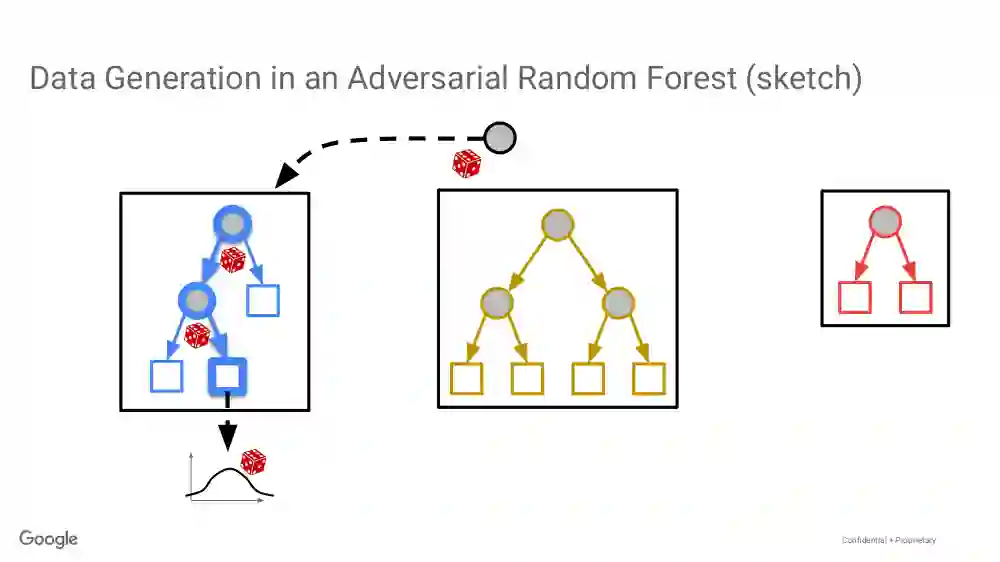
Tabular data represents one of the most prevalent form of data. When it comes to data generation, many approaches would learn a density for the data generation process, but would not necessarily end up with a sampler, even less so being exact with respect to the underlying density. A second issue is on models: while complex modeling based on neural nets thrives in image or text generation (etc.), less is known for powerful generative models on tabular data. A third problem is the visible chasm on tabular data between training algorithms for supervised learning with remarkable properties (e.g. boosting), and a comparative lack of guarantees when it comes to data generation. In this paper, we tackle the three problems, introducing new tree-based generative models convenient for density modeling and tabular data generation that improve on modeling capabilities of recent proposals, and a training algorithm which simplifies the training setting of previous approaches and displays boosting-compliant convergence. This algorithm has the convenient property to rely on a supervised training scheme that can be implemented by a few tweaks to the most popular induction scheme for decision tree induction with two classes. Experiments are provided on missing data imputation and comparing generated data to real data, displaying the quality of the results obtained by our approach, in particular against state of the art.
翻译:表格数据是最常见的数据形式之一。在数据生成领域,许多方法会学习数据生成过程的密度函数,但未必能生成采样器,更不用说能与底层密度精确对应了。第二个问题在于模型:尽管基于神经网络的复杂建模在图像或文本生成等领域成效显著,但针对表格数据的强大生成模型却鲜为人知。第三个问题是表格数据在监督学习(如提升算法)与数据生成之间存在的显著鸿沟:前者具有卓越特性,后者则缺乏相应保证。本文针对这三个问题,提出了基于树的新型生成模型,该模型便于密度建模和表格数据生成,改进了近期提案的建模能力,并设计了简化先前方法训练设置且具有提升兼容收敛性的训练算法。该算法的一大优势在于,它依赖的监督训练方案仅需对最流行的两类决策树归纳方案稍作改动即可实现。通过缺失数据插补实验及生成数据与真实数据的对比实验,验证了该方法(尤其相较于当前最优方法)所获结果的优异质量。





相关内容





 微信扫码咨询专知VIP会员