

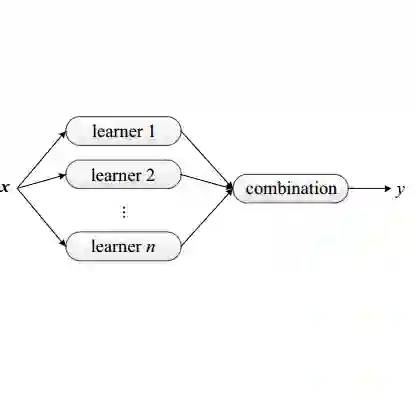
In machine learning (ML), ensemble methods such as bagging, boosting, and stacking are widely-established approaches that regularly achieve top-notch predictive performance. Stacking (also called "stacked generalization") is an ensemble method that combines heterogeneous base models, arranged in at least one layer, and then employs another metamodel to summarize the predictions of those models. Although it may be a highly-effective approach for increasing the predictive performance of ML, generating a stack of models from scratch can be a cumbersome trial-and-error process. This challenge stems from the enormous space of available solutions, with different sets of data instances and features that could be used for training, several algorithms to choose from, and instantiations of these algorithms using diverse parameters (i.e., models) that perform differently according to various metrics. In this work, we present a knowledge generation model, which supports ensemble learning with the use of visualization, and a visual analytics system for stacked generalization. Our system, StackGenVis, assists users in dynamically adapting performance metrics, managing data instances, selecting the most important features for a given data set, choosing a set of top-performant and diverse algorithms, and measuring the predictive performance. In consequence, our proposed tool helps users to decide between distinct models and to reduce the complexity of the resulting stack by removing overpromising and underperforming models. The applicability and effectiveness of StackGenVis are demonstrated with two use cases: a real-world healthcare data set and a collection of data related to sentiment/stance detection in texts. Finally, the tool has been evaluated through interviews with three ML experts.
翻译:在机器学习中,Bagging、Boosting和Stacking等集成方法是被广泛采用且常取得顶尖预测性能的成熟方法。Stacking(亦称"堆叠泛化")是一种集成方法,它结合了至少一层异构基模型,并利用另一元模型来汇总这些模型的预测结果。尽管该方法能有效提升机器学习预测性能,但从零构建模型堆叠往往需要繁琐的试错过程。这一挑战源于可用解决方案的庞大空间:可使用的不同训练数据实例与特征集、可选择的多种算法,以及通过不同参数实例化这些算法后(即模型)在各类指标上的差异化表现。本文提出了一种支持可视化辅助集成学习的知识生成模型,以及专为堆叠泛化设计的视觉分析系统。我们的系统StackGenVis能够帮助用户动态调整性能指标、管理数据实例、为给定数据集选择最重要的特征、挑选一组性能优异且多样化的算法,并评估预测性能。该工具可帮助用户在相异模型间进行决策,并通过剔除过度承诺及表现欠佳的模型来降低最终堆叠的复杂度。通过两个应用案例——真实医疗数据集与文本情感/立场检测数据集——验证了StackGenVis的适用性与有效性。此外,该系统已通过三位机器学习专家的访谈评估。




相关内容




 微信扫码咨询专知VIP会员