

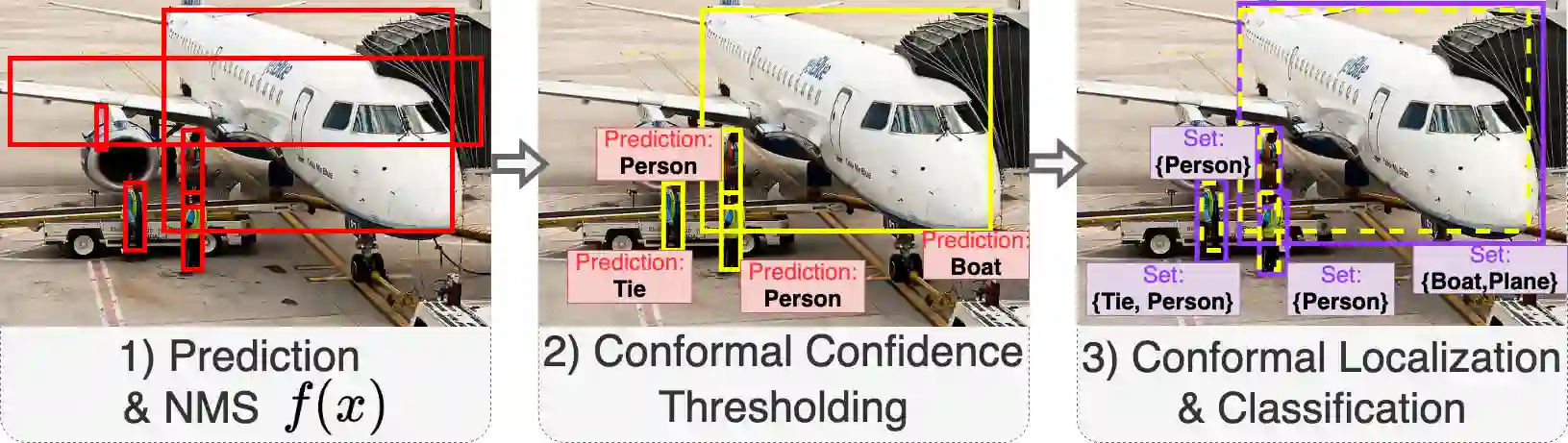
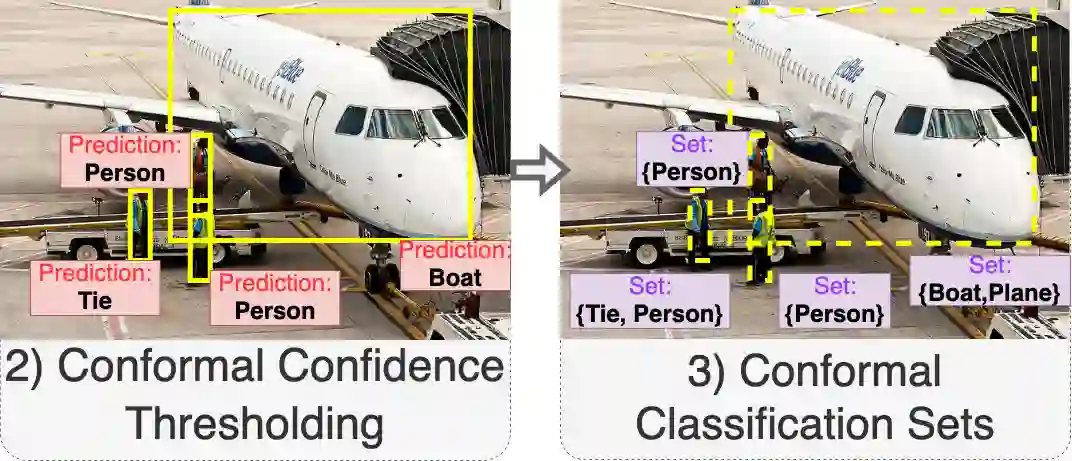
Recent advances in object detectors have led to their adoption for industrial uses. However, their deployment in safety-critical applications is hindered by the inherent lack of reliability of neural networks and the complex structure of object detection models. To address these challenges, we turn to Conformal Prediction, a post-hoc predictive uncertainty quantification procedure with statistical guarantees that are valid for any dataset size, without requiring prior knowledge on the model or data distribution. Our contribution is manifold. First, we formally define the problem of Conformal Object Detection (COD). We introduce a novel method, Sequential Conformal Risk Control (SeqCRC), that extends the statistical guarantees of Conformal Risk Control to two sequential tasks with two parameters, as required in the COD setting. Then, we present old and new loss functions and prediction sets suited to applying SeqCRC to different cases and certification requirements. Finally, we present a conformal toolkit for replication and further exploration of our method. Using this toolkit, we perform extensive experiments that validate our approach and emphasize trade-offs and other practical consequences.
翻译:目标检测器的近期进展促进了其在工业应用中的采用。然而,神经网络固有的可靠性不足以及目标检测模型的复杂结构阻碍了其在安全关键场景中的部署。为应对这些挑战,我们转向共形预测——一种具有统计保证的后处理预测不确定性量化方法,该方法适用于任意数据集规模,且无需模型或数据分布的先验知识。我们的贡献是多方面的。首先,我们正式定义了共形目标检测问题。我们提出了一种新方法——序贯共形风险控制,该方法将共形风险控制的统计保证扩展到COD场景中所需的、具有两个参数的序贯双任务框架。接着,我们介绍了适用于不同案例与认证要求的传统及新型损失函数与预测集。最后,我们开发了用于方法复现与深入探索的共形工具包。基于该工具包,我们进行了大量实验以验证所提方法,并深入分析了性能权衡与实际应用影响。




相关内容




 微信扫码咨询专知VIP会员