

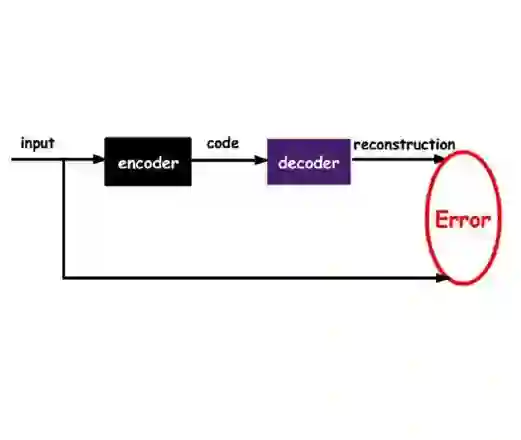
Evolutionary partial differential equations play a crucial role in many areas of science and engineering. Spatial discretization of these equations leads to a system of ordinary differential equations which can then be solved by numerical time integration. Such a system is often of very high dimension, making the simulation very time consuming. One way to reduce the computational cost is to approximate the large system by a low-dimensional model using a model reduction approach. This master thesis deals with structure-preserving model reduction of Hamiltonian systems by using machine learning techniques. We discuss a nonlinear approach based on the construction of an encoder-decoder pair that minimizes the approximation error and satisfies symplectic constraints to guarantee the preservation of the structure inherent in Hamiltonian systems. More specifically, we study an autoencoder network that learns a symplectic encoder-decoder pair. Symplecticity poses some additional difficulties, as we need to ensure this structure in each network layer. Since these symplectic constraints are described by the (symplectic) Stiefel manifold, we use manifold optimization techniques to ensure the symplecticity of the encoder and decoder. A particular challenge is to adapt the ADAM optimizer to the manifold structure. We present a modified ADAM optimizer that works directly on the Stiefel manifold and compare it to the existing approach based on homogeneous spaces. In addition, we propose several modifications to the network and training setup that significantly improve the performance and accuracy of the autoencoder. Finally, we numerically validate the modified optimizer and different learning configurations on two Hamiltonian systems, the 1D wave equation and the sine-Gordon equation, and demonstrate the improved accuracy and computational efficiency of the presented learning algorithms.
翻译:演化偏微分方程在科学与工程的诸多领域中发挥着关键作用。对这些方程进行空间离散化会得到常微分方程组,进而可通过数值时间积分方法求解。此类系统往往具有极高的维度,导致模拟计算耗时严重。降低计算成本的一种途径是采用模型降阶方法,通过低维模型近似原高维系统。本硕士学位论文研究利用机器学习技术实现哈密顿系统的结构保持模型降阶。我们探讨了一种基于编码器-解码器对构建的非线性方法,该方法在最小化近似误差的同时满足辛约束条件,从而保证哈密顿系统内在结构的保持。具体而言,我们研究了一种能够学习辛编码器-解码器对的自编码器网络。辛结构的保持带来了额外挑战,因为我们需要确保网络每一层均满足该结构。由于这些辛约束可由(辛)Stiefel流形描述,我们采用流形优化技术来保证编码器与解码器的辛特性。其中一个特殊挑战是如何使ADAM优化器适应流形结构。我们提出了一种直接在Stiefel流形上运行的改进型ADAM优化器,并将其与基于齐性空间的现有方法进行比较。此外,我们对网络结构与训练设置提出了若干改进方案,显著提升了自编码器的性能与精度。最后,我们在两个哈密顿系统(一维波动方程与正弦-戈登方程)上对改进的优化器及不同学习配置进行了数值验证,证明了所提出学习算法在精度与计算效率方面的提升。




相关内容



 微信扫码咨询专知VIP会员