

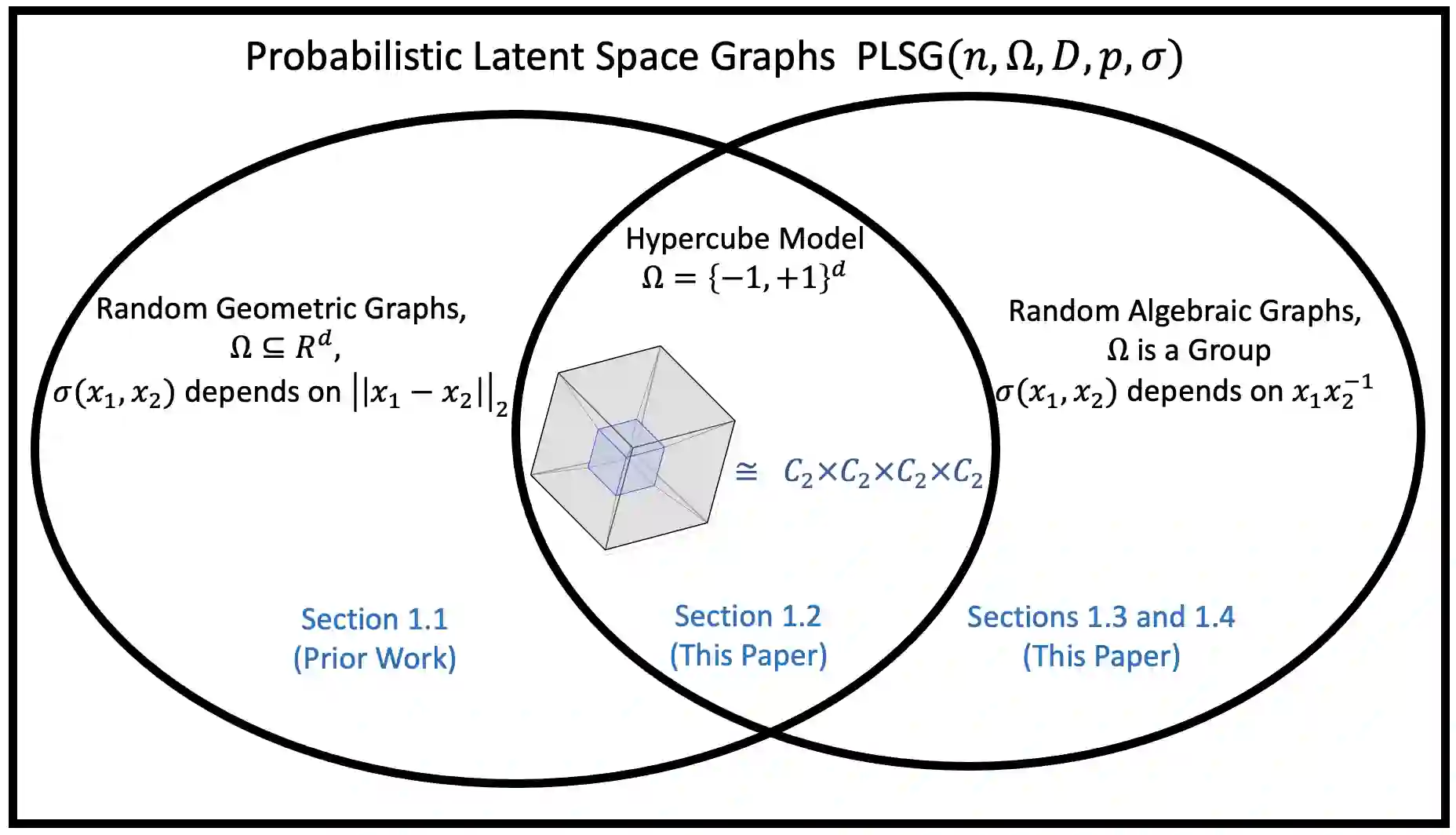
A random algebraic graph is defined by a group ${G}$ with a "uniform" distribution over it and a connection $\sigma:{G}\longrightarrow [0,1]$ with expectation $p,$ satisfying $\sigma({g}) = \sigma({g}^{-1}).$ The random graph $\mathsf{RAG}(n,{G},p,\sigma)$ with vertex set $[n]$ is formed as follows. First, $n$ independent latent vectors ${x}_1, \ldots, {x}_n$ are sampled uniformly from ${G}.$ Then, vertices $i,j$ are connected with probability $\sigma({x}_i{x}_j^{-1}).$ This model captures random geometric graphs with latent space the unit sphere and the hypercube, certain regimes of the stochastic block model, and random subgraphs of Cayley graphs. The main question of interest to the current paper is: when is a random algebraic graph statistically and/or computationally distinguishable from $\mathsf{G}(n,p)$? Our results fall into two main categories. 1) Geometric. We focus on the case ${G} =\{\pm1\}^d$ and use Fourier-analytic tools. For hard threshold connections, we match [LMSY22b] for $p = \omega(1/n)$ and for connections that are $\frac{1}{r\sqrt{d}}$-Lipschitz we extend the results of [LR21b] when $d = \Omega(n\log n)$ to the non-monotone setting. 2) Algebraic. We provide evidence for an exponential statistical-computational gap. Consider any finite group ${G}$ and let $A\subseteq {G}$ be a set of elements formed by including each set of the form $\{{g}, {g}^{-1}\}$ independently with probability $1/2.$ Let $\Gamma_n({G},A)$ be the distribution of random graphs formed by taking a uniformly random induced subgraph of size $n$ of the Cayley graph $\Gamma({G},A).$ Then, $\Gamma_n({G}, A)$ and $\mathsf{G}(n,1/2)$ are statistically indistinguishable with high probability over $A$ if and only if $\log |{G}| \gtrsim n.$ However, low-degree polynomial tests fail to distinguish $\Gamma_n({G}, A)$ and $\mathsf{G}(n,1/2)$ with high probability over $A$ when $\log |{G}| = \log^{\Omega(1)}n.$
翻译:随机代数图由具有“均匀”分布的群${G}$和连接函数$\sigma:{G}\longrightarrow [0,1]$定义,其中$\sigma$的期望为$p$,且满足$\sigma({g}) = \sigma({g}^{-1}).$ 顶点集为$[n]$的随机图$\mathsf{RAG}(n,{G},p,\sigma)$按如下方式生成:首先,从${G}$中均匀独立采样$n$个潜在向量${x}_1, \ldots, {x}_n$;然后,顶点$i,j$以概率$\sigma({x}_i{x}_j^{-1})$相连。该模型涵盖了以单位球面和超立方体为潜在空间的随机几何图、随机块模型的某些情形,以及Cayley图的随机子图。本文关注的主要问题是:随机代数图何时能在统计上和/或计算上与$\mathsf{G}(n,p)$区分?我们的结果可分为两类:1)几何情形。我们聚焦于${G} =\{\pm1\}^d$的情形,并利用傅里叶分析工具。对于硬阈值连接,我们匹配了[LMSY22b]在$p = \omega(1/n)$时的结果;对于满足$\frac{1}{r\sqrt{d}}$-Lipschitz条件的连接,我们将[LR21b]在$d = \Omega(n\log n)$时的结果推广到非单调情形。2)代数情形。我们为指数级的统计-计算鸿沟提供了证据。考虑任意有限群${G}$,令$A\subseteq {G}$为由独立以概率$1/2$包含每个形如$\{{g}, {g}^{-1}\}$的集合所构成的元素集。设$\Gamma_n({G},A)$为从Cayley图$\Gamma({G},A)$中均匀随机选取大小为$n$的诱导子图所得到的随机图分布。那么,当且仅当$\log |{G}| \gtrsim n$时,$\Gamma_n({G}, A)$与$\mathsf{G}(n,1/2)$在$A上$高概率下统计不可区分。然而,当$\log |{G}| = \log^{\Omega(1)}n$时,低阶多项式检验无法在$A上$高概率下区分$\Gamma_n({G}, A)$与$\mathsf{G}(n,1/2)$。




相关内容



 微信扫码咨询专知VIP会员